

CJC-1295 and ipamorelin are two of the most frequently studied peptides in growth-hormone (GH) axis research, and they're often combined in a single blend. They reach the same pituitary cells by two completely different receptors. Understanding that split is the key to understanding why researchers pair them.
The two signals that control GH release
Growth-hormone release from the pituitary is controlled by several hormonal inputs. Two of the most important are:
- GHRH (growth hormone-releasing hormone), from the hypothalamus, which binds the GHRH receptor on pituitary somatotroph cells.
- Ghrelin, which binds the growth hormone secretagogue receptor (GHS-R1a) on the same cells.
The two receptors use different intracellular signalling routes, and in research models activating both produces a different release pattern than activating either one alone.
CJC-1295: a modified GHRH analogue
CJC-1295 is a synthetic analogue of the first 29 amino acids of GHRH, the part of the hormone responsible for its activity. Native GHRH breaks down within minutes, so CJC-1295 carries four amino-acid substitutions that make it far more resistant to enzymatic cleavage.
There are two forms in the literature:
- CJC-1295 without DAC (also called modified GRF 1-29) has the stabilising substitutions only. Its activity is relatively short.
- CJC-1295 with DAC adds a drug affinity complex that binds albumin in circulation, which extends its half-life substantially in animal models.
Both act on the GHRH receptor.
Ipamorelin: a selective ghrelin-receptor agonist
Ipamorelin is a pentapeptide that binds the ghrelin receptor (GHS-R1a). It belongs to the growth hormone secretagogue family alongside GHRP-2 and GHRP-6.
What made ipamorelin notable in the original pharmacology research was its selectivity. Earlier secretagogues also raised cortisol and prolactin in animal models; ipamorelin was characterised as stimulating GH release without significantly affecting those other hormones.
Why they're studied together
Because CJC-1295 and ipamorelin act on separate receptors, combining them lets researchers examine both arms of GH regulation at once:
| CJC-1295 | Ipamorelin | |
|---|---|---|
| Receptor | GHRH receptor | Ghrelin receptor (GHS-R1a) |
| Class | GHRH analogue | GH secretagogue |
| Length | 29 amino acids (plus DAC in some forms) | 5 amino acids |
| Research focus | Amplitude and duration of GHRH signalling | Selective secretagogue signalling |
Codex Research carries the two as a CJC-1295 / Ipamorelin blend and ipamorelin on its own as a single-compound vial.
Related: tesamorelin
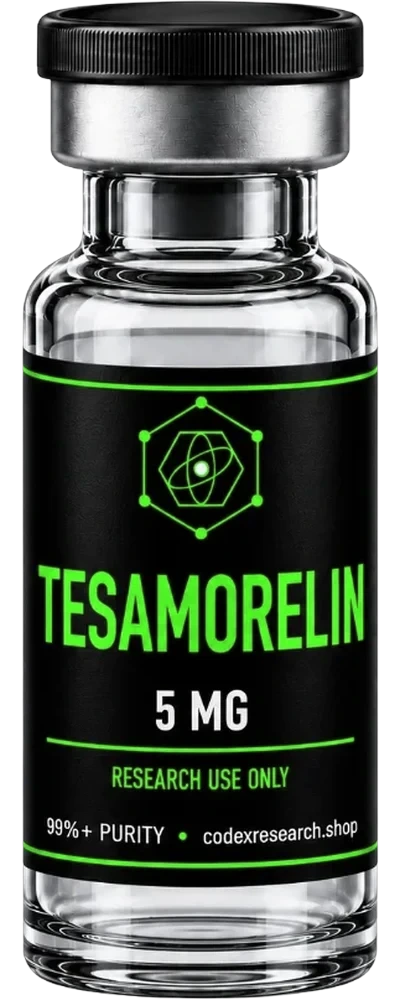
Tesamorelin is another stabilised GHRH analogue, built on the full 44-amino-acid GHRH sequence with a trans-3-hexenoyl group added to protect it from degradation. It's studied for GHRH-receptor signalling and its downstream effects on IGF-1 and lipid metabolism in research models.
Handling
All three are lyophilized peptides. Reconstitute gently with bacteriostatic water, keep reconstituted material at 2–8 °C, and aliquot for longer studies. The reconstitution calculator handles the concentration math.



 From lab to your door