
Da
Base unit
Dalton (Da)
One twelfth of the mass of a carbon-12 atom. The base unit for molecular masses.
(“KIL-oh-dawl-tun”)
One unit, two jobs: the mass of a molecule and the mass of a mole.
The short answer
A kilodalton is 1,000 daltons, the unit of mass used for molecules, so a 5 kDa molecule weighs about 5,000 daltons.
A dalton is one twelfth of the mass of a carbon-12 atom, roughly the mass of a hydrogen atom. Small peptides are usually given in daltons, larger peptides and proteins in kilodaltons. A mass in daltons is numerically the same as the molar mass in grams per mole, which is what connects a molecule’s size to how much a weighed amount actually contains.
Reviewed by the Codex Research quality teamUpdated Nov 8, 2026
Word study
Say it
kil·o·dal·ton
(“KIL-oh-dawl-tun”)
Roots and origin
RootGreek
Origin
John Dalton proposed in the early 1800s that each element’s atoms have a characteristic weight, measured against the lightest one. The unit carries his name; the kilo- simply scales it up a thousand times for bigger molecules.
Around the world
Tap a language to hear it spokenDefinition
A dalton, symbol Da, is a unit of mass for atoms and molecules. IUPAC defines it as equal to the unified atomic mass unit: one twelfth of the mass of a carbon-12 atom. That is very close to the mass of a single hydrogen atom. A kilodalton, kDa, is 1,000 daltons.
The dalton has an unusual status. IUPAC’s Gold Book records that it was long used in biochemistry without formal approval by the General Conference on Weights and Measures. It has since been listed in the SI Brochure as a non-SI unit accepted for use with the SI, alongside units such as the litre and the tonne, and it remains the everyday unit for molecular masses in the life sciences.
Daltons connect to the lab balance through the mole. A molecule’s mass in daltons is, for practical purposes, the same number as its molar mass in grams per mole. A peptide of 3,483 Da has a molar mass of about 3,483 g/mol, so one micromole of it weighs about 3.5 mg. This is how a weighed amount of powder is turned into a number of molecules.
Size conventions follow the scale. Small peptides are usually given in daltons, such as a three-residue peptide at about 340 Da. Longer peptides run into the low kilodaltons, and proteins are usually given in kilodaltons: ubiquitin at about 8.6 kDa, serum albumin at about 66 kDa. Tools such as ProtParam calculate these figures from a sequence by adding residue masses and one water.
The symbol is worth getting right. It is kDa, with a lowercase k for kilo and a capital D for dalton. KD is a different quantity entirely in biochemistry, a dissociation constant, so mixing them up on a document is more than a typo.
Interactive
Slide along the mass scale or pick a known molecule. Each step on the ladder is a multiplication, which is why one scale fits a water molecule and an antibody.
1 kDa = 1,000 Da. A mass in daltons is numerically the same as the molar mass in grams per mole, which is why one micromole of a 3,483 Da molecule weighs about 3.5 mg. Residue counts use the common rule of thumb of about 110 Da per amino acid residue, so they are estimates only. Size ranges are rough guides; definitions of where a peptide ends and a protein begins vary.
Units
One twelfth of the mass of a carbon-12 atom. The base unit for molecular masses.
1,000 daltons. Used for larger peptides and proteins.
The same unit as the dalton under another name and symbol.
Molar mass. Numerically the same as the molecular mass in daltons.
1,000,000 daltons. Used for very large complexes.
For buyers
Because daltons match grams per mole, the molecular mass tells you how many molecules are in a weighed amount.
Mass spectrometry measures mass. A result that matches the expected mass in daltons supports identity.
A wrong symbol or missing unit makes a figure impossible to check.
At Codex Research
Each Codex Research product page carries a lot-matched certificate of analysis reporting mass spectrometry identity for the lot in stock, so the measured mass can be compared with the expected value.
See it live: the molecular weight guide in the glossary
Myth vs fact
Tap a card to flip it.
Watch for
Quick check
Da or kDa, written correctly.
The stated mass fits the sequence and the MS result.
Peptide alone, not the salt or water.
 Full walkthrough · JournalHPLC vs mass spec: how purity is tested
Questions
A unit of molecular mass equal to 1,000 daltons.
One twelfth of the mass of a carbon-12 atom, about the mass of a hydrogen atom.
Divide by 1,000. A 3,483 Da peptide is 3.483 kDa.
Numerically, yes, for practical purposes. One is per molecule, the other per mole.
Short peptides are a few hundred daltons; longer ones reach a few kilodaltons.
kDa, with a lowercase k and a capital D.
By adding the masses of its residues and one water, as tools like ProtParam do.
Sources and standards
Written and reviewed by the Codex Research quality team · Last reviewed November 8, 2026 · For laboratory research use only.
On real products
See kilodalton in context on real Codex research products, then read the full guide.
 Blends
Research peptide
Repair Blend
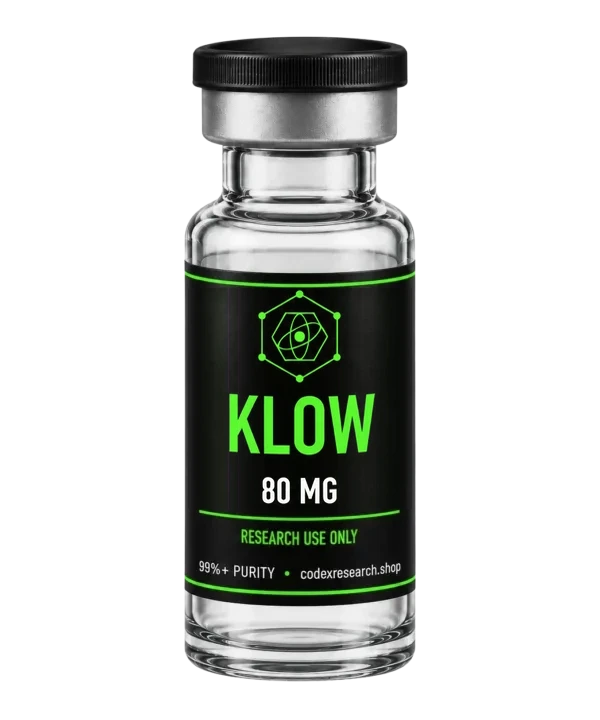
Klow is a four-peptide research blend: 51.33 mg GHK-Cu, 11.55 mg KPV, 9.32 mg TB-500 and 8.00 mg BPC-157 per vial on the current lot, for multi-pathway laboratory research.
 GH axis
Research peptide
GH-Axis Research
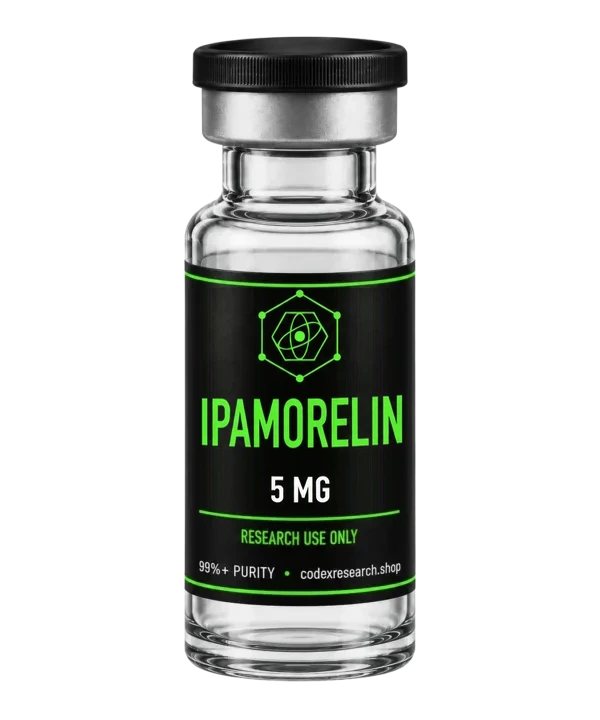
Ipamorelin is a five-residue synthetic peptide, Aib-His-D-2-Nal-D-Phe-Lys-NH2, studied as a selective agonist at the ghrelin receptor. Lot-tested by RP-HPLC.
 Neuro
Research peptide
Neuropeptide Research
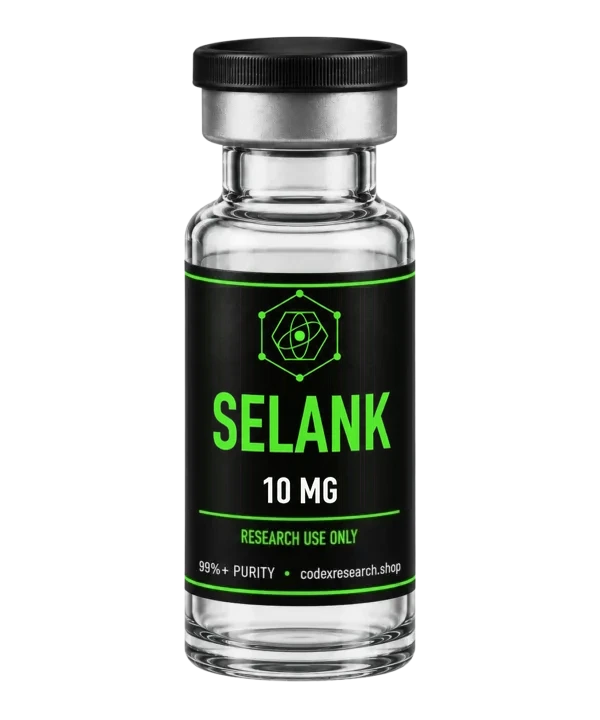
Selank is a seven-residue tuftsin analogue, Thr-Lys-Pro-Arg-Pro-Gly-Pro, studied in enkephalinase and neurotransmission gene-expression research. Lot-tested by LC-MS.
Journal guideHPLC vs mass spec: how purity is testedRead the guideKeep going
 From lab to your door
U.S.-made research vials, shipped with lot-matched, lab-tested COAs you can scan straight off the label.

21+ Only
Codex Research provides research-grade compounds for laboratory and research use only. By entering, you confirm you are at least 21 and agree to our Terms & Conditions.
By proceeding you affirm the statements above are true. Products are supplied for laboratory research use only — not for human or veterinary use, not for use in diagnostic procedures, and not evaluated by the U.S. Food and Drug Administration. Full disclaimer.


