Area 0122 terms
Testing & analysis
The methods labs use and the words on a test report.
Plain-English definitions for every word on a certificate of analysis, a lab report or a product page, each linked to the guides that go deeper.
Browse by category05 areas · 55 terms
Every term on a COA, a lab report or a product label sits in one of five areas: how it is tested, how it is documented, how it is made, how it is stored, and the core science behind it.
Open an area to see its terms, then filter the A–Z list below to just that area.
Area 0122 terms
The methods labs use and the words on a test report.

Area 027 terms
The paperwork that proves what is in a vial.
Area 039 terms
How peptides are made, purified and dried.
Area 046 terms
What changes a material over time, and how that is measured.
Area 0511 terms
The core vocabulary of peptides and research use.
The A–Z
The language of peptide research, from how a compound is made and tested to how it is stored and documented, defined in plain English and linked to the guides that go deeper.
No terms match. Try another word, or email info@codexresearch.shop and we will add it.
Manufacturing01/55
Also calledPeptide acetate
A peptide in which acetate is the counter-ion. Acetate salts are made by ion exchange after purification, replacing TFA, and are a common form for peptides used in biological research. See full definition
Basics & regulation02/55
Also calledBuilding block
The building blocks of peptides and proteins. Twenty standard amino acids are encoded by DNA. Each shares the same backbone and has a different side chain, which gives it its chemical properties. See full definition
Testing & analysis03/55
Also calledAAA, amino acid composition
A laboratory method that hydrolyzes a peptide into its individual amino acids and quantifies each one by chromatography. It confirms sequence stoichiometry and provides an exact measurement of net peptide content by weight, independent of optical UV absorption. See full definition
Testing & analysis04/55
Also calledArea %, area normalization
A peak's integrated area as a share of the total area of every integrated peak in an HPLC run. On a peptide COA the main peak's area percent is the purity result. It assumes every component gives the same UV response, and it says nothing about milligrams. See full definition
Testing & analysis05/55
Also calledTotal viable count, microbial limits
The total number of viable microorganisms present on or within a material prior to sterilization or final packaging. Measured in colony-forming units (CFU), bioburden testing quantifies bacterial and fungal population levels before downstream processing. See full definition
COAs & documents06/55
Also calledCOA
A lab document reporting the test results for one specific lot: identity, purity and any other tests run, each with its method, result and date, and the lab that ran it. It applies only to the lot number printed on it. Verify lot-matched test results in our COA verification catalog or review our lot matching guide. See full definition
COAs & documents07/55
Also calledSample custody
The documented record of who handled a sample, when, and how it was stored from collection to testing. It shows that the sample tested is the one it claims to be and was not swapped or altered along the way. See full definition
Testing & analysis08/55
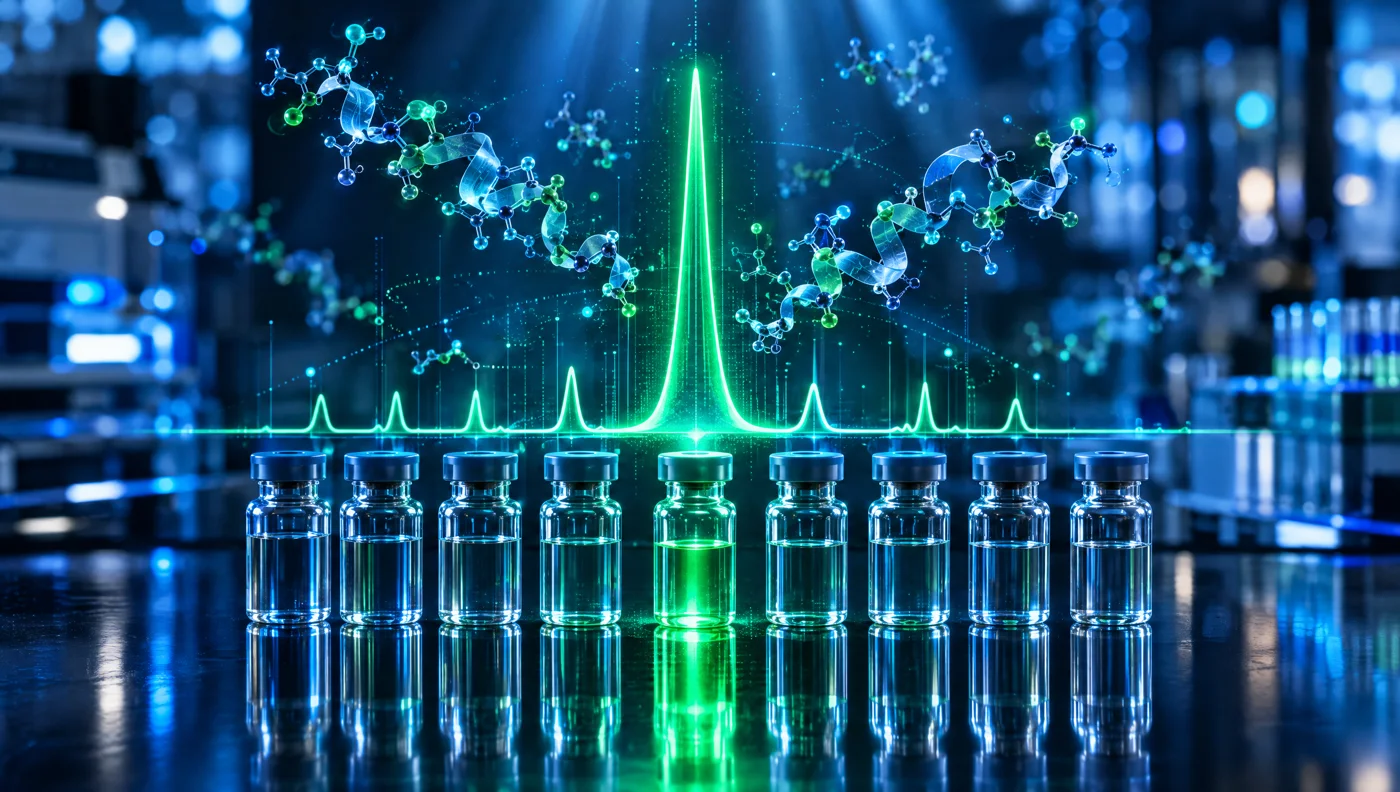
Also calledHPLC trace
The graph an HPLC run produces: detector signal on the vertical axis, time on the horizontal. Each peak is one component. Where a peak appears is its retention time, and the area under it shows how much of that component is present. See full definition
Manufacturing09/55
Also calledSalt form
A charged ion paired with the peptide to balance its charge, forming a salt. The most common are trifluoroacetate (TFA) and acetate. Counter-ions add weight to the powder but are not counted in HPLC purity. See full definition
Storage & stability10/55
Also calledAsparagine/glutamine deamidation
A reaction in which an asparagine or glutamine side chain loses its amide group, changing the peptide's structure and adding about one dalton to its mass. It speeds up with moisture, higher pH and warmth. See full definition
Storage & stability11/55
Also calledChemical breakdown
The chemical breakdown of a peptide over time. The main routes are oxidation, deamidation and hydrolysis. Heat, moisture, light and oxygen all speed it up, which is why cold, dry and dark storage matters. See full definition
Storage & stability12/55
Also calledDrying agent
A drying agent, such as silica gel, that absorbs moisture inside a sealed container. It keeps the humidity low around moisture-sensitive materials. See full definition
Testing & analysis13/55
Also calledEluent, mobile phase
The process of washing components through a chromatography column with a moving liquid called the mobile phase, or eluent. Each component elutes, or comes off the column, at its own time, which is what lets HPLC separate a peptide from its impurities. See full definition
Testing & analysis14/55
Also calledLipopolysaccharide (LPS)
Fragments of the outer wall of gram-negative bacteria that can contaminate materials during manufacturing and are not removed by ordinary filtration. Results are reported in endotoxin units (EU), most often measured with the LAL test. See full definition
Testing & analysis15/55
Also calledGC
A separation method that vaporizes a sample and carries it through a heated column with an inert gas. It suits small, volatile compounds, which is why it is the standard test for residual solvents rather than for the peptide itself. See full definition
Manufacturing16/55
Also calledGood manufacturing practice
A set of regulations on how products are made, tested and documented; for drugs in the US they sit in 21 CFR parts 210 and 211. Research-grade materials are generally not made under drug GMP, so any GMP claim on a research product should come with documentation. See full definition
Testing & analysis17/55
Also calledElemental impurities
Testing for trace metals such as lead, arsenic, cadmium and mercury, usually by ICP-MS. Results are reported in parts per million or parts per billion and compared against set limits, such as those in the ICH Q3D guideline. See full definition
Testing & analysis18/55
Also calledHigh-performance liquid chromatography
A lab method that pushes a dissolved sample through a packed column under high pressure, separating each component so it can be measured. For peptides, HPLC is the standard way to report purity: the main peak's share of the total peak area, usually read by a UV detector at about 214–220 nm. See full definition
Storage & stability19/55
Also calledMoisture-absorbing
Readily absorbing moisture from the air. Lyophilized peptide powders such as GHK-Cu and BPC-157 are highly hygroscopic, so a vial opened while cold can draw condensation. Vacuum-sealed glass vials and desiccants protect stability before reconstitution. See full definition
Testing & analysis20/55
Also calledRelated substances
Anything in the peptide material that is not the target sequence. The common ones are deletion sequences (missing an amino acid), truncated chains, and oxidized or deamidated forms, plus non-peptide leftovers from synthesis. See full definition
Basics & regulation21/55
Also calledLab-based research
Research done outside a living organism, in test tubes, cell cultures or other controlled lab systems. Research-use-only materials are sold for this kind of work. See full definition
Basics & regulation22/55
Also calledResearch in living organisms
Research done inside a living organism. It is the counterpart to in vitro. Codex Research materials are sold for in-vitro laboratory research only. See full definition
COAs & documents23/55
Also calledLab accreditation
The international standard for the competence of testing and calibration labs. An accredited lab has been audited on its methods, equipment, staff and quality system. The accreditation covers the specific methods listed on its scope, not everything the lab does. See full definition
Testing & analysis24/55
Also calledWater content, KF
A titration method that measures the water content of a sample. Lyophilized peptides are hygroscopic, so they usually hold a few percent water even when the powder looks completely dry. See full definition
Basics & regulation25/55
Also calledkDa
A unit of molecular mass equal to 1,000 daltons. Small peptides are usually described in daltons, while larger peptides and proteins are often given in kilodaltons: a 5 kDa molecule weighs about 5,000 Da. See full definition
Testing & analysis26/55
Also calledLiquid chromatography–mass spectrometry
Liquid chromatography and mass spectrometry run together in one analysis. The LC step separates the components and the MS step weighs each one, so a lab can confirm identity and also see what the smaller impurity peaks actually are. See full definition
Testing & analysis27/55
Also calledLimit of detection, limit of quantitation
The limit of detection is the smallest amount a method can reliably detect. The limit of quantitation is the smallest amount it can measure with acceptable accuracy. Results below them are reported as "<LOD" or "<LOQ", not as zero. See full definition
COAs & documents28/55
Also calledBatch number
A code that identifies one production run. It ties a vial to its manufacturing records and its COA, so results can be traced and any problem can be narrowed down to the units affected. Cross-reference your vial with our COA verification tool and follow our lot number matching walkthrough. See full definition
Manufacturing29/55
Also calledFreeze-drying
A drying process that freezes a material and then lowers the pressure so the ice turns straight to vapor, a step called sublimation. It leaves a dry, stable powder, which is why most research peptides—including BPC-157 and TB-500—ship as lyophilized solids in sealed glass vials. See full definition
Testing & analysis30/55
Also calledMS
A method that weighs molecules by turning them into charged ions and sorting them by mass-to-charge ratio. On a COA it confirms identity: the measured molecular weight should match the peptide's theoretical weight within a small tolerance. See full definition
Basics & regulation31/55
Also calledMW, molecular mass
The mass of one molecule, given in daltons (Da) or grams per mole. For a peptide it is the sum of its amino acids minus the water released at each bond. Mass spectrometry checks it to confirm identity. See full definition
Testing & analysis32/55
Also calledNot detected
A result meaning the substance was not found above the method's limit of detection. It does not mean zero. It means any amount present is below what that test can see. See full definition
Testing & analysis33/55
Also calledNPC, peptide content
The share of a vial's total powder weight that is actually peptide. The rest is mostly bound water and counter-ions such as acetate or TFA. A peptide can be 99% pure by HPLC and still have a net peptide content well below 100%, often somewhere between 60% and 90%. See full definition
Testing & analysis34/55
Also calledSpecific rotation, polarimetry
The angle through which plane-polarized light is rotated when passing through a dissolved chiral substance. For synthetic peptides, specific optical rotation confirms that amino acids have retained their correct L-stereochemical configuration and have not racemized during synthesis. See full definition
Basics & regulation35/55
Also calledPolypeptide
A short string of amino acids linked by peptide bonds, usually no more than about 50 amino acids in length. Longer chains are usually called proteins. See full definition
Basics & regulation36/55
Also calledProtein, peptide bond
A peptide is a short chain of amino acids and a protein is a long, folded one, and both are joined by peptide bonds. The FDA defines a protein as more than 40 amino acids, while other references draw the line near 50 residues or a molecular weight of about 10,000. See full definition
Testing & analysis37/55
Also calledHPLC quantitation, peptide assay
On a peptide COA, the measured amount of target peptide in the vial, usually in milligrams, read by HPLC against a reference standard of known concentration. It is an amount, where HPLC purity is a share, so a high-purity lot can still assay a few percent under its label. See full definition
Manufacturing38/55
Also calledPeptide purification
The purification step after synthesis. The crude peptide runs through a large HPLC column and only the fractions containing the target sequence are collected, raising purity from crude levels to 98–99% or higher. See full definition
Testing & analysis39/55
Also calledChromatographic purity
The percentage of the peptide material that is the correct full-length sequence, calculated from HPLC peak areas. It describes peptide-related content only. Water, salts and counter-ions are not counted, which is why purity and net peptide content are two different numbers. See full definition
Basics & regulation40/55
Also calledResearch chemical
A loose term for materials made and tested for laboratory research rather than for clinical or drug use. It has no single legal definition, so the testing documented on the COA matters more than the label. See full definition
Basics & regulation41/55
Also calledRUO
A label meaning a product is sold only for laboratory research and not for human or veterinary use, diagnosis or treatment. It states the intended use. It is not a quality grade. See full definition
Testing & analysis42/55
Also calledOrganic volatile impurities
Traces of solvents left over from synthesis and purification, such as acetonitrile. They are measured by gas chromatography (GC) and compared against limits set in guidelines like ICH Q3C. See full definition
Manufacturing43/55
Also calledFree TFA, residual trifluoroacetic acid
Traces of free, non-bound trifluoroacetic acid remaining in a peptide batch after cleavage, purification and freeze-drying. While bound TFA acts as a paired counter-ion, excess residual TFA is an unbonded chemical leftover measured by HPLC, ion chromatography or headspace GC. See full definition
COAs & documents44/55
Also calledSDS, formerly MSDS
A standardized document describing a chemical's hazards, safe handling, storage, spill response and disposal. In the US, OSHA's Hazard Communication Standard sets its 16-section format. An SDS covers safety, not quality. See full definition
COAs & documents45/55
Also calledSample ID
The unique code a testing lab gives a physical sample when it arrives. Every measurement is logged under it, so it ties the results on a certificate to the item the lab actually tested. It is separate from the lot number, which the maker assigns to the production run. See full definition
Basics & regulation46/55
Also calledAmino acid sequence
The order of amino acids in a peptide, written from the N-terminus to the C-terminus in one-letter or three-letter codes. The sequence is what defines the molecule. See full definition
Storage & stability47/55
Also calledExpiration, retest date
How long a material is expected to stay within its specifications under stated storage conditions. It is set from stability data and depends on how the material is kept: the same powder lasts longer frozen than at room temperature. See full definition
Manufacturing48/55
Also calledSPPS
The standard way peptides are made: the chain is built one amino acid at a time on tiny resin beads, with protecting groups controlling each coupling step. The method was developed by Bruce Merrifield, who received the 1984 Nobel Prize in Chemistry for it. See full definition
Basics & regulation49/55
Also calledDissolution profile, reconstitutability
The ability of a lyophilized peptide powder to dissolve completely in a liquid solvent to form a clear, homogeneous solution. A peptide's net charge, hydrophobicity and sequence length dictate whether it dissolves readily in sterile water, bacteriostatic water or dilute aqueous buffers. See full definition
Storage & stability50/55
Also calledStability testing
Testing a material at set conditions over time to see how it changes. Real-time studies use the intended storage conditions. Accelerated studies use higher heat and humidity to predict long-term behavior faster. See full definition
Testing & analysis51/55
Also calledSterility test
A test that checks whether any bacteria or fungi grow from a sample placed in culture media, typically incubated for 14 days. A pass means nothing grew from the portion tested. It cannot prove that every unit in a lot is sterile. See full definition
Manufacturing52/55
Also calledTrifluoroacetic acid
A strong acid used to release peptides from the synthesis resin and in HPLC purification. It often stays bound to the peptide as a counter-ion, giving a "TFA salt". Some labs prefer acetate or hydrochloride salts, where the TFA has been exchanged out. See full definition
COAs & documents53/55
Also calledIndependent testing
Testing done by an independent lab with no stake in the result, rather than by the manufacturer or seller. It is only as useful as the lab's credibility and the link between the sample tested and the lot you receive. See full definition
Testing & analysis54/55
Also called214 nm, 220 nm
The wavelength of ultraviolet light an HPLC detector uses to see the sample. Peptide bonds absorb strongly around 214–220 nm, so purity is usually read there. It should be listed on a COA, because results read at different wavelengths are not directly comparable. See full definition
Manufacturing55/55
Also calledPrivate label
A product made by one company and sold under another company's brand. It is common in many industries, including research materials. What matters is whether the brand can trace and document every lot it sells. See full definition
Last updated November 7, 2026 · Reviewed by the Codex Research quality team · For laboratory research use only.
Go deeper
The glossary gives the short answer. These Journal guides walk through the testing, documents and storage behind the terms, ranked by how many terms they explain.
Browse the Journal Most-referenced guide · explains 22 termsHPLC vs mass spec: how purity is testedAcetate saltAmino acidAmino acid analysisCertificate of analysisChromatogramCounter-ion+16Read the guide
 Peptide purity grades explainedAcetate saltAmino acid analysis+1921terms03
 Third-party testing and how to spot a fake COABioburdenCertificate of analysis+1012terms04
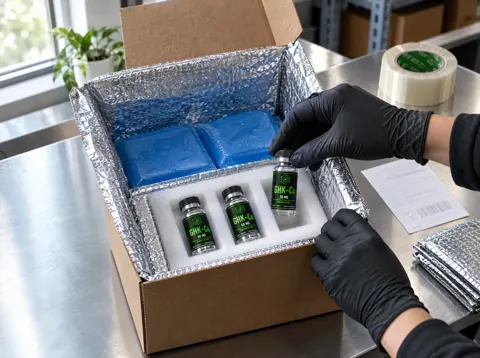 Research peptides in transit: heat, cold and storageDeamidationDegradation+68terms05
 US-made vs imported research peptidesDegradationLyophilization+46terms06
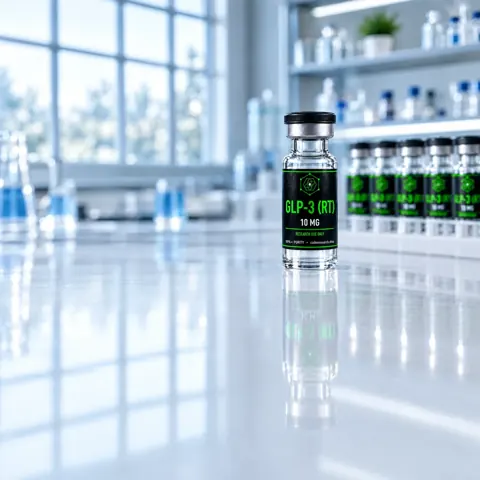 What research use only meansGMPIn vitro+46terms07
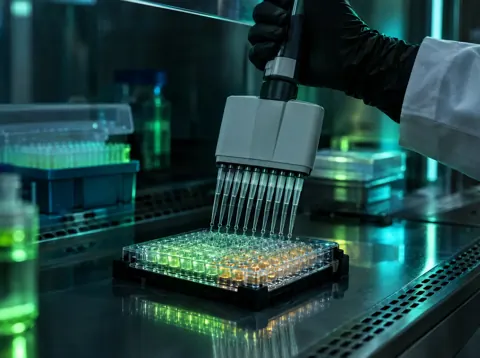 What endotoxin testing meansBioburdenEndotoxin+35terms08
 How to read a peptide certificate of analysisArea percentPotency+24terms09
 What a peptide certificate of analysis can’t tell youArea percentPotency2terms10
 Matching a peptide COA to your lot numberSample identification1terms
Missing a word?
Saw a word on a label, a report or a product page that isn't here? Send it over and our quality team will define it and add it to the glossary.
 From lab to your door
U.S.-made research vials, shipped with lot-matched, lab-tested COAs you can scan straight off the label.

21+ Only
Codex Research provides research-grade compounds for laboratory and research use only. By entering, you confirm you are at least 21 and agree to our Terms & Conditions.
By proceeding you affirm the statements above are true. Products are supplied for laboratory research use only — not for human or veterinary use, not for use in diagnostic procedures, and not evaluated by the U.S. Food and Drug Administration. Full disclaimer.