
mL
Higher water
Volumetric KF
Iodine reagent is added from a burette until the endpoint. Suited to samples with higher water levels.
(“KARL FISH-er ty-TRAY-shun”)
How a lab measures the water in a powder that looks completely dry.
The short answer
Karl Fischer titration is a method that measures how much water a sample contains, using a chemical reaction that consumes water and nothing else.
In the reaction, iodine reacts with sulfur dioxide only when water is present, so the amount of iodine used tells you exactly how much water there was. On a peptide COA the result is reported as a percentage of weight, and it matters because lyophilized peptides pull moisture from the air.
Reviewed by the Codex Research quality teamUpdated Nov 8, 2026
Word study
Say it
Karl Fisch·er ti·tra·tion
(“KARL FISH-er ty-TRAY-shun”)
Roots and origin
RootGerman
OriginFrench
The method is named after the German chemist who published it in 1935. Titration comes from the French titre, the standard of fineness for gold and silver, and means measuring an unknown by adding a reagent of known strength until the reaction is complete.
Around the world
Tap a language to hear it spokenDefinition
Karl Fischer titration measures water. The sample is introduced into a cell containing a reagent of iodine, sulfur dioxide, a base and an alcohol. Iodine reacts with the sulfur dioxide only when water is present, consuming one molecule of iodine for each molecule of water. When all the water is used up, free iodine appears, an electrode detects it, and the titration stops. The amount of iodine used tells the instrument how much water there was.
The method was published in 1935 by the German chemist Karl Fischer, and it remains the standard way to measure water in pharmaceuticals, chemicals and many other materials. Its great advantage is selectivity. Simpler tests, such as weighing a sample before and after heating, measure everything that evaporates; Karl Fischer responds to water alone.
There are two main versions. Volumetric titration adds iodine from a burette and suits samples with higher water levels. Coulometric titration generates iodine electrically inside the cell and can measure very small amounts of water, down to micrograms. For solids that dissolve poorly or react with the reagent, a Karl Fischer oven heats the sample and carries only the released water into the cell on a stream of dry gas.
Water content matters for peptides because lyophilized powders are hygroscopic. Even a cake that looks perfectly dry holds some residual moisture from drying, and it absorbs more whenever it is exposed to humid air. That water adds weight that is not peptide, which is one reason net peptide content is always below 100%, and over time moisture can speed up degradation.
On a certificate of analysis, water content is reported as a percentage of weight, ideally with the method named. A typical lyophilized peptide holds a few percent water. A result is most useful read alongside the lot’s net peptide content and counter-ion content, because together they account for the parts of the powder that are not peptide.
Methods
Iodine reagent is added from a burette until the endpoint. Suited to samples with higher water levels.
Iodine is generated electrically in the cell, so tiny amounts of water can be measured precisely. Suited to trace moisture.
The sample is heated in a separate oven and only the released water is carried into the cell. Avoids side reactions and poor solubility.
Not Karl Fischer: measures all weight lost on heating. Faster and simpler, but counts any volatile, not just water.
For buyers
Every percent of water is a percent of the powder that is not peptide. Water content is part of what explains net peptide content.
Water drives many degradation reactions. A low, measured water content is a sign the lot was dried and sealed well.
A powder that has absorbed moisture tells a story about drying, sealing and storage that appearance alone cannot.
At Codex Research
Every Codex Research product page shows the lot-matched certificate with identity and HPLC purity for the lot in stock. If water content data matters for your work, send the team the product and lot number and we will confirm what is available for that batch.
See it live: the net peptide content page in the glossary
Myth vs fact
Tap a card to flip it.
Watch for
Quick check
Usually a few percent for a lyophilized peptide.
Karl Fischer, not loss on drying, for water specifically.
Water is part of the non-peptide share of the powder.
 Full walkthrough · JournalPeptide purity grades explained
Questions
Water content. The reaction consumes water specifically, so the result reflects water rather than every volatile substance in the sample.
Volumetric adds iodine reagent from a burette and suits higher water levels. Coulometric generates iodine electrically and suits trace amounts.
Lyophilized peptides are hygroscopic. Water adds non-peptide weight and can affect stability, so it is measured on the lot.
Commonly a few percent by weight, depending on the peptide, the drying cycle and how the powder has been stored and handled.
No. Loss on drying measures all weight lost on heating, including other volatiles. Karl Fischer measures water specifically.
An attachment that heats a solid sample and carries the released water into the titration cell, useful for samples that dissolve poorly or react with the reagent.
The German chemist Karl Fischer, who published the method in 1935.
Sources and standards
Written and reviewed by the Codex Research quality team · Last reviewed November 8, 2026 · For laboratory research use only.
On real products
Every Codex lot is tested before it ships, and each product page publishes that lot’s certificate of analysis. See where Karl Fischer titration fits on a real product, then read the full guide.
 GH axis
Research peptide
GH-Axis Research
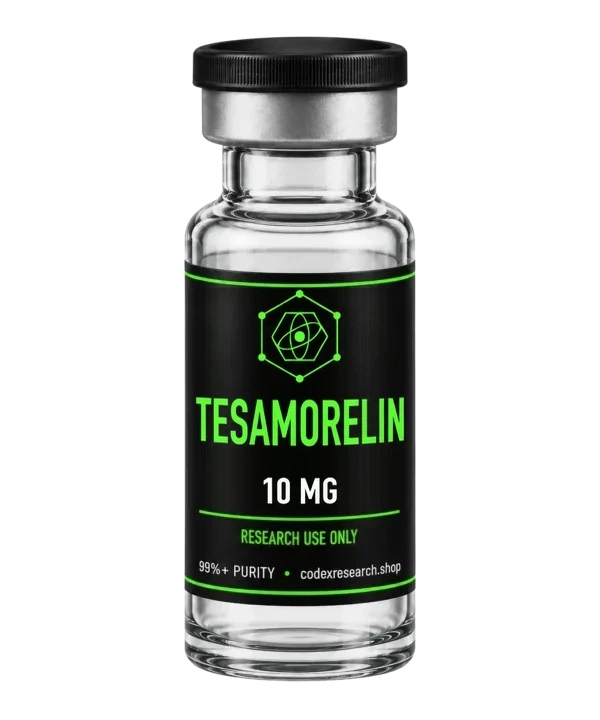
Tesamorelin is a 44-residue GHRH analog carrying a trans-3-hexenoyl group on Tyr1, studied in GHRH-receptor and peptide-stability research. Lot-tested by HPLC.
 Metabolic
Research peptide
Metabolic Research
5-Amino-1MQ is a membrane-permeable small-molecule inhibitor of nicotinamide N-methyltransferase (NNMT), supplied in 10 mg and 50 mg vials for enzyme research.
 Cellular
Research peptide
Cellular Research
Cobalamin is a cobalt atom held in a corrin ring, the cofactor for methionine synthase and methylmalonyl-CoA mutase, studied in one-carbon metabolism.
Journal guidePeptide purity grades explainedRead the guideKeep going
 From lab to your door
U.S.-made research vials, shipped with lot-matched, lab-tested COAs you can scan straight off the label.

21+ Only
Codex Research provides research-grade compounds for laboratory and research use only. By entering, you confirm you are at least 21 and agree to our Terms & Conditions.
By proceeding you affirm the statements above are true. Products are supplied for laboratory research use only — not for human or veterinary use, not for use in diagnostic procedures, and not evaluated by the U.S. Food and Drug Administration. Full disclaimer.


