25 °C / 60% RH
Real conditions
Long-term
Storage at the intended conditions for at least the proposed shelf life. The primary basis for shelf life.
(“stuh-BIL-ih-tee STUD-ee”)
The evidence behind every expiry and retest date.
The short answer
A stability study is a planned experiment that stores a material under defined conditions and tests it at set intervals to show how its quality changes over time.
Samples from representative lots are stored at long-term conditions that match intended storage, and often at harsher accelerated conditions too. At each pull point, such as 0, 3, 6, 9 and 12 months, they are tested with stability-indicating methods for appearance, identity, purity and degradation products. The results show how fast quality changes and support a shelf life or retest date.
Reviewed by the Codex Research quality teamUpdated Nov 8, 2026
Word study
Say it
sta·bil·i·ty stud·y
(“stuh-BIL-ih-tee STUD-ee”)
Roots and origin
RootLatin
OriginLatin
Stability is the ability to stand firm, so a stability study is a careful, planned look at how well a material holds its quality as time passes.
Around the world
Tap a language to hear it spokenDefinition
A stability study answers a simple question with a careful design: how does this material change over time under the conditions it will be stored in? FDA guidance based on ICH Q1A(R2) describes its purpose as providing evidence on how the quality of a substance varies with time under the influence of environmental factors such as temperature, humidity and light.
Samples from representative lots are placed in controlled chambers. Long-term conditions reflect intended storage: 25 °C and 60% relative humidity for the general case, or 5 °C for refrigerated materials. Accelerated conditions are harsher, such as 40 °C and 75% relative humidity, so that changes appear sooner. An intermediate condition, 30 °C and 65% relative humidity, is used when accelerated testing shows significant change.
Testing follows a schedule. For long-term studies, Q1A(R2) describes testing every three months in the first year, every six months in the second year and annually after that. Accelerated studies use at least three time points, such as 0, 3 and 6 months. Light sensitivity is covered by a separate photostability guideline, Q1B.
The tests themselves must be stability-indicating: able to detect and measure the degradation products that matter, not just the main component. For peptides that usually means HPLC for purity and degradants, mass spectrometry to identify changes, appearance, and water content for a solid. Guidance for biotechnological products adds that proteins and polypeptides are particularly sensitive to temperature, oxidation, light and other environmental factors.
The data set the shelf life or retest date: the period over which the material stays within its specifications under the stated storage conditions. A storage instruction and an expiry date on a label are only as meaningful as the stability data behind them.
Kinds of study
Storage at the intended conditions for at least the proposed shelf life. The primary basis for shelf life.
Storage at harsher conditions for six months to show how the material responds to stress and to flag problems early.
A middle condition used when accelerated testing shows a significant change.
Deliberately harsh exposure to heat, humidity, oxidation, light or pH to reveal degradation pathways and prove the methods can see them.
Exposure to defined amounts of visible and ultraviolet light, covered by ICH Q1B.
Interactive
Choose how the material is meant to be stored to see the storage conditions and testing time points ICH Q1A(R2) describes for that case.
How the material is meant to be stored
Conditions and testing frequencies follow the general case and the refrigerated case in ICH Q1A(R2). Long-term testing normally continues through the proposed shelf life; accelerated and intermediate studies run alongside it. Tap a time point to see what is usually tested.
For buyers
A shelf life is a conclusion drawn from stability data. Without the data, it is a guess.
Temperature and humidity guidance on a label reflects the conditions under which stability was shown.
A stability study is only as good as its ability to detect the degradation products that form.
At Codex Research
Codex Research peptides ship as freeze-dried solids in sealed vials with ice packs, dispatched the same business day. Each product page carries a lot-matched certificate reporting HPLC purity and mass spectrometry identity for the lot in stock.
See it live: the degradation guide, with a temperature model
Myth vs fact
Tap a card to flip it.
Watch for
Quick check
The temperature and humidity of the study.
Long-term results, not only accelerated ones.
Storage instructions consistent with the study.
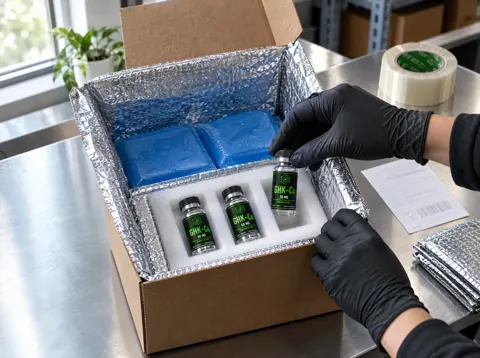 Full walkthrough · JournalResearch peptides in transit: heat, cold and storage
Questions
A planned study that stores samples under controlled conditions and tests them at set intervals to show how quality changes over time.
For the general case, long-term at 25 °C / 60% RH, intermediate at 30 °C / 65% RH and accelerated at 40 °C / 75% RH.
For long-term studies, typically every three months in year one, every six months in year two and annually after that.
A study at harsher conditions, such as 40 °C / 75% RH for six months, that shows how the material responds to stress.
A test that can detect and measure degradation products, not just the main component.
From stability data showing how long the material stays within its specifications under the stated storage conditions.
A shelf life is a fixed expiry period; a retest date is when a material should be retested to confirm it is still suitable.
Sources and standards
Written and reviewed by the Codex Research quality team · Last reviewed November 8, 2026 · For laboratory research use only.
On real products
Every Codex vial ships freeze-dried, sealed and lot-labelled. See how stability study applies on a real product, then read the full guide.
 Repair
Research peptide
Immune Research
Thymosin alpha-1 is a 28-residue acetylated peptide isolated from calf thymus in 1977 and generated from prothymosin alpha, studied in T-cell biology.
 Repair
Research peptide
Tissue-Repair Research
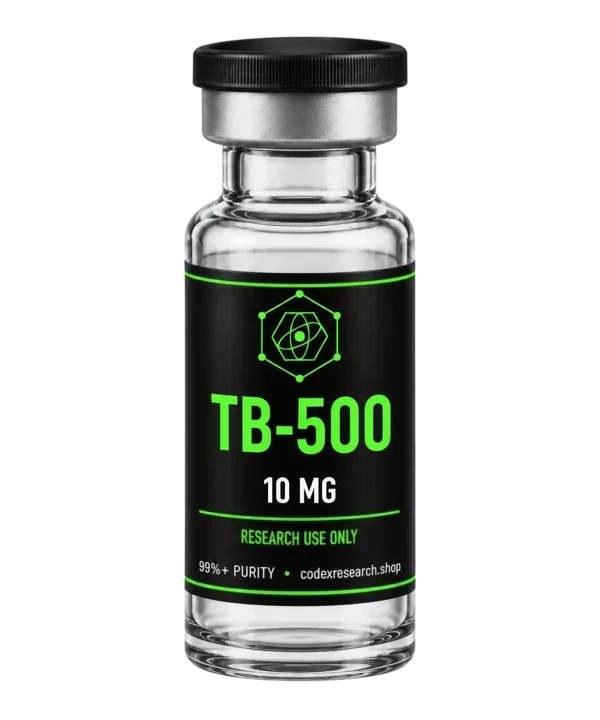
TB-500 is Ac-LKKTETQ, the acetylated actin-binding fragment of Thymosin Beta-4 (residues 17–23), supplied as a lyophilized peptide for actin-regulation and cell-migration research.
 Blends
Research peptide
Repair Blend
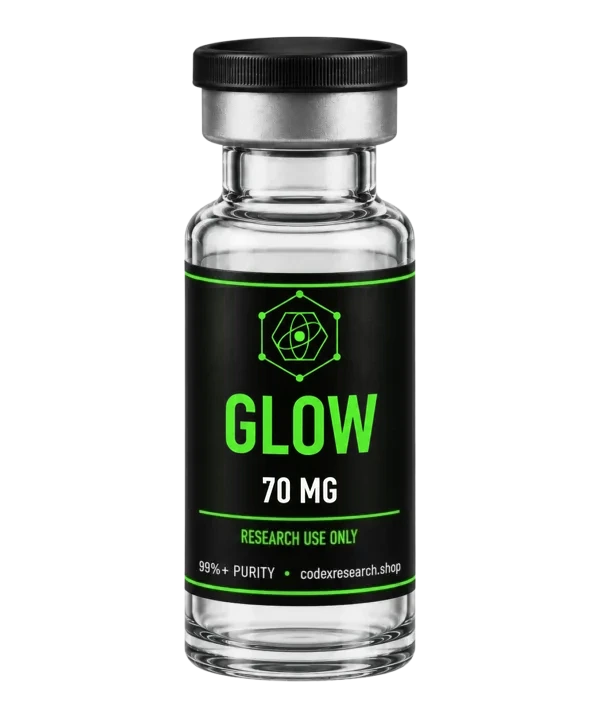
Glow is a three-peptide research blend: 49.87 mg GHK-Cu, 9.88 mg BPC-157 and 9.32 mg TB-500 per vial on the current lot, measured by HPLC and tested on a full safety panel.
Journal guideResearch peptides in transit: heat, cold and storageRead the guideKeep going
 From lab to your door
U.S.-made research vials, shipped with lot-matched, lab-tested COAs you can scan straight off the label.

21+ Only
Codex Research provides research-grade compounds for laboratory and research use only. By entering, you confirm you are at least 21 and agree to our Terms & Conditions.
By proceeding you affirm the statements above are true. Products are supplied for laboratory research use only — not for human or veterinary use, not for use in diagnostic procedures, and not evaluated by the U.S. Food and Drug Administration. Full disclaimer.