+0.98 Da
Water-driven
Deamidation
Asparagine or glutamine loses its side-chain amide and becomes an acidic residue. The mass rises by about 1 Da and the charge changes, so the product often separates on HPLC.
(“deg-ruh-DAY-shun”)
Why cold, dry and dark is the standard for storing peptides.
The short answer
Degradation is the gradual chemical or physical change of a peptide into something else, driven mainly by heat, water, oxygen and light.
A peptide can change in several ways: amide side chains can deamidate, sulfur-containing residues can oxidize, backbone bonds can hydrolyze, and chains can stick together into aggregates. Each pathway turns some of the target peptide into a related impurity. Removing water, lowering temperature and limiting oxygen and light all slow these reactions, which is why peptides are stored freeze-dried and cold.
Reviewed by the Codex Research quality teamUpdated Nov 8, 2026
Word study
Say it
deg·ra·da·tion
(“deg-ruh-DAY-shun”)
Roots and origin
RootLatin
OriginLatin
Degradation literally means stepping down. It entered English for lowering someone in rank, and chemistry borrowed it for a molecule stepping down into simpler or altered products.
Around the world
Tap a language to hear it spokenDefinition
Degradation is the slow change of a peptide into related but different molecules. Some changes are chemical, where bonds break or atoms are added or lost; others are physical, where chains clump together or stick to surfaces. Either way, part of the material in the vial stops being the target peptide.
Most of the important chemical pathways need water or oxygen. Deamidation converts asparagine, and more slowly glutamine, into acidic residues and is fastest when asparagine is followed by glycine. Oxidation attacks methionine, cysteine and tryptophan. Hydrolysis breaks the backbone itself, and bonds next to aspartic acid are especially prone to it. Each pathway leaves a recognizable change in mass or charge.
Temperature speeds up nearly all of these reactions. A common rule of thumb is that rates roughly double or triple for every 10 °C rise, which is why a few days in a hot vehicle matter more than weeks in a refrigerator. Water matters even more: in solution a peptide can change in days, while the same peptide freeze-dried and dry can stay essentially unchanged for far longer.
Solid-state stability is not absolute. Reviews of freeze-dried peptides and proteins describe deamidation, oxidation, bond cleavage and aggregation all continuing in the dry state, slowed but not stopped, with residual moisture and temperature as the main levers. That is why water content and storage temperature both appear in good handling guidance.
Degradation is measured rather than guessed. HPLC shows degradants as new or growing peaks beside the main peak, and mass spectrometry identifies them by their mass shift, such as +16 Da for a single oxidation or about +1 Da for deamidation. Formal stability studies follow guidelines such as ICH Q1A(R2), storing samples under set conditions and testing them at intervals.
Pathways
Asparagine or glutamine loses its side-chain amide and becomes an acidic residue. The mass rises by about 1 Da and the charge changes, so the product often separates on HPLC.
Oxygen is added to sensitive residues, most often methionine, which becomes methionine sulfoxide. Light, trace metals and air speed it up.
A backbone bond is cut by water, splitting the chain into two shorter fragments. Bonds beside aspartic acid are especially susceptible.
Chains associate into dimers or larger clusters, sometimes reversibly, sometimes not. It can lower the amount of free peptide without changing its mass.
An amino acid flips from its L form to its D form. The mass does not change, so it needs a separation that can tell the two forms apart.
Interactive
Most degradation reactions run faster as temperature rises and much faster when the peptide is dissolved. Pick a storage temperature and a physical form to see how long a teaching-model peptide takes to lose 5%.
Physical form
A teaching model, not data for any specific peptide: first-order loss, an activation energy of 80 kJ/mol (roughly a doubling to tripling of the rate for every 10 °C), and assumed baseline rates at 25 °C of 0.25% a month for a dry powder and 10% a month in solution. Real rates depend on the sequence, residual moisture, pH, oxygen and light, which is why they are measured in stability studies.
For buyers
An HPLC purity result describes the lot when it was tested. Storage decides how close the material stays to that number.
Most degradation products differ by a single atom or bond, so they are easy to miss without a method that can separate them.
Heat, water, oxygen and light are the main drivers, and every one of them can be limited by how material is packed, shipped and kept.
At Codex Research
Codex Research peptides ship as freeze-dried solids in sealed vials, packed with ice packs in an insulated mailer and dispatched the same business day, which keeps time at elevated temperature short. Each product page carries a lot-matched certificate reporting HPLC purity for the lot in stock.
See it live: the guide to peptides in transit, heat and cold
Myth vs fact
Tap a card to flip it.
Watch for
Quick check
A dry, intact cake or powder, not sticky, discolored or melted.
A stated storage temperature, and material kept dry and sealed.
A recent HPLC result close to the original certificate’s value.
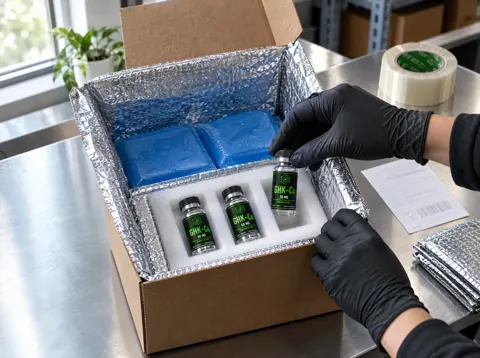 Full walkthrough · JournalResearch peptides in transit: heat, cold and storage
Questions
Mainly heat, water, oxygen and light. They drive reactions such as deamidation, oxidation and hydrolysis, and physical changes such as aggregation.
Yes, but far more slowly than in solution. Reactions continue in the solid state, and residual moisture and temperature control how fast.
Deamidation and oxidation are among the most common. Which one dominates depends on the sequence, especially asparagine, glutamine, methionine and cysteine content.
HPLC shows degradants as new or growing peaks, and mass spectrometry identifies them by their change in mass.
Chemical reaction rates rise with temperature. A rough rule is a two- to three-fold increase for each 10 °C, so short periods of heat can matter.
It usually indicates one added oxygen atom, the signature of oxidation, most often of a methionine residue.
A planned study that stores a material under defined temperature and humidity and tests it at intervals to show how it changes over time.
Sources and standards
Written and reviewed by the Codex Research quality team · Last reviewed November 8, 2026 · For laboratory research use only.
On real products
Every Codex vial ships freeze-dried, sealed and lot-labelled. See how degradation applies on a real product, then read the full guide.
 Dermal
Research peptide
Melanocortin Research
Melanotan I is [Nle4,D-Phe7]-alpha-MSH, a 13-residue analog of alpha-MSH with high MC1R selectivity, the molecule later named afamelanotide.
 Metabolic
Research peptide
Metabolic Research
Cagrilintide is a lipidated amylin analog that acts at the AMY1-3 receptors and the calcitonin receptor, studied in calcitonin-family GPCR pharmacology.
 Dermal
Research peptide
Dermal Research
SNAP-8 is an eight-amino-acid peptide modelled on the SNAP-25 N-terminus, studied in SNARE-complex assembly research.
Journal guideResearch peptides in transit: heat, cold and storageRead the guideKeep going
 From lab to your door
U.S.-made research vials, shipped with lot-matched, lab-tested COAs you can scan straight off the label.

21+ Only
Codex Research provides research-grade compounds for laboratory and research use only. By entering, you confirm you are at least 21 and agree to our Terms & Conditions.
By proceeding you affirm the statements above are true. Products are supplied for laboratory research use only — not for human or veterinary use, not for use in diagnostic procedures, and not evaluated by the U.S. Food and Drug Administration. Full disclaimer.