Area %
Most COAs
Area percent normalization
Each peak’s raw area as a share of the total. No standard needed. Assumes equal detector response.
(“AIR-ee-uh per-SENT”)
The arithmetic behind every HPLC purity figure, and the assumptions that come with it.
The short answer
Area percent is one peak’s area expressed as a share of the total area of every integrated peak in a chromatogram.
Area percent (area %) is a peak’s integrated area divided by the summed area of all integrated peaks in an HPLC run, times 100. On a peptide COA, the main peak’s area percent is the reported purity, and each smaller peak’s area percent is that impurity’s reported level.
Reviewed by the Codex Research quality teamUpdated Nov 14, 2026
Word study
Say it
ar·e·a per·cent
(“AIR-ee-uh per-SENT”)
Roots and origin
RootLatin
OriginLatin
The area is the region under a peak on the chromatogram, which the data system measures by integration. Per centum turns that area into a share of a hundred, so every peak in the run adds up to 100.
Around the world
Tap a language to hear it spokenDefinition
An HPLC run separates a sample into components and records each one as a peak. The data system integrates each peak, which means it measures the area under the curve between the points where the signal leaves and returns to the baseline. Area percent takes one of those areas and divides it by the sum of every integrated area in the run, then multiplies by 100. The numbers across the run always add up to 100.
On a peptide certificate of analysis, the main peak’s area percent is the purity result. A line that reads “Purity 99.23% (RP-HPLC)” means the main peak made up 99.23% of the integrated area, and every other peak together made up 0.77%. The Ghent University group that re-tested 98 research peptides calculated purity this way: the UV area of the most abundant peak as a percentage of total peak area.
The method is popular because it needs no reference standard. Chromatography texts list area percent normalization as the simplest quantitation technique, ahead of response-factor correction, external standards and internal standards. It is common for impurity reporting in early pharmaceutical development, before standards for each impurity exist.
The simplicity carries three assumptions. The integrated peaks are the only components in the sample. Each peak is one pure component. And the detector responds the same way to every component, so equal amounts give equal areas. Real samples break all three. Water and salts give no UV peak at all, and an impurity that leaves the column with the main peak hides inside it.
Regulators expect a report to say which basis it uses. FDA’s methodology guidance for validating analytical procedures states that it should be clear how individual or total impurities are determined, for example weight/weight or area percent, with respect to the major analyte. A COA that names the method and the detection wavelength lets you judge which assumptions apply.
Quantitation methods
Each peak’s raw area as a share of the total. No standard needed. Assumes equal detector response.
Raw areas multiplied by relative response factors before normalizing, to correct for components that absorb more or less UV.
The sample’s peak is compared with a reference of known concentration run separately. Gives an amount, not a share.
A known compound is added to the sample itself, and areas are read relative to it. Corrects for losses as the sample is loaded.
For buyers
Every HPLC purity claim on a peptide COA is an area percent unless the report says otherwise.
Water, counter-ions and co-eluting impurities do not lower it, so it can read high.
Area % says nothing about milligrams. The assay line carries the amount.
At Codex Research
Codex Research product pages publish the lot’s purity as an RP-HPLC result, for example 99.23% for the BPC-157 lot in stock, with the assay in milligrams on its own line so the share and the amount are never confused.
See it live: the RP-HPLC purity line on the BPC-157 certificate
Myth vs fact
Tap a card to flip it.
Watch for
Quick check
RP-HPLC, the column type and a wavelength near 214–220 nm.
Main peak area % plus each impurity, to two decimals below 1%.
Milligrams come from the assay line, not from area %.
 Full walkthrough · JournalHow to read a peptide certificate of analysis
Questions
Area percent is the share of the total integrated peak area that one peak makes up in an HPLC run. On a peptide COA, the main peak’s area percent is the purity result, and the smaller peaks’ area percents are the impurity levels. The values in one run always add up to 100.
The data system integrates every peak above its reporting threshold, adds the areas together and divides each peak’s area by that total, then multiplies by 100. A main peak of 9,923 area units in a run totaling 10,000 units reads as 99.23 area percent.
Usually, yes. Most peptide certificates report purity as the main peak’s area percent by reversed-phase HPLC. A report can instead quote a weight-percent purity against a reference standard, so check the method line. If no basis is stated, assume area percent.
Area percent is a ratio of detector signals and needs no reference standard. Weight percent compares the sample with a standard of known concentration and reports how much of the material, by mass, is the analyte. The two only agree when every component gives the same UV response.
It counts only what the detector sees and what the column separates. Water and salts give no UV peak, an impurity that leaves the column with the main peak hides inside it, and weak UV absorbers give small peaks. Each of those pushes the main peak’s share upward.
A relative response factor compares how strongly an impurity absorbs UV with how strongly the main compound absorbs at the same wavelength. Multiplying an impurity’s area by its factor before normalizing corrects area percent for unequal response. Plain area percent assumes every factor equals one.
The ICH impurity guideline for drug substances asks for results below 1.0% to be reported to two decimal places, such as 0.06% or 0.13%, and results at or above 1.0% to one decimal place. Research COAs are not bound by it, but the convention makes a report easier to read.
Sources and standards
Written and reviewed by the Codex Research quality team · Last reviewed November 14, 2026 · For laboratory research use only.
On real products
These products’ current certificates report purity by RP-HPLC, the method behind area percent. See the result on each product page, then read the full guide.
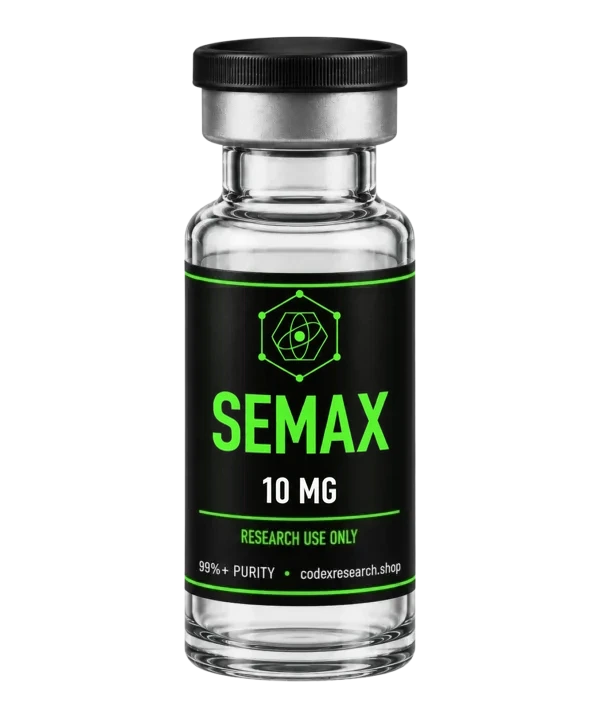 Neuro
Research peptide
Neuropeptide Research
Semax is a seven-residue ACTH(4-7) analogue with a Pro-Gly-Pro tail, studied in BDNF, trkB and cholinergic-neuron research. 5 mg and 10 mg vials, lot-tested by LC-MS.
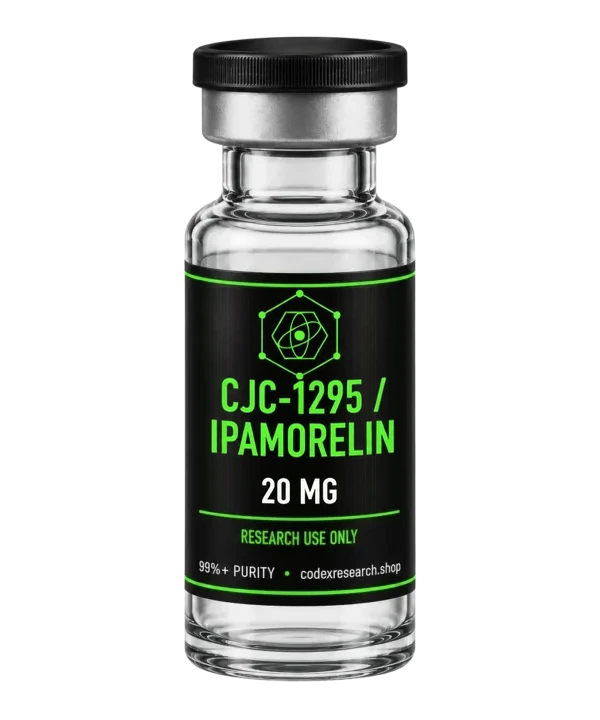 Blends
Research peptide
GH-Axis Research
A single vial pairing CJC-1295 without DAC, a tetrasubstituted GRF(1-29) analog, with Ipamorelin, a five-residue ghrelin-receptor agonist. Lot-tested by RP-HPLC.
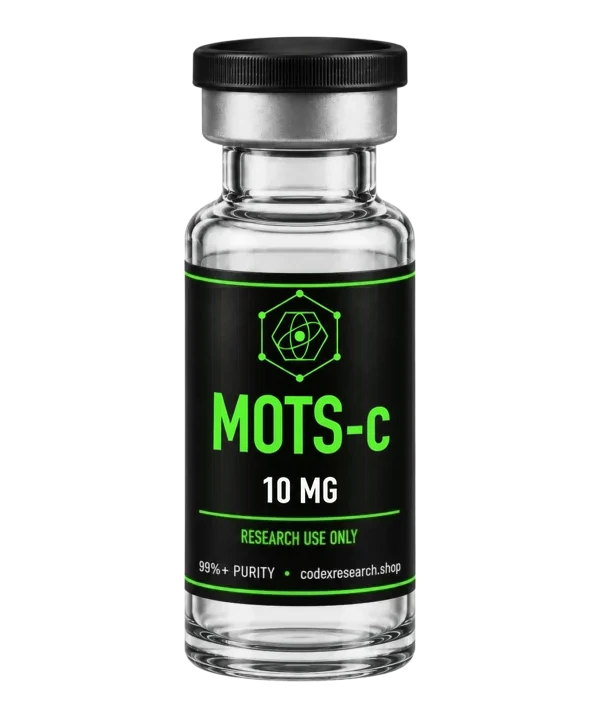 Cellular
Research peptide
Cellular Research
MOTS-c is a 16-residue peptide encoded inside the mitochondrial 12S rRNA gene, studied in AMPK, folate-cycle and mitonuclear signaling research. Lot-tested by LC-MS.
Journal guideHow to read a peptide certificate of analysisRead the guideKeep going
 From lab to your door
U.S.-made research vials, shipped with lot-matched, lab-tested COAs you can scan straight off the label.

21+ Only
Codex Research provides research-grade compounds for laboratory and research use only. By entering, you confirm you are at least 21 and agree to our Terms & Conditions.
By proceeding you affirm the statements above are true. Products are supplied for laboratory research use only — not for human or veterinary use, not for use in diagnostic procedures, and not evaluated by the U.S. Food and Drug Administration. Full disclaimer.