
Gel
Pass or fail
Gel-clot
The sample is mixed with LAL and checked for a firm gel. A simple pass or fail against a set sensitivity, and the referee method when results are disputed.
(“EN-doh-TOK-sin”)
The contaminant that sterile filtration does not remove.
The short answer
An endotoxin is a lipopolysaccharide from the outer membrane of gram-negative bacteria, a contaminant that can be present even when no living bacteria are.
Endotoxins are released when gram-negative bacteria die or divide, and they are heat-stable enough to survive ordinary sterilization. They are measured with the LAL test, made from horseshoe crab blood, and reported in endotoxin units (EU), usually per milligram of material. For cell-based work in particular, a low result matters.
Reviewed by the Codex Research quality teamUpdated Nov 8, 2026
Word study
Say it
en·do·tox·in
(“EN-doh-TOK-sin”)
Roots and origin
RootGreek
OriginGreek
The name was coined in the 1890s by the bacteriologist Richard Pfeiffer for a toxic substance held within the bacterial cell, as opposed to exotoxins that bacteria secrete. It turned out to be part of the cell wall itself, which is why it is released when bacteria break apart.
Around the world
Tap a language to hear it spokenDefinition
Gram-negative bacteria, a large group that includes E. coli, are wrapped in an outer membrane studded with lipopolysaccharide. When the bacteria die, divide or break apart, fragments of that membrane are released. Those fragments are endotoxins. They are not alive, they do not grow, and killing the bacteria does not destroy them; it releases more.
That is what makes endotoxin a separate problem from sterility. A material can be sterile, with no living organisms at all, and still carry endotoxin from bacteria that were present earlier in the process: in water, on equipment or in raw materials. Endotoxins are also remarkably heat-stable. Ordinary autoclaving does not reliably destroy them, which is why glassware for sensitive work is depyrogenated with dry heat at around 250 °C.
The standard test grew out of an observation in the 1960s by Jack Levin and Frederik Bang: the blood cells of the Atlantic horseshoe crab clot on contact with tiny amounts of endotoxin. An extract of those cells, Limulus amebocyte lysate or LAL, is now the reagent behind the bacterial endotoxins test in the US, European and Japanese pharmacopoeias, which have been harmonized so that results are interchangeable.
Results are given in endotoxin units, a measure of activity calibrated against a reference endotoxin, and for a solid material usually per milligram: EU/mg. A result means little without the limit it is judged against and the sensitivity of the test, because a reading of “below 0.5 EU/mg” and a reading of “below 10 EU/mg” both pass different specifications while describing very different materials.
Endotoxin matters most where a material meets living cells. Immune cells in culture respond to endotoxin at very low levels, which can produce responses that have nothing to do with the compound being studied. For in vitro research, a lot with a documented low endotoxin result removes one of the most common hidden variables in cell-based work.
Methods
The sample is mixed with LAL and checked for a firm gel. A simple pass or fail against a set sensitivity, and the referee method when results are disputed.
Measures the cloudiness that develops as the lysate reacts. Gives a number by comparing the reaction rate with a standard curve.
The reaction releases a yellow color that is measured by absorbance. Quantitative and widely used for low limits.
Uses a lab-made version of the crab’s endotoxin-sensing protein instead of blood extract. An animal-free alternative now recognized by the pharmacopoeias.
For buyers
Endotoxin does not show up in HPLC purity or mass spectrometry. Only a dedicated test finds it.
Cells in culture can respond to endotoxin at very low levels, producing effects that have nothing to do with the material being studied.
A sterility result says nothing is alive. Endotoxin can remain after every organism is gone, so the two are tested separately.
At Codex Research
If endotoxin data matters for your work, send the Codex Research team the product and lot number and we will confirm what testing is on file for that batch. Every product page shows the lot-matched certificate with identity and HPLC purity for the lot in stock.
See it live: the certificate of analysis guide in the glossary
Myth vs fact
Tap a card to flip it.
Watch for
Quick check
Usually EU/mg for a powder.
A result is only meaningful next to its specification.
Sterile and low-endotoxin are two different claims.
 Full walkthrough · JournalWhat endotoxin testing means
Questions
A lipopolysaccharide fragment from the outer membrane of gram-negative bacteria. It can contaminate a material even when no living bacteria are present.
Endotoxin units per milligram of material. EU is a measure of endotoxin activity calibrated against a reference standard.
The bacterial endotoxins test that uses Limulus amebocyte lysate, made from horseshoe crab blood cells, which forms a clot when endotoxin is present.
No. Sterility testing looks for living organisms. Endotoxin testing looks for a non-living bacterial fragment that can remain after sterilization.
Not with ordinary sterilizing filters. Endotoxin fragments are far smaller than bacteria and pass through.
Cells in culture, especially immune cells, can respond to very low levels of endotoxin, which can distort results that have nothing to do with the material being studied.
A lab-made version of the endotoxin-sensing protein from horseshoe crab blood. It allows endotoxin testing without using animal-derived lysate.
Sources and standards
Written and reviewed by the Codex Research quality team · Last reviewed November 8, 2026 · For laboratory research use only.
On real products
The current certificates for these products report a endotoxin result for the lot in stock. See it on each product page, then read the full guide.
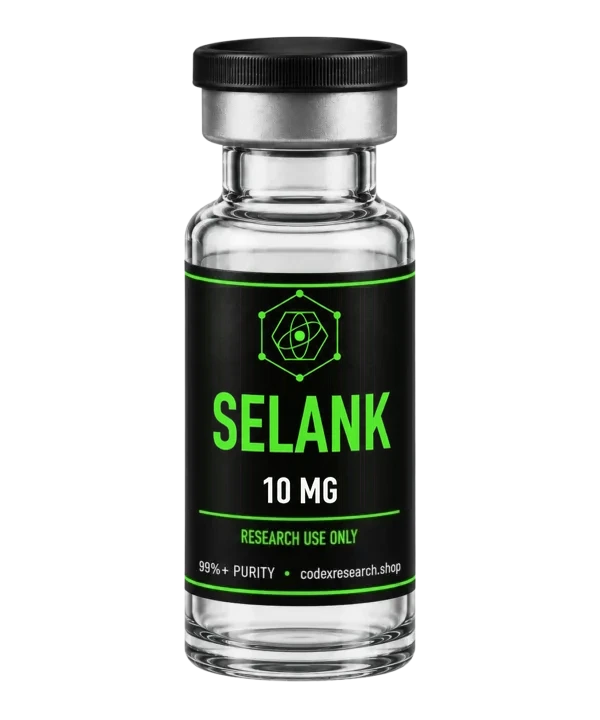 Neuro
Research peptide
Neuropeptide Research
Selank is a seven-residue tuftsin analogue, Thr-Lys-Pro-Arg-Pro-Gly-Pro, studied in enkephalinase and neurotransmission gene-expression research. Lot-tested by LC-MS.
 Cellular
Research peptide
Hormonal Research
Kisspeptin-10 is the C-terminal decapeptide of kisspeptin and an agonist at KISS1R (GPR54), studied in receptor-signaling and GnRH-neuron research. Lot-tested by LC-MS.
 Dermal
Research peptide
Melanocortin Research
PT-141 (Bremelanotide) is a cyclic seven-residue analog of alpha-MSH, studied as an agonist at the MC3R and MC4R melanocortin receptors. Lot-tested by LC-MS.
Journal guideWhat endotoxin testing meansRead the guideKeep going
 From lab to your door
U.S.-made research vials, shipped with lot-matched, lab-tested COAs you can scan straight off the label.

21+ Only
Codex Research provides research-grade compounds for laboratory and research use only. By entering, you confirm you are at least 21 and agree to our Terms & Conditions.
By proceeding you affirm the statements above are true. Products are supplied for laboratory research use only — not for human or veterinary use, not for use in diagnostic procedures, and not evaluated by the U.S. Food and Drug Administration. Full disclaimer.


