Endotoxins are invisible fragments of bacterial cell walls that survive the heat that kills bacteria and can trigger strong responses in cell-based experiments. This guide explains how they are measured, what EU/mg means on a certificate of analysis and how to read the result.
Key takeaways
- Endotoxins are lipopolysaccharide fragments from the outer membrane of Gram-negative bacteria. Sterilization kills bacteria but does not destroy endotoxin.
- Sterility and endotoxin are separate tests. A lot can show "no growth" for sterility and still carry endotoxin.
- Most labs measure endotoxin with the LAL test, built on the clotting reaction of horseshoe crab blood cells; recombinant factor C (rFC) is an animal-free alternative.
- Results are reported in endotoxin units (EU) per milligram or millilitre and judged against a stated limit, such as ≤ 0.05 EU/mg.
- Endotoxin matters for research because picogram amounts can activate immune cells in culture, producing effects that are easy to mistake for the compound being studied.
ImportantResearch use only. This guide explains how endotoxin is measured in laboratory research materials. It does not describe human or animal use. Codex Research compounds are not approved by the FDA and are sold for in-vitro laboratory research only.
Quick answer
Endotoxin is lipopolysaccharide (LPS), a molecule that makes up much of the outer coat of Gram-negative bacteria. It is invisible, it survives the heat and filtration that kill or remove bacteria, and tiny amounts can switch on immune cells in culture. Labs measure it with the LAL test (or its animal-free alternative, recombinant factor C) and report the result in endotoxin units per milligram (EU/mg) against a stated limit.
On a certificate of analysis, endotoxin is a separate line from sterility. A lot can show "no growth" for sterility and still carry endotoxin, so a complete report shows both.
Endotoxin terms you will see on reports
| Term | Meaning |
|---|---|
| Endotoxin | Lipopolysaccharide released from Gram-negative bacteria; heat stable and biologically active. |
| Pyrogen | Any substance that can cause a fever response. Endotoxin is the most common pyrogen. |
| LAL | Limulus amebocyte lysate: the horseshoe crab blood-cell extract used to detect endotoxin. |
| rFC | Recombinant factor C: a lab-made, animal-free reagent that detects endotoxin. |
| EU | Endotoxin unit, a standardized measure of endotoxin activity. |
| EU/mg | Endotoxin units per milligram of material; the usual unit for a solid research material. |
| LOD / λ | The lowest endotoxin level a method can reliably detect (λ is the label sensitivity for gel-clot). |
| Masking (LER) | Low endotoxin recovery: sample components that hide endotoxin from the test. |
What endotoxin is, and why it is hard to get rid of
The outer membrane of Gram-negative bacteria is studded with lipopolysaccharide. Its lipid A portion anchors it in the membrane and is the part that immune cells recognize [1]. When bacteria divide or die, LPS is shed into whatever surrounds them: water, reagents, equipment and the materials being made.
Three properties make endotoxin a persistent quality problem:
- It is not alive. Sterilization kills bacteria but leaves their LPS behind, still active.
- It is heat stable. Standard autoclaving does not destroy it. Breaking it down takes dry heat at high temperatures for extended periods, conditions most peptides would not survive.
- It is small and sticky. LPS forms aggregates and can bind to other molecules, so it can pass through filters or ride along with a product through purification [12].
That is why endotoxin is controlled at every stage, from water and reagents to equipment and containers, and then measured directly in the finished lot.
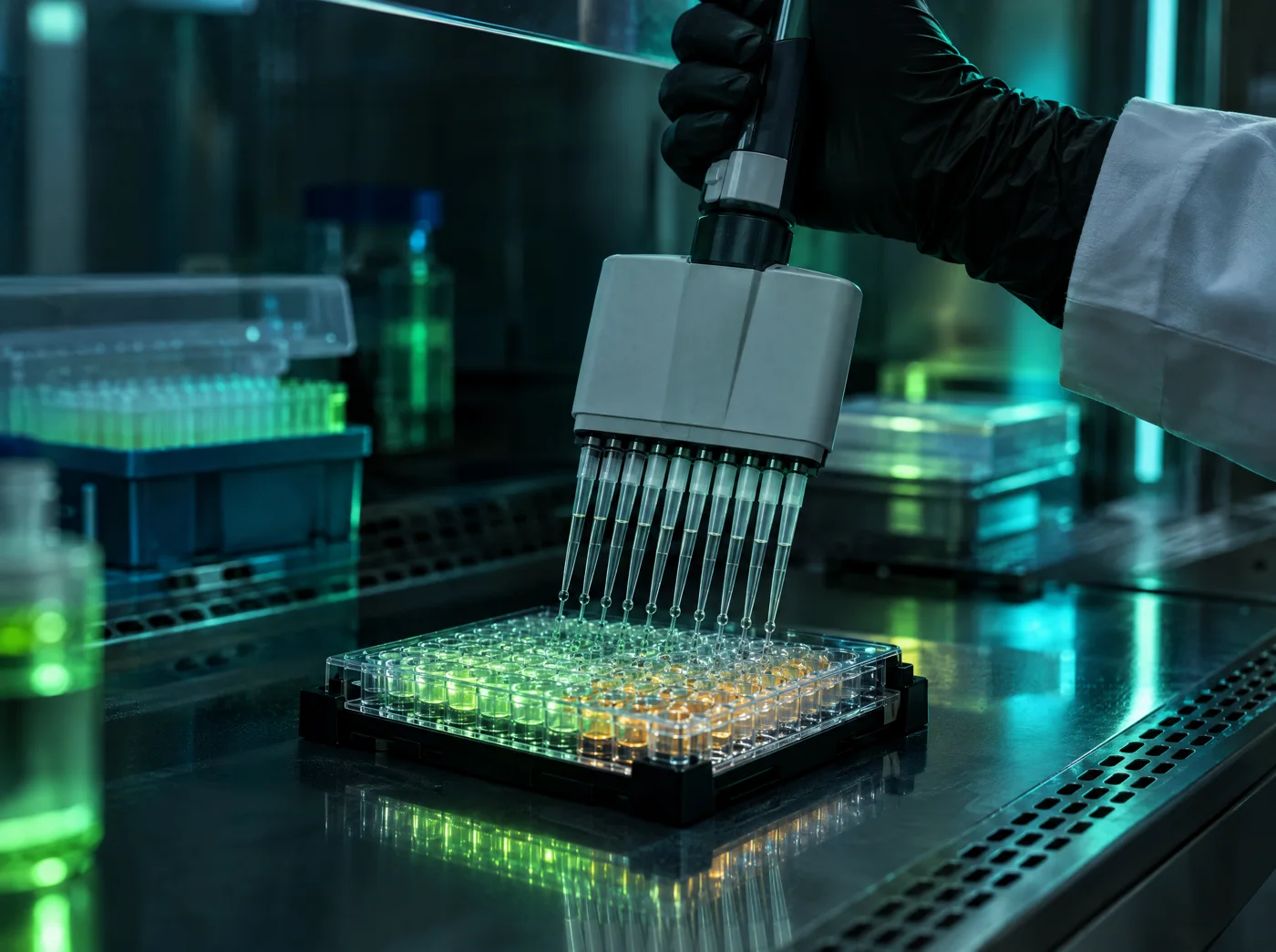
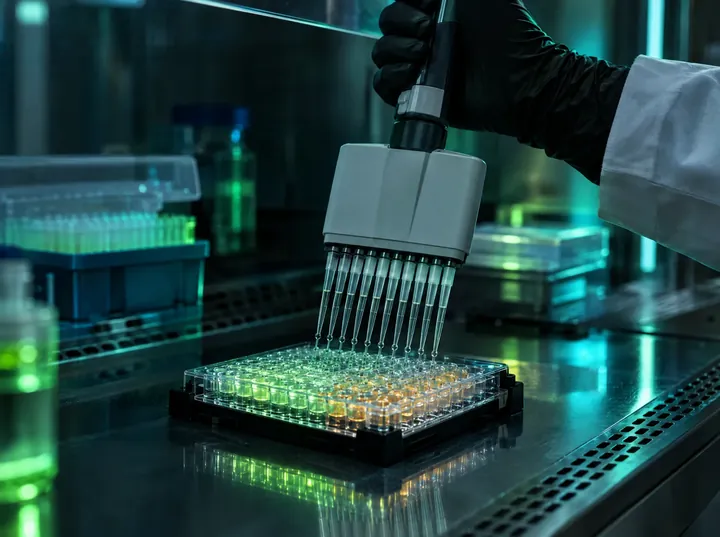
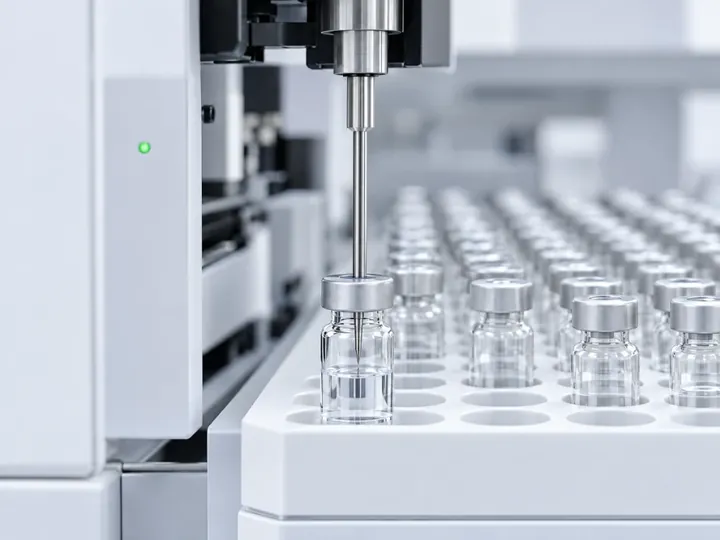
Endotoxin assays are run in microplates alongside a series of known endotoxin standards.
Sterility vs endotoxin: two different tests
| Sterility test | Endotoxin test | |
|---|---|---|
| What it looks for | Living bacteria and fungi that can grow | Bacterial lipopolysaccharide, living or not |
| Typical method | USP <71>: incubate in growth media | LAL or rFC assay |
| How the result reads | "No growth" or "Growth" | A number in EU/mg against a limit |
| What a pass means | No viable organisms detected | Endotoxin at or below the stated limit |
| What it can miss | Endotoxin from dead bacteria | Living organisms that do not shed much LPS |
Because each test answers a different question, neither can stand in for the other. A complete certificate of analysis reports both.
How the LAL test works
In the 1960s, researchers studying the horseshoe crab, Limulus polyphemus, found that its blood clotted in the presence of Gram-negative bacteria and their endotoxin [2]. The clotting is driven by a cascade of enzymes inside the crab's blood cells (amebocytes). An extract of those cells, Limulus amebocyte lysate, became the basis of the standard endotoxin test.
The cascade runs like this:
- Factor C binds endotoxin and becomes active.
- Active factor C switches on factor B, which activates a proclotting enzyme.
- The clotting enzyme converts a protein called coagulogen into a gel, or, in chromogenic kits, cuts a synthetic substrate that releases color.
The test sample is run alongside a series of endotoxin standards of known strength. Comparing the sample's reaction with that standard curve gives its endotoxin level in EU. FDA guidance describes how these LAL methods are applied and validated [3].
The three main LAL formats
| Method | What is measured | Result type | Notes |
|---|---|---|---|
| Gel-clot | Whether a firm gel forms | Pass or fail at a set sensitivity | Simple and robust; semi-quantitative |
| Turbidimetric | How cloudy the reaction becomes | Quantitative (endpoint or kinetic) | Follows the clotting reaction optically |
| Chromogenic | Color released from a synthetic substrate | Quantitative (endpoint or kinetic) | Widely used; sensitive to low levels |
Kinetic versions of the turbidimetric and chromogenic methods follow the reaction over time, which widens the measurable range and makes them the most common choice for quantitative work [4].
Recombinant factor C: the animal-free alternative
LAL depends on harvesting blood from wild horseshoe crabs, which has raised conservation concerns. Recombinant factor C (rFC) replaces the crab extract with a lab-made version of the cascade's first enzyme. When factor C binds endotoxin, it cuts a fluorescent substrate, and the signal is read against standards in the same way [5].
Because rFC uses only the first step of the cascade, it is not triggered by (1→3)-β-D-glucans, fungal molecules that can activate a separate branch of the LAL pathway and cause false positives. Comparisons have found rFC and LAL perform comparably: a six-year proficiency-testing program found rFC assays comparable to LAL, with equal or better endotoxin recovery [6], and a study of pharmaceutical water samples found an rFC assay reliable and less prone to interference than the established LAL method [7].
| LAL | rFC | |
|---|---|---|
| Source | Horseshoe crab blood cells | Recombinant protein |
| Detection | Clotting, turbidity or color | Fluorescence |
| Responds to β-glucans | Yes, unless blocked | No |
| History of use | Decades; long-established methods | Newer; growing adoption |
| Animal-derived | Yes | No |
Where endotoxin comes from in peptide manufacturing
How a peptide is made has a large effect on how much endotoxin it is likely to carry.
| Production route | How it works | Endotoxin risk |
|---|---|---|
| Chemical synthesis (SPPS) | Amino acids are joined one by one on a resin, with no living cells involved | Lower: endotoxin can only enter from water, reagents, equipment or handling |
| Recombinant expression | Bacteria such as E. coli are engineered to produce the peptide or protein | Higher: the host cells are themselves Gram-negative bacteria, so their LPS must be removed |
| Extraction from natural sources | The material is purified from animal or plant tissue | Variable: depends on source and purification |
Most short research peptides are made by solid-phase chemical synthesis, so the main endotoxin sources are environmental rather than built into the process [12]:
- Water. Purification systems and storage tanks can harbor bacterial biofilms that shed LPS.
- Reagents and buffers. Any ingredient that has been in contact with bacteria can carry endotoxin.
- Equipment and containers. Glassware, tubing and vials can hold endotoxin on their surfaces.
- Handling. Open steps during purification, freeze-drying and filling are chances for contamination.
How endotoxin is kept out
Because endotoxin is so hard to destroy, manufacturers rely mostly on prevention and removal rather than treatment of the finished product. Common approaches include [12]:
| Approach | How it works | Where it is used |
|---|---|---|
| Depyrogenated glassware | Dry heat at high temperature breaks down endotoxin on surfaces | Vials and glassware before filling |
| Low-endotoxin water | Distillation or membrane systems produce water with very low endotoxin | Buffers, mobile phases and rinses |
| Ion-exchange chromatography | Negatively charged LPS binds to a positively charged resin and is held back | Purification of peptides and proteins |
| Affinity adsorbents | Ligands such as polymyxin B bind lipid A selectively | Removal from protein preparations |
| Ultrafiltration | Membranes retain large LPS aggregates | Some solutions, depending on size |
| Closed, clean processing | Fewer open steps and controlled environments | Filling and freeze-drying |
None of these methods is perfect on its own, and each must be suited to the molecule being made. That is why the final word always comes from testing the finished lot.
How to read an endotoxin result on a COA
An endotoxin line usually has four parts. Each tells you something different:
| Part | Example | What it tells you |
|---|---|---|
| Specification | ≤ 0.05 EU/mg | The limit the lot must meet |
| Method | LAL, kinetic chromogenic | How the number was produced |
| Result | < 0.05 EU/mg or Pass | What the lab measured for this lot |
| Lot number | KIZN072426 | Which batch the result describes |
A few points help when reading the number:
- Lower is better, and the result must sit at or below the stated limit to pass.
- "Less than" results mean the sample was below the lowest level that method can reliably measure.
- Units matter. EU/mg describes activity per milligram of material; EU/mL describes activity per millilitre of a solution. They are not interchangeable.
- A limit with no result, or a result with no limit, is incomplete. Look for both.
TipA strong report names the endotoxin method next to the result. "Endotoxin: Pass" with no method or limit gives you nothing to evaluate.
Why endotoxin matters for research results
Immune cells such as macrophages carry a receptor, TLR4, that recognizes lipid A. Even very small amounts of endotoxin can trigger these cells to release inflammatory signals such as TNF-α and interleukins. In cell-based experiments, that response can look exactly like a biological effect of the compound being tested.
This is not hypothetical:
- A misattributed effect. Researchers studying a recombinant heat shock protein, Hsp70, found that the inflammatory signaling attributed to the protein was actually caused by contaminating endotoxin in the preparation. Removing or blocking the endotoxin essentially eliminated the effect, and adding the same amount of endotoxin to a clean preparation reproduced it [8].
- A recognized blind spot. A review titled "Dirty little secrets" described endotoxin contamination of recombinant proteins as a widespread, underappreciated source of experimental artifacts, and called for routine testing of reagents used in immune studies [9].
- Hidden but active. Studies of endotoxin masking have shown that endotoxin bound up in a sample can escape detection by standard assays while remaining able to activate immune cells [10, 11].
For researchers, the practical message is simple: when a study involves immune or inflammatory readouts, the endotoxin result on the certificate is as important as the purity figure.
Endotoxin masking and method validation
Masking, sometimes called low endotoxin recovery (LER), happens when components of a sample, such as certain buffers, chelating agents or surfactants, change the form of endotoxin so the assay underreports it [10, 11]. The endotoxin is still present and can still be biologically active.
This is why endotoxin methods are validated for each sample type. Labs typically run:
| Validation check | What it confirms |
|---|---|
| Positive product control (spike recovery) | A known amount of endotoxin added to the sample is recovered within an acceptable range |
| Inhibition and enhancement testing | The sample itself does not suppress or exaggerate the reaction |
| Dilution series | The sample is diluted enough to remove interference while staying above the detection limit |
| Standard curve | The assay responds predictably across the measured range |
A certificate does not usually show these validation details, but an accredited lab running a named, validated method will have them on file.
How much endotoxin is found in practice
Endotoxin is controlled well in properly made materials, but independent testing shows it is not guaranteed everywhere. A 2024 study that bought semaglutide vials from illegal online pharmacies found endotoxin in every sample, at levels of roughly 2.2 to 9.0 EU/mg, even though no viable microorganisms were found in the same vials [13]. The finding illustrates the point above: a sterile sample is not necessarily an endotoxin-free one.
| Finding | What it shows |
|---|---|
| Sterility: no viable organisms | Sterilization or aseptic handling worked |
| Endotoxin: detected in every vial | Bacterial LPS was present anyway |
| Purity well below the label | Endotoxin was one of several quality failures |
Questions to ask about endotoxin testing
- Is endotoxin tested on every lot? Results can vary between batches, so each lot needs its own.
- Which method is used? Gel-clot, kinetic chromogenic, turbidimetric or rFC.
- What is the specification? The limit should be stated next to the result.
- What are the units? EU/mg for solid material, EU/mL for solutions.
- Who ran the test? A named laboratory, ideally accredited for the method.
Common misconceptions about endotoxin
| Misconception | Reality |
|---|---|
| "Sterile means endotoxin-free." | Sterility and endotoxin are separate. Dead bacteria still leave endotoxin behind. |
| "High purity means low endotoxin." | HPLC purity measures peptide impurities, not bacterial contaminants. |
| "Autoclaving removes endotoxin." | Endotoxin is heat stable and survives standard autoclaving. |
| "Any result with Pass is fine." | A pass means little without the limit and the method beside it. |
| "EU/mL and EU/mg are the same." | One is per volume of solution, the other per mass of material. |
| "A result for one lot covers them all." | Endotoxin can vary between batches; each lot needs its own result. |
What an endotoxin result does not tell you
An endotoxin result describes one contaminant in a research material at the time it was tested. It does not describe how a compound behaves in any organism, establish safety or effectiveness for any use, or account for contamination introduced after the vial leaves the laboratory. Research compounds are not approved by the FDA for human or veterinary use.
How Codex Research reports endotoxin
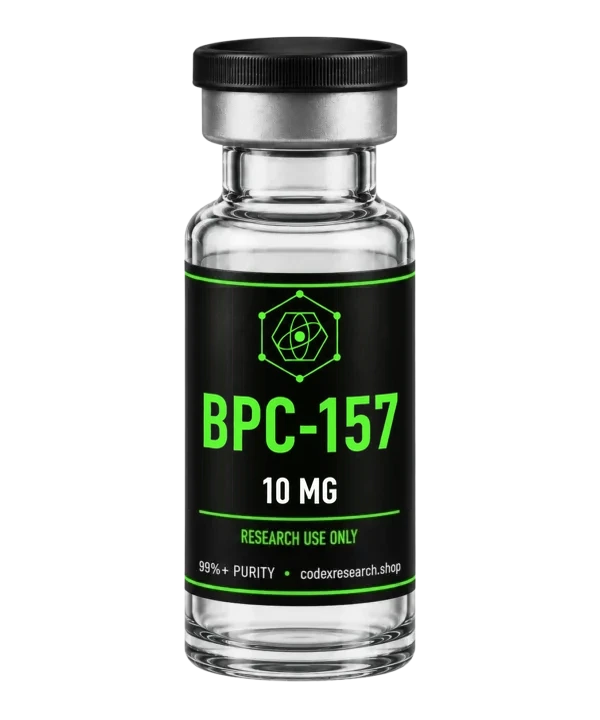
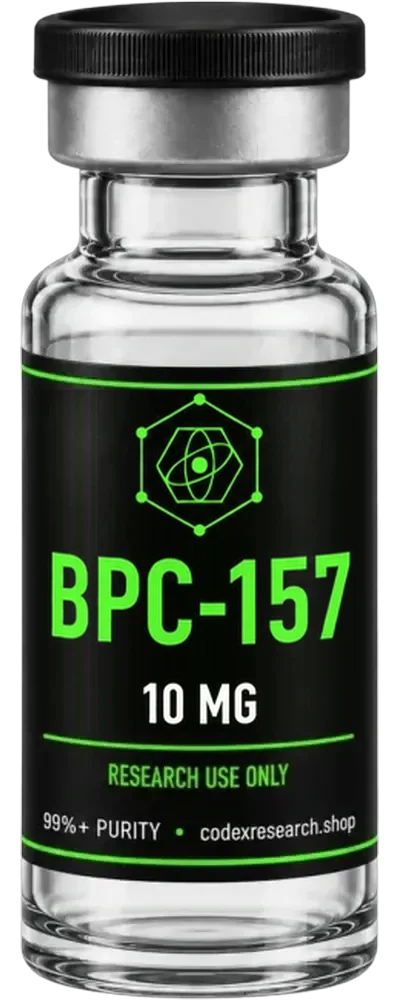
Where a lot's results have been fully reported, the Codex Research certificate lists endotoxin by LAL against a stated limit, together with sterility, HPLC purity, LC-MS identity and potency, for that specific lot. Our BPC-157 lot KIZN072426, for example, passed an endotoxin specification of ≤ 0.05 EU/mg alongside a sterility result of no growth. For what a complete certificate contains and how to verify it, read our guide on third-party testing, or contact info@codexresearch.shop for the certificate for any lot. What is GHK-Cu? shows a report that gives endotoxin as a number, 0.10 EU/mg, and BPC-157 vs TB-500 covers two peptides widely used in cell-based assays.
Frequently asked questions
What is endotoxin?
What is the difference between endotoxin and sterility testing?
What is the LAL test?
What are the different LAL methods?
What does EU/mg mean on a COA?
What is recombinant factor C (rFC)?
Can sterilizing a sample remove endotoxin?
Why does endotoxin matter in cell-based research?
Has endotoxin contamination ever misled published research?
What is endotoxin masking?
What is a good endotoxin result for a research peptide?
Why are endotoxin results sometimes reported as "less than"?
Does an endotoxin pass mean a compound is safe?
Do online peptide products always meet endotoxin limits?
How does Codex Research report endotoxin?
References
- Raetz CR, Whitfield C. Lipopolysaccharide endotoxins. Annu Rev Biochem. 2002;71:635-700.
- Levin J, Bang FB. The role of endotoxin in the extracellular coagulation of Limulus blood. Bull Johns Hopkins Hosp. 1964;115:265-274.
- U.S. FDA. Pyrogen and Endotoxins Testing: Questions and Answers. Guidance for Industry (revised March 2026).
- Dullah EC, Ongkudon CM. Current trends in endotoxin detection and analysis of endotoxin-protein interactions. Crit Rev Biotechnol. 2017;37(2):251-261.
- Maloney T, Phelan R, Simmons N. Saving the horseshoe crab: a synthetic alternative to horseshoe crab blood for endotoxin detection. PLoS Biol. 2018;16(10):e2006607.
- Piehler M, Roeder R, Blessing S, Reich J. Comparison of LAL and rFC assays: participation in a proficiency test program between 2014 and 2019. Microorganisms. 2020;8(3):418.
- Marius M, Vacher F, Bonnevay T. Comparison of bacterial endotoxin testing methods in purified pharmaceutical water matrices. Biologicals. 2020;67:49-55.
- Gao B, Tsan MF. Endotoxin contamination in recombinant human heat shock protein 70 (Hsp70) preparation is responsible for the induction of tumor necrosis factor alpha release by murine macrophages. J Biol Chem. 2003;278(1):174-179.
- Wakelin SJ, Sabroe I, Gregory CD, et al. "Dirty little secrets": endotoxin contamination of recombinant proteins. Immunol Lett. 2006;106(1):1-7.
- Schwarz H, Gornicec J, Neuper T, et al. Biological activity of masked endotoxin. Sci Rep. 2017;7:44750.
- Burgmaier L, Pölt S, Avci-Adali M, et al. The impact of LPS mutants on endotoxin masking in different detection systems. Biologicals. 2025;89:101808.
- Magalhães PO, Lopes AM, Mazzola PG, et al. Methods of endotoxin removal from biological preparations: a review. J Pharm Pharm Sci. 2007;10(3):388-404.
- Ashraf AR, Mackey TK, Vida RG, et al. Multifactor quality and safety analysis of semaglutide products sold by online sellers without a prescription. J Med Internet Res. 2024;26:e65440.


 From lab to your door