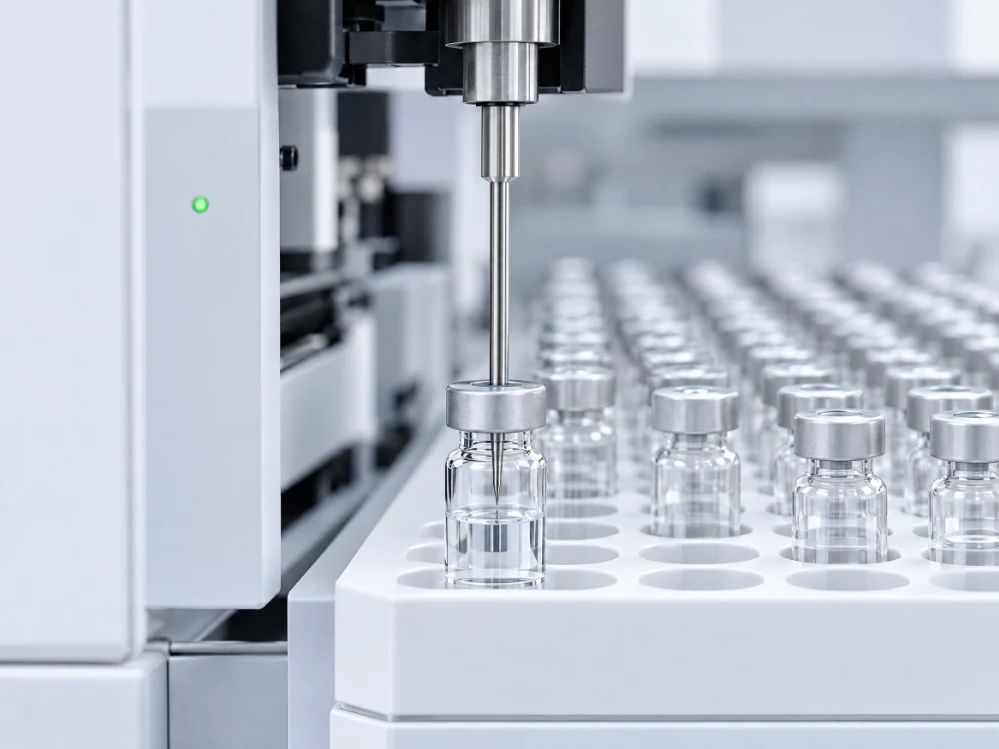
Free
Mostly removed
Free TFA
Unbound acid left over from processing. Volatile, so most of it is removed by freeze-drying.
(“tee-eff-AY”)
The acid that makes peptide purification work, and the reason many peptides arrive as TFA salts.
The short answer
TFA is trifluoroacetic acid, a strong, volatile acid used in peptide processing and purification that often remains in the finished powder as a salt.
TFA is used to release peptides from the resin they are built on and as an additive in reversed-phase HPLC, where it sharpens peaks. Free TFA evaporates during freeze-drying, but trifluoroacetate ions bound to the peptide’s positive charges stay, so the powder is a TFA salt. It can be exchanged for acetate or chloride, and the amount left can be measured.
Reviewed by the Codex Research quality teamUpdated Nov 8, 2026
Word study
Say it
tri·flu·o·ro·a·ce·tic ac·id
(“tee-eff-AY”)
Roots and origin
RootGreek
OriginLatin
OriginLatin
The name reads like a recipe: vinegar’s acid, acetic acid, with three of its hydrogens swapped for fluorine. That swap makes it thousands of times stronger as an acid.
Around the world
Tap a language to hear it spokenDefinition
TFA is trifluoroacetic acid, CF₃COOH: acetic acid with its three methyl hydrogens replaced by fluorine. The fluorines pull electrons away from the acid group, which makes TFA a far stronger acid than acetic acid. It is also volatile and mixes freely with water and organic solvents, which is why it is so useful in peptide work.
Peptide production leans on TFA twice. It is used to cut finished peptides off the solid support they are assembled on, and it is the standard acidic additive in reversed-phase HPLC purification, where it pairs with the peptide’s positive charges and gives sharp, well-separated peaks. A 2025 review of TFA in synthetic peptides describes it as the reagent the field relies on for both steps, with the result that peptides are obtained as TFA salts.
Most of the TFA leaves, but not all of it. Free, unbound acid evaporates during freeze-drying. Trifluoroacetate ions that are paired with positively charged groups, such as the N-terminus, lysine and arginine, are held much more tightly and stay in the powder. Studies on removing them note that this bound fraction is the hard part, and that peptides often carry more TFA than one per charge.
TFA can be exchanged out. The two common routes are replacing it with chloride by repeated dissolving and freeze-drying in dilute hydrochloric acid, studied in detail by Andrushchenko and colleagues, and replacing it with acetate by ion-exchange or chromatography with acetic acid, compared by Roux and colleagues. Each route needs checking afterwards, because exchange is rarely complete in one pass.
Whether TFA matters depends on the work. Reviews report that trifluoroacetate can interfere with some biological assays and with techniques such as infrared spectroscopy, which is why many researchers prefer acetate or hydrochloride salts. The practical point is simple: the salt form should be stated, and a “TFA-free” or “low TFA” claim should come with a measured result.
Forms
Unbound acid left over from processing. Volatile, so most of it is removed by freeze-drying.
TFA ions paired with the peptide’s positive charges. These stay through freeze-drying and make the powder a TFA salt.
TFA replaced by chloride, giving a hydrochloride salt. Often done by repeated freeze-drying from dilute HCl.
TFA replaced by acetate through ion exchange or chromatography with acetic acid.
For buyers
Bound TFA adds about 113 Da per charge, so a TFA salt holds less peptide per milligram than the label weight suggests.
Trifluoroacetate has been reported to interfere with some cell-based assays and spectroscopy, so the salt form is worth knowing.
TFA content can be quantified by ¹⁹F NMR, ion chromatography or IR. A claim without a number is just a claim.
At Codex Research
Each Codex Research product page carries a lot-matched certificate of analysis reporting HPLC purity and mass spectrometry identity for the lot in stock. For the salt form or TFA content of a specific lot, contact us.
See it live: the counter-ion guide in the glossary
Myth vs fact
Tap a card to flip it.
Watch for
Quick check
TFA, acetate or hydrochloride, stated plainly.
A residual TFA result if the material is called TFA-free.
Net peptide content accounts for TFA and water.
 Full walkthrough · JournalPeptide purity grades explained
Questions
Trifluoroacetic acid, used in processing and HPLC purification. Its ion often stays bound to the peptide, making a TFA salt.
Trifluoroacetate pairs with the peptide’s positive charges and is not removed by freeze-drying.
A peptide whose positive charges are balanced by trifluoroacetate ions.
By exchanging it for chloride or acetate, through repeated freeze-drying from dilute acid or ion exchange.
Commonly by fluorine NMR or ion chromatography; IR spectroscopy can also track it.
No. It is not a peptide peak. It affects net peptide content, not purity.
It should mean residual TFA was measured below a stated limit. Without a result, the claim cannot be checked.
Sources and standards
Written and reviewed by the Codex Research quality team · Last reviewed November 8, 2026 · For laboratory research use only.
On real products
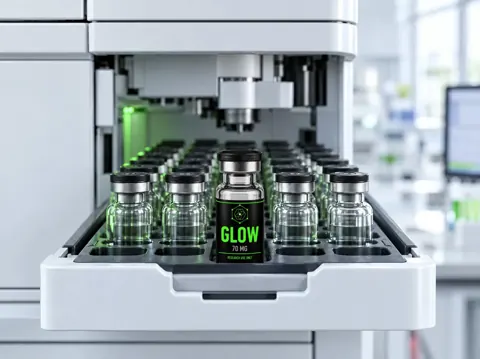
Every Codex peptide is synthesized, purified and freeze-dried before it is tested. See TFA on a real product, then read the full guide.
 Blends
Research peptide
Neuropeptide Research
A blend of Semax, an ACTH(4-7) analog, with Selank, a tuftsin analog. Both are seven-residue peptides from the same Russian design programme.
 Neuro
Research peptide
Neuropeptide Research
DSIP is a nine-residue peptide isolated from rabbits in the 1970s and named for the delta EEG pattern it produced, studied in neuropeptide research.
 Dermal
Research peptide
Melanocortin Research
Melanotan I is [Nle4,D-Phe7]-alpha-MSH, a 13-residue analog of alpha-MSH with high MC1R selectivity, the molecule later named afamelanotide.
Journal guidePeptide purity grades explainedRead the guideKeep going
 From lab to your door
U.S.-made research vials, shipped with lot-matched, lab-tested COAs you can scan straight off the label.

21+ Only
Codex Research provides research-grade compounds for laboratory and research use only. By entering, you confirm you are at least 21 and agree to our Terms & Conditions.
By proceeding you affirm the statements above are true. Products are supplied for laboratory research use only — not for human or veterinary use, not for use in diagnostic procedures, and not evaluated by the U.S. Food and Drug Administration. Full disclaimer.