−40 °C
Stage one
Freezing
The solution is cooled until it is completely solid, setting the structure the final cake will have. Slower or faster freezing changes the size of the ice crystals and the pores they leave.
(“lye-OFF-ih-lih-ZAY-shun”)
Why research peptides arrive as a powder and not a liquid.
The short answer
Lyophilization is a drying process that freezes a material and then lowers the pressure so the ice turns straight into vapor, leaving a dry, stable solid behind.
The process runs in three stages: freezing, primary drying, where ice sublimes under vacuum, and secondary drying, where the last bound water is driven off. Because nothing ever melts, the material is dried without heat damage, and the result is a light cake or powder that is far more stable than a solution.
Reviewed by the Codex Research quality teamUpdated Nov 8, 2026
Word study
Say it
ly·oph·i·li·za·tion
(“lye-OFF-ih-lih-ZAY-shun”)
Roots and origin
RootGreek
OriginGreek
Lyophilization literally means making something solvent-loving. The term was coined in the 1930s for a drying process whose product dissolves back almost instantly, because the open, sponge-like structure the ice leaves behind lets liquid flood back in.
Around the world
Tap a language to hear it spokenDefinition
Lyophilization, usually called freeze-drying, removes water from a material without ever letting it become liquid again. The material is dissolved, frozen solid, and then placed under a deep vacuum. With the pressure low enough, the ice does not melt as it warms; it turns directly into vapor, a change called sublimation, and the vapor is pulled away and frozen onto a cold condenser.
A cycle runs in three stages. In freezing, the solution is cooled until ice and solid material separate into a frozen structure. In primary drying, the chamber is pumped down and the shelves are gently warmed so the ice sublimes; this removes most of the water and is the longest step. In secondary drying, the temperature is raised further to drive off water still bound to the solid, which takes residual moisture down to a low level.
Temperature control matters throughout. Each formulation has a collapse temperature: warm the product above it during primary drying and the structure softens and slumps before it is dry. A well-run cycle keeps the product below that point, which is why it can take a day or more. The reward is a light, porous cake that holds its shape in the vial.
Peptides are freeze-dried because water is what drives most of their degradation. In solution, a peptide can hydrolyze, deamidate, oxidize or aggregate over days or weeks. Remove the water and those reactions slow dramatically, so the same material can be stored and shipped far longer. The trade-off is that a lyophilized powder is hygroscopic: it pulls moisture back from the air whenever it is exposed.
For a buyer, freeze-drying shows up in two places. The first is the vial itself, which should hold an intact, dry cake or powder. The second is the certificate of analysis, where a water content result, usually by Karl Fischer titration, shows how dry the lot actually is. Both say something about how carefully the material was made and handled.
The cycle
The solution is cooled until it is completely solid, setting the structure the final cake will have. Slower or faster freezing changes the size of the ice crystals and the pores they leave.
Under deep vacuum the shelves are warmed slightly and the ice sublimes. This removes the bulk of the water and takes the most time.
The temperature is raised to drive off water still bound to the solid. This sets the final residual moisture of the cake.
Vials are usually stoppered inside the chamber, often under dry nitrogen, before air is let back in, so the dried cake never meets humid air.
Interactive
Water can be solid, liquid or vapor depending on temperature and pressure. Below about 6 mbar, the pressure of water’s triple point, liquid water cannot exist at all, so warming ice turns it straight into vapor. Move the point to see which phase water takes, or jump to the conditions of a typical drying step.
Curves use standard vapor-pressure equations for ice and liquid water; the triple point is 0.01 °C and 6.1 mbar. Real freeze-drying runs below the product’s collapse temperature, often well below −20 °C during primary drying.
For buyers
Removing water slows the reactions that break peptides down, so a freeze-dried lot holds its quality far longer than a solution would.
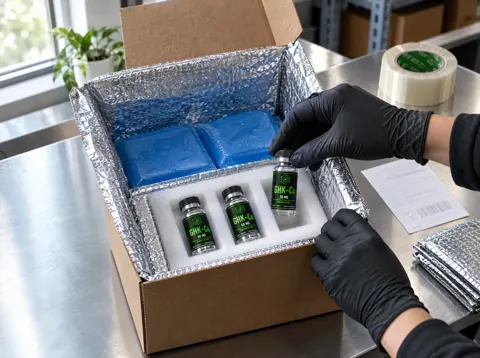
A dry powder tolerates the hours and days of normal transit much better than a liquid, which is why research peptides ship as solids.
An intact, dry cake is a quick visual check that the lot was dried and sealed properly before it reached you.
At Codex Research
Codex Research peptides ship as lyophilized solids in sealed vials, packed in an insulated mailer with ice packs and dispatched the same business day. The lot-matched certificate on each product page reports identity and HPLC purity for the lot in stock.
See it live: the BPC-157 product page
Myth vs fact
Tap a card to flip it.
Watch for
Quick check
It should be dry, intact and porous, not wet or melted.
The stopper and crimp should be tight and undamaged.
A Karl Fischer result on the COA shows how dry the lot is.
 Full walkthrough · JournalResearch peptides in transit: heat, cold and storage
Questions
Freeze-dried. The material was frozen and dried under vacuum so the ice turned straight into vapor, leaving a dry solid.
Water drives most peptide degradation. Removing it slows those reactions, so the dry powder stays stable far longer than a solution and is easier to ship.
The freeze-dried peptide. Its porous structure is left behind by the ice crystals that sublimed away during drying.
No. Freezing is only the first stage. Lyophilization then removes the ice by sublimation under vacuum, so the end product is dry, not frozen.
A typical cycle runs from about a day to several days, depending on the formulation, fill depth and equipment. Primary drying is usually the longest step.
A small amount. Secondary drying leaves residual moisture, and the hygroscopic powder can absorb more from the air, which is why water content is tested.
When the product warms above its collapse temperature during drying, the structure softens and shrinks before it is dry, leaving a dense or slumped cake.
Sources and standards
Written and reviewed by the Codex Research quality team · Last reviewed November 8, 2026 · For laboratory research use only.
On real products
Every Codex peptide is synthesized, purified and freeze-dried before it is tested. See lyophilization on a real product, then read the full guide.
 Cellular
Research peptide
Cellular Research
SS-31 (elamipretide) is a synthetic tetrapeptide that binds cardiolipin at the inner mitochondrial membrane, studied in bioenergetics and oxidative-stress research.
 Blends
Research peptide
Neuropeptide Research
A blend of Semax, an ACTH(4-7) analog, with Selank, a tuftsin analog. Both are seven-residue peptides from the same Russian design programme.
 Neuro
Research peptide
Neuropeptide Research
DSIP is a nine-residue peptide isolated from rabbits in the 1970s and named for the delta EEG pattern it produced, studied in neuropeptide research.
Journal guideResearch peptides in transit: heat, cold and storageRead the guideKeep going
 From lab to your door
U.S.-made research vials, shipped with lot-matched, lab-tested COAs you can scan straight off the label.

21+ Only
Codex Research provides research-grade compounds for laboratory and research use only. By entering, you confirm you are at least 21 and agree to our Terms & Conditions.
By proceeding you affirm the statements above are true. Products are supplied for laboratory research use only — not for human or veterinary use, not for use in diagnostic procedures, and not evaluated by the U.S. Food and Drug Administration. Full disclaimer.