The difference between 95% and 99% purity sounds small, but it means five times more impurity in the vial. This guide explains what a purity grade measures, what it leaves out, how impurities can distort laboratory results and how to judge a purity claim.
Key takeaways
- A purity percentage is the share of detected peptide material that is the target sequence, measured by reversed-phase HPLC. It is a ratio, not an amount.
- Small differences in the headline number are large differences in impurity: 95% purity allows five times as much impurity as 99%.
- Impurities are not inert. Documented cases show a contaminant at about 1% by weight producing false-positive results in a cell-based assay.
- Purity does not include water, salts or counter-ions, so a 99% pure lot can still hold noticeably less peptide by weight than the powder weight suggests.
- Independent studies have found stated purity grades that the material did not meet, so a grade is only as credible as the method, lot match and lab behind it.
ImportantResearch use only. This guide explains how peptide purity is measured and reported for laboratory research materials. It does not describe human or animal use. Codex Research compounds are not approved by the FDA and are sold for in-vitro laboratory research only.
Quick answer
A peptide purity grade is the percentage of the detected peptide material that is the intended sequence, measured by reversed-phase HPLC. The rest is mostly closely related impurities left by synthesis or degradation.
The grades are closer than they look on paper but further apart in practice: a 95% lot carries about 5% impurity, a 98% lot about 2%, and a 99% lot about 1%. That makes a 95% lot carry five times the impurity of a 99% lot. Purity also leaves out water, salts and counter-ions, so it is not the same as how much peptide is in the vial. A grade means the most when a lot-specific COA shows the method, the chromatogram and an independent lab behind it.
What a purity percentage actually measures
Purity is measured by separating a dissolved sample on a reversed-phase HPLC column and recording each component as a peak with a UV detector set near 214 nm, where the peptide bond absorbs light [6]. The result is calculated by area:
Purity (%) = main-peak area ÷ total area of all peptide peaks × 100
Three consequences follow from that definition:
- It is a ratio, not an amount. It tells you how much of the peptide is the intended molecule, not how many milligrams of target are present.
- It only counts what the detector sees. Water, inorganic salts and most counter-ions do not register at 214 nm.
- It depends on the separation. An impurity that elutes underneath the main peak is counted as target unless the lab checks peak purity with spectral or mass data [7].
For a detailed explanation of the method itself, see our guide to HPLC vs mass spectrometry.
Purity terms you will see on reports
| Term | Meaning |
|---|---|
| Area % | The share of total detected peak area belonging to the main peak. The usual basis of a purity figure. |
| Related impurity | An impurity structurally related to the target, such as a deletion sequence or an oxidized form. |
| Largest single impurity | The biggest individual impurity peak, a stricter measure than total impurity. |
| Total impurities | The sum of all impurity peaks; 100% minus area purity. |
| Specification | The acceptance limit the lot is judged against, such as "≥ 98.0%". |
| Peak purity | A check, using UV spectra or mass data, that the main peak contains only one component. |
| Net peptide content | The share of the powder's weight that is peptide rather than water or counter-ions. |
| Salt form | The counter-ion the peptide was isolated with, such as acetate or trifluoroacetate. |
Purity grades at a glance
Custom peptide synthesis has settled into a set of conventional purity tiers. Labs choose among them based on how sensitive the experiment is to minor components and how much purification cost is justified.
| Grade | Approximate impurity | Typical laboratory uses |
|---|---|---|
| Crude | Variable; often 30–70% | Initial screening of many sequences, where the result will be confirmed later |
| > 70–80% | 20–30% | Raising antibodies, early non-quantitative screens |
| > 85–90% | 10–15% | Semi-quantitative work such as some binding and blocking studies |
| > 95% | Up to 5% | Quantitative in-vitro assays, cell-based screening, chromatography standards |
| > 98% | Up to 2% | Sensitive cell-based work, receptor and enzyme studies, quantitative comparisons |
| > 99% | Up to 1% | Structural studies, analytical reference use, work where any minor component could confound results |
These tiers are conventions, not regulations. Nothing stops a supplier from labeling material with any number, which is why the evidence behind the number matters more than the tier.
Why 95% vs 99% is a bigger gap than it looks
Purity figures are usually read as "nearly 100%", which hides the meaningful number: how much of the material is not the target.
| Stated purity | Impurity share | Impurity in a 10 mg lot of peptide material | Impurity relative to a 99% lot |
|---|---|---|---|
| 99% | 1% | 0.1 mg | 1× |
| 98% | 2% | 0.2 mg | 2× |
| 97% | 3% | 0.3 mg | 3× |
| 95% | 5% | 0.5 mg | 5× |
| 90% | 10% | 1.0 mg | 10× |
Seen this way, moving from 95% to 99% is not a 4% improvement. It is an 80% reduction in impurity. For experiments where a minor component could produce a signal of its own, that is the difference that matters.
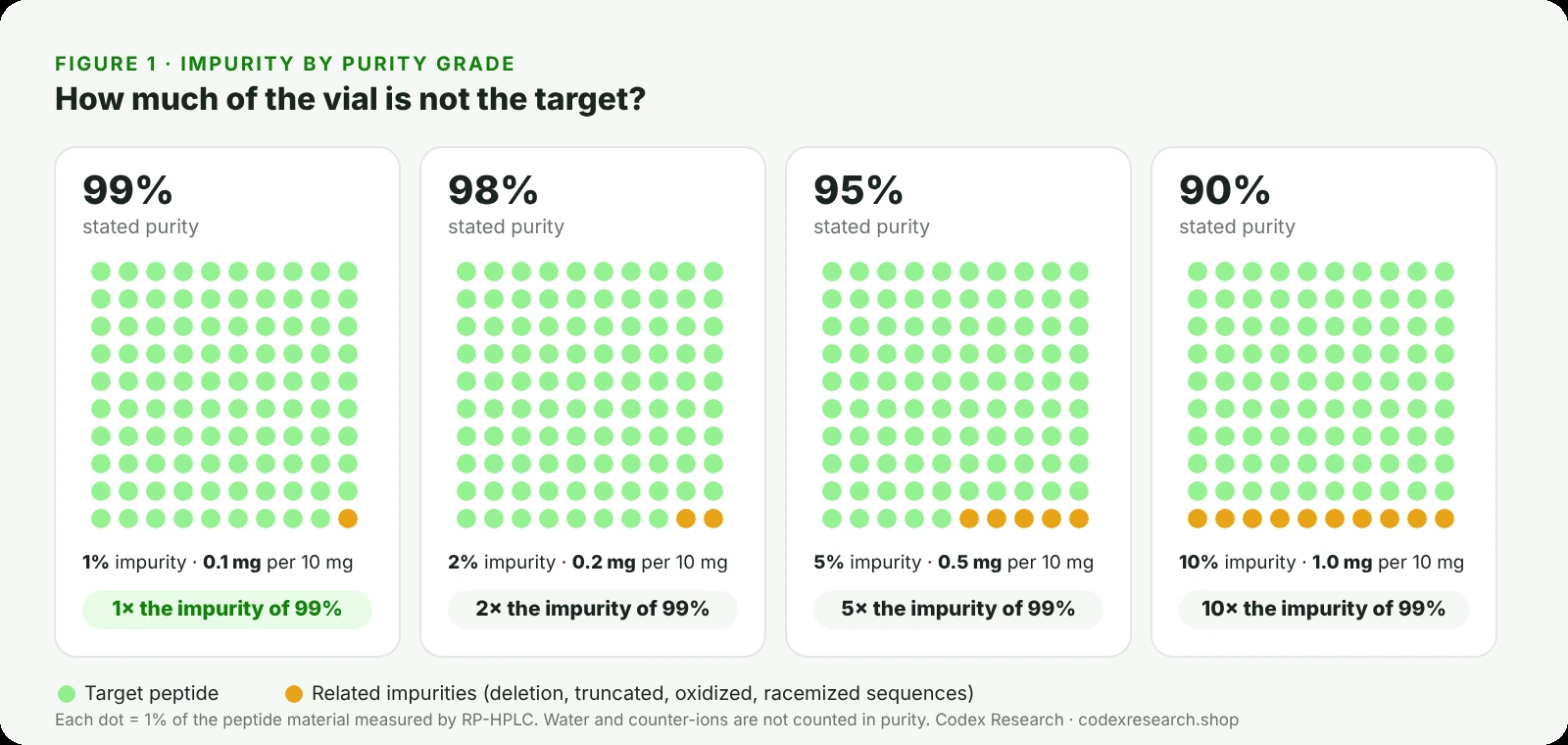
Figure 1. Each dot is 1% of the peptide material. Moving from 95% to 99% purity cuts the impurity from five dots to one.
What the impurities actually are
The impurities in a synthetic peptide are not random dirt. Most are close relatives of the target, created during solid-phase synthesis, cleavage, purification or storage [2]:
| Impurity | How it forms | Why it matters |
|---|---|---|
| Deletion sequences | An amino acid fails to couple during synthesis | A shorter peptide that may still bind or act |
| Insertion sequences | An amino acid couples twice | A longer variant of the target |
| Truncated sequences | Chain growth stops early | Fragments of the target |
| Protecting-group adducts | A side-chain protecting group is not fully removed | Altered chemistry and hydrophobicity |
| Racemized residues | An L-amino acid converts to its D-form | Same mass, different 3D shape |
| Oxidation | Methionine, cysteine or tryptophan reacts with oxygen | Can change structure and activity |
| Deamidation and cyclization | Asparagine, glutamine or aspartic acid rearranges, often during storage | Gradual change in the material over time |
Because these impurities share most of the target's structure, some can retain partial activity or interfere with the same assay the target is being used in. That is the core reason purity matters.
How impurities can distort research results
The cost of low purity is not just a smaller number on a report. Impurities have produced misleading results in published research:
- False-positive cell responses. Researchers at the U.S. Military HIV Research Program found that HIV-1 peptides bought from two independent custom suppliers contained contaminating peptides that produced false-positive results in a T-cell assay. In one case, the contaminant was a peptide from a different virus, present at about 1% by weight, enough to mimic a genuine response [4].
- Counter-ion effects. Peptides purified by HPLC are often supplied as trifluoroacetate (TFA) salts. TFA itself has been shown to reduce the proliferation of bone and cartilage cells in culture at nanomolar concentrations, enough to mask or reverse an experimental effect [5].
- Mismatched expectations. When researchers at Ghent University re-tested synthetic peptides ordered at 95% purity or higher, only 44% met the required purity, and in one case the main compound had a different structure from the one ordered [1].
The lesson from these cases is that a purity specification is only useful if it is both high enough for the experiment and true for the lot in use.
Purity is not potency: what else is in the vial
A lyophilized peptide powder contains more than peptide. Residual water and counter-ions from purification add weight without appearing as impurities on HPLC. That is why a COA reports several different measurements that are easy to confuse:
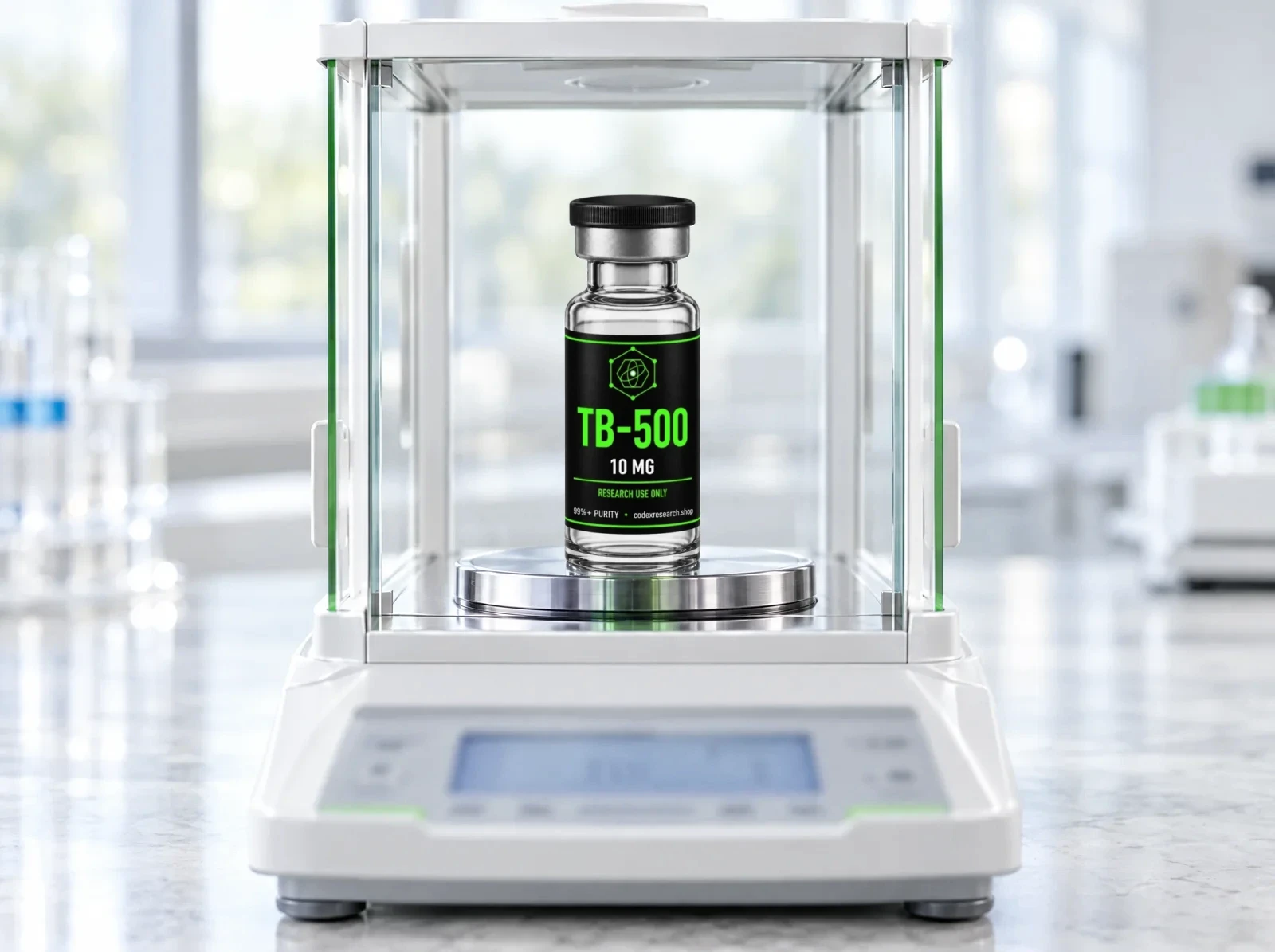
Peptide content is measured by weight and assay, separately from the HPLC purity ratio.
| Measurement | Question it answers | Typical method | Example |
|---|---|---|---|
| Purity | How much of the peptide is the intended molecule? | RP-HPLC area % | 99.23% |
| Potency / assay | How many mg of target peptide are present? | Quantitative HPLC against a standard | 4.85 mg in a 5 mg vial |
| Net peptide content | What share of the powder's weight is peptide? | Amino acid or nitrogen analysis | Often 70–90% |
| Counter-ion content | How much acetate, TFA or chloride is present? | Ion chromatography | Reported as % |
| Water content | How much moisture is in the powder? | Karl Fischer titration or water activity | % or aw |
A high-purity lot can therefore show potency slightly below the label amount. That is normal and expected for a lyophilized salt. What would be a red flag is a COA that reports purity but never addresses how much peptide is actually present.
How higher purity is achieved
Crude synthetic peptide is purified by preparative reversed-phase HPLC: the same separation used for analysis, scaled up so that fractions can be collected [6]. The fractions richest in the target are pooled and freeze-dried, and the pool is tested again.
Each step toward higher purity costs yield. Impurities that elute just before or after the main peak can only be removed by discarding the edges of the main peak along with them, so more of the target is lost as the purity target rises. Very difficult separations may need a second purification under different conditions. That is why 99% material costs more than 95% material, and why a very low price on a high-purity claim deserves a closer look.
Choosing a purity grade for an experiment
There is no single correct grade. Researchers weigh how sensitive the experiment is against the cost of purification:
| Factor | Points toward a higher grade | Points toward a lower grade may be acceptable |
|---|---|---|
| Assay sensitivity | Cell-based, receptor or enzyme assays that respond to small amounts | Coarse screens where only large effects are read |
| Quantitative vs qualitative | Results compared numerically across conditions or studies | Yes/no or ranking results |
| Reference use | The material is used as a standard or comparator | The material is the subject of a one-off screen |
| Consequence of a false result | A false positive would send follow-up work in the wrong direction | Hits will be re-tested with purer material anyway |
| Related-sequence activity | Truncated or modified forms of the sequence are known to be active | Fragments are known to be inactive |
Whatever grade is chosen, the most important habit is consistency: using the same specification, ideally from the same well-characterized lot, across an entire series of experiments, so that a change in results reflects the experiment rather than the material.
Why some sequences are harder to purify
Purity is not equally easy to reach for every peptide. Some sequences routinely produce more impurities during synthesis, or impurities that sit closer to the main peak [2, 6]:
| Sequence feature | Why it complicates purity |
|---|---|
| Length | Every coupling step has a small failure rate, so longer chains accumulate more deletion sequences. |
| Hydrophobic stretches | Chains can aggregate on the synthesis resin, causing incomplete couplings. |
| Aspartic acid followed by glycine | Prone to aspartimide formation, which creates same-mass and near-mass by-products. |
| Methionine, cysteine or tryptophan | Easily oxidized during cleavage, purification or storage. |
| Asparagine or glutamine | Can deamidate over time, creating impurities that grow after testing. |
| Many repeated residues | Deletion of one repeat produces impurities that separate poorly from the target. |
This is why a 99% result means more for a long or difficult sequence than for a short, simple one, and why some suppliers quote lower standard grades for difficult peptides.
Purity describes the lot on the test date
Peptides can change chemically over time through reactions such as oxidation and deamidation [2]. A purity result therefore describes the lot on the date it was tested. A report dated long before a lot was sold, or one that never changes across orders, tells you less about the material in your vial than a recent, lot-matched certificate.
Common misconceptions about purity
| Misconception | Reality |
|---|---|
| "99% pure means 99% of the powder is peptide." | Purity counts only peptide material. Water and counter-ions are excluded, so peptide content by weight is lower. |
| "98% and 99% are basically the same." | A 98% lot carries twice the impurity of a 99% lot. |
| "A high purity number confirms the right compound." | Purity cannot identify the main peak. Identity needs mass spectrometry. |
| "Purity covers contamination." | Endotoxin, sterility and microbial limits are separate tests. |
| "Every lab would report the same purity." | Results depend on column, gradient, wavelength and integration. The method must be stated. |
| "A grade on the label is proof." | Only a lot-matched certificate from an identifiable lab is evidence. |
| "Pharmaceutical grade means drug quality." | The term has no defined meaning for research peptides. |
How reliable are stated purity grades?
Independent testing shows that stated grades and measured grades do not always match, particularly in loosely regulated online markets:
- In the Ghent University study above, more than half of the research peptides tested fell short of the purity they were ordered at [1].
- A 2024 study that bought semaglutide vials from illegal online pharmacies found measured purity of only 7.7% to 14.37%, against the 99% printed on the labels, along with endotoxin in every sample [8].
- A study of somatropin products bought from websites selling without prescription found that every sample contained significantly less active substance than labeled [9].
These are not research peptide suppliers in every case, but they show the same pattern: a number on a label is not evidence. The evidence is a lot-specific certificate from a laboratory that can be identified and checked.
How drug standards treat purity
Approved peptide medicines are not judged by a single purity percentage. Regulators control individual impurities, because one unknown impurity at 1% can matter more than several known ones at 0.2% each [3]. For certain synthetic peptide drug applications, FDA guidance expects any peptide-related impurity at 0.10% of the drug substance or more to be identified, and limits any new specified impurity to 0.5% [10].
Research materials are not drugs and are not held to these standards. The benchmark is still useful, because it shows what careful impurity control looks like: identified impurities, individual limits and validated methods [11], rather than a single rounded number.
How to judge a purity claim
Use this checklist whenever you see a purity grade:
- Is there a lot-specific COA? The lot number on the report must match the vial.
- Is the method named? Look for reversed-phase HPLC, ideally with the detection wavelength.
- Is there a specification and a result? "≥ 98.0%" is the target; the measured value, such as 99.23%, is the result.
- Is the chromatogram or peak table shown? The number should be traceable to data.
- Is identity confirmed separately? Purity cannot tell you the main peak is the right molecule; mass spectrometry can.
- Who tested it? An independent laboratory, ideally accredited to ISO/IEC 17025, has no stake in the result [12].
| Claim | Stronger evidence | Weaker evidence |
|---|---|---|
| "99% pure" | COA for the same lot: RP-HPLC 99.2%, chromatogram attached | Purity stated only on the label or product page |
| "≥ 98%" | Specification plus measured result | Specification only, no measured value |
| "Lab tested" | Named lab, report ID, test date | No lab name or contact details |
| "HPLC verified" | Method, wavelength and peak table | A single percentage with no data |
| "Pharmaceutical grade" | Not a defined term for research peptides | Used as a marketing phrase |
What a purity grade does not tell you
A purity grade describes the composition of a research material at the time it was tested. It does not describe how a compound behaves in any organism, establish safety or effectiveness for any use, or account for degradation after the vial leaves the laboratory. Research compounds are not approved by the FDA for human or veterinary use.
How Codex Research handles purity
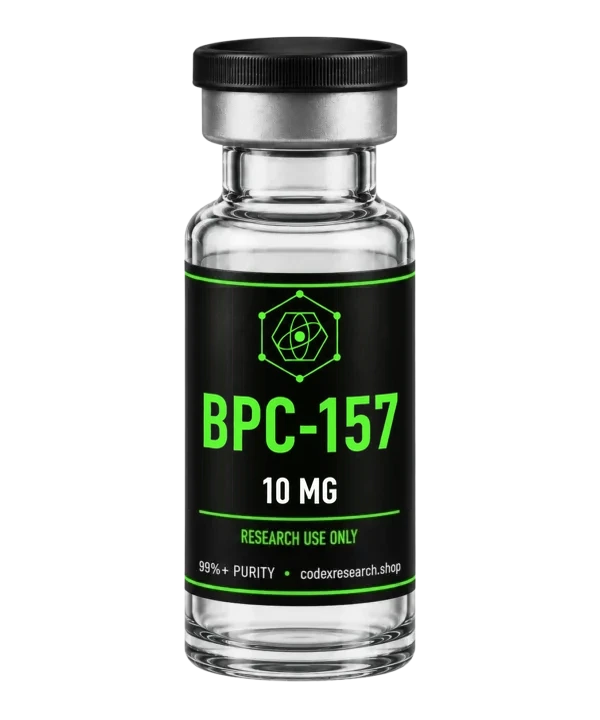
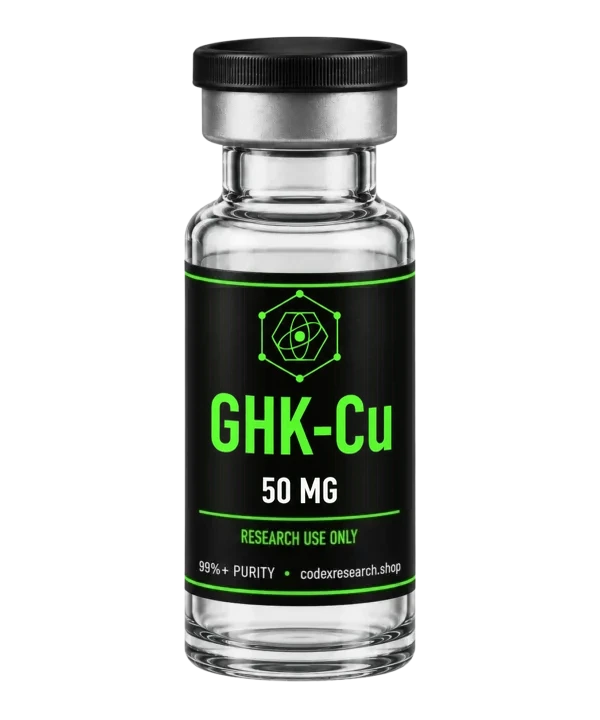
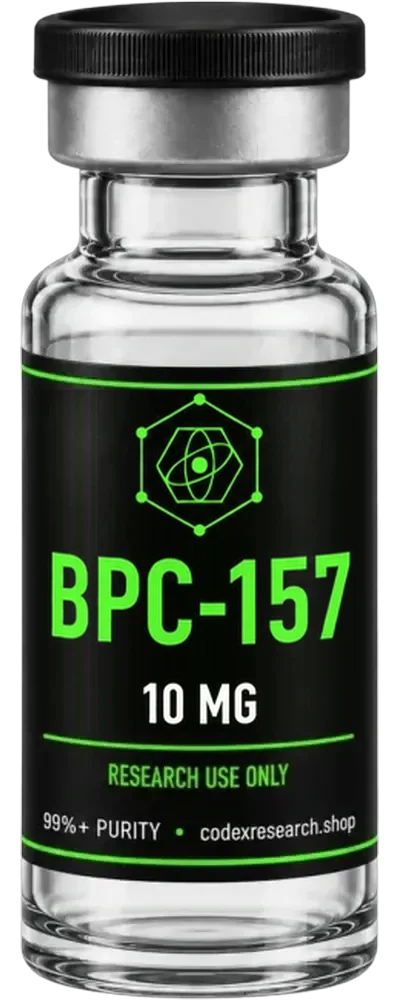
Published Codex Research certificates judge purity against a specification of 98.0% or higher by reversed-phase HPLC. Full reports also confirm identity by LC-MS and add potency, endotoxin, sterility and microbial results. Our BPC-157 lot KIZN072426, for example, measured 99.23% purity. Where a lot's results have been reported, the product page shows its measured purity and the full certificate for that lot. To check a certificate with the lab that issued it, read our guide on third-party testing, or contact info@codexresearch.shop for the certificate for any lot. For single-compound examples, our profiles of BPC-157 and GHK-Cu walk through the results for each current lot.
Frequently asked questions
What does peptide purity mean?
Is 95% peptide purity good enough?
What is the difference between 98% and 99% purity?
Does 99% purity mean the vial is 99% peptide?
What is the difference between purity and potency?
What are the impurities in a synthetic peptide?
Can a 1% impurity really affect an experiment?
Why do higher purity peptides cost more?
What does "≥ 98%" mean on a COA?
Is a purity claim of "99%+" trustworthy?
Can a peptide be 99% pure and still be the wrong compound?
Do purity grades include endotoxin or bacterial contamination?
Why might two labs report different purity for the same lot?
What purity are pharmaceutical peptides held to?
What purity does Codex Research test to?
References
- Verbeke F, Wynendaele E, Braet S, D’Hondt M, De Spiegeleer B. Quality evaluation of synthetic quorum sensing peptides used in R&D. J Pharm Anal. 2015;5(3):169-181.
- D’Hondt M, Bracke N, Taevernier L, et al. Related impurities in peptide medicines. J Pharm Biomed Anal. 2014;101:2-30.
- Vergote V, Burvenich C, Van de Wiele C, De Spiegeleer B. Quality specifications for peptide drugs: a regulatory-pharmaceutical approach. J Pept Sci. 2009;15(11):697-710.
- Currier JR, Galley LM, Wenschuh H, et al. Peptide impurities in commercial synthetic peptides and their implications for vaccine trial assessment. Clin Vaccine Immunol. 2008;15(2):267-276.
- Cornish J, Callon KE, Lin CQ, et al. Trifluoroacetate, a contaminant in purified proteins, inhibits proliferation of osteoblasts and chondrocytes. Am J Physiol. 1999;277(5):E779-E783.
- Mant CT, Chen Y, Yan Z, et al. HPLC analysis and purification of peptides. Methods Mol Biol. 2007;386:3-55.
- Lincoln D, Fell AF, Anderson NH, England D. Assessment of chromatographic peak purity of drugs by multivariate analysis of diode-array and mass spectrometric data. J Pharm Biomed Anal. 1992;10(10-12):837-844.
- Ashraf AR, Mackey TK, Vida RG, et al. Multifactor quality and safety analysis of semaglutide products sold by online sellers without a prescription: market surveillance, content analysis, and product purchase evaluation study. J Med Internet Res. 2024;26:e65440.
- Vida RG, Fittler A, Mikulka I, et al. Availability and quality of illegitimate somatropin products obtained from the Internet. Int J Clin Pharm. 2017;39(1):78-87.
- U.S. FDA. ANDAs for Certain Highly Purified Synthetic Peptide Drug Products That Refer to Listed Drugs of rDNA Origin. Guidance for Industry, May 2021.
- U.S. FDA / ICH. Q2(R2) Validation of Analytical Procedures. Guidance for Industry, March 2024.
- ISO/IEC 17025:2017. General requirements for the competence of testing and calibration laboratories.


 From lab to your door