+0.98 Da
Normal form
Aspartic acid (Asp)
The ring opens on one side and the residue becomes ordinary aspartic acid: same backbone, new negative charge.
(“dee-am-ih-DAY-shun”)
A one-dalton change that can quietly turn part of a lot into something else.
The short answer
Deamidation is a slow chemical reaction in which the side chain of asparagine, or more slowly glutamine, loses its amide group and becomes an acidic residue.
In deamidation, an asparagine side chain usually folds back to form a short-lived ring called a succinimide, which then opens to give aspartic acid or its isomer, isoaspartic acid. The mass rises by about 0.98 Da and a negative charge appears. The rate depends strongly on the neighboring residue, pH, temperature and water, and asparagine followed by glycine is the fastest.
Reviewed by the Codex Research quality teamUpdated Nov 8, 2026
Word study
Say it
de·am·i·da·tion
(“dee-am-ih-DAY-shun”)
Roots and origin
RootLatin
Origin
Deamidation means taking the amide away. The amide group on an asparagine or glutamine side chain leaves as ammonia, and what remains is the acid it came from.
Around the world
Tap a language to hear it spokenDefinition
Deamidation is one of the most common chemical changes in peptides and proteins. The side chain of asparagine, and much more slowly glutamine, loses its amide group as ammonia and becomes a carboxylic acid. The residue is now aspartic acid or glutamic acid, or an isomer of them, and the peptide carries an extra negative charge.
For asparagine, the main route runs through a ring. The nitrogen of the next peptide bond attacks the side chain and forms a five-membered succinimide, releasing ammonia. Water then opens the ring in one of two ways, giving normal aspartic acid or isoaspartic acid, in which the backbone runs through the side chain. Work in the 1980s on model peptides showed that the same succinimide intermediate also drives isomerization and racemization at these residues.
The neighbor matters most. When the residue after asparagine is small and flexible, especially glycine, the ring forms easily and deamidation is fast. Systematic measurements of hundreds of asparagine sequences in model peptides found rates spanning a wide range, with Asn-Gly the fastest. In folded proteins, three-dimensional structure usually slows the reaction.
Conditions decide the rest. Deamidation runs faster at neutral to basic pH, at higher temperature and in solution. In a dry, freeze-dried solid it is much slower, though residual water still allows it to continue. This is one reason peptides are stored dry and cold.
Detecting deamidation takes care. The mass rises by only about 0.98 Da, which a high-resolution mass spectrometer resolves but a low-resolution one may blur into the isotope pattern. The added charge usually changes HPLC retention, so deamidated forms often appear as separate peaks. Aspartic and isoaspartic forms have the same mass and need a good separation to tell apart.
Products
The ring opens on one side and the residue becomes ordinary aspartic acid: same backbone, new negative charge.
The ring opens the other way and the backbone now runs through the side chain. Usually the larger share of the product.
The short-lived ring intermediate. It has lost ammonia but not yet gained water, so its mass is about 17 Da lower than the starting peptide.
The same change at glutamine, giving glutamic acid. Usually far slower than at asparagine.
The succinimide can also flip the residue’s stereochemistry, giving D-Asp or D-isoAsp with no change in mass.
For buyers
A deamidated peptide has a different charge and, for isoAsp, a different backbone. It is no longer the stated sequence.
A shift of under one dalton can hide in the isotope pattern. Good separation and high resolution are needed to see it.
Water, warmth and pH drive the reaction, so dry, cold storage is the main way to keep it in check.
At Codex Research
Codex Research peptides ship as freeze-dried solids in sealed vials with ice packs, dispatched the same business day. Each product page carries a lot-matched certificate reporting HPLC purity and mass spectrometry identity for the lot in stock.
See it live: the degradation guide in the glossary
Myth vs fact
Tap a card to flip it.
Watch for
Quick check
Look for Asn, especially Asn-Gly.
Dry, sealed and cold.
No new peak growing beside the main one.
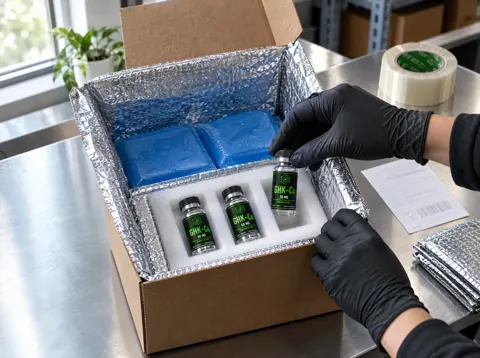 Full walkthrough · JournalResearch peptides in transit: heat, cold and storage
Questions
A chemical change in which asparagine or glutamine loses its side-chain amide and becomes an acidic residue.
Asparagine followed by a small, flexible residue, especially glycine (Asn-Gly).
An increase of about 0.98 Da.
An isomer of aspartic acid formed during deamidation, in which the peptide backbone runs through the side chain.
A short-lived five-membered ring that forms when the next backbone nitrogen attacks the asparagine side chain.
By keeping the peptide dry, cold and sealed, since water, warmth and higher pH all speed it up.
By HPLC, where the deamidated forms often separate from the main peak, and by high-resolution mass spectrometry.
Sources and standards
Written and reviewed by the Codex Research quality team · Last reviewed November 8, 2026 · For laboratory research use only.
On real products
Every Codex vial ships freeze-dried, sealed and lot-labelled. See how deamidation applies on a real product, then read the full guide.
 Cellular
Research peptide
Hormonal Research
Oxytocin is a nine-residue cyclic peptide closed by a Cys1-Cys6 disulfide, the first polypeptide hormone ever synthesised, studied at the OXTR receptor.
 Repair
Research peptide
Immune Research
LL-37 is the only human cathelicidin peptide, a 37-residue amphipathic helix released from the hCAP-18 precursor encoded by the CAMP gene.
 Repair
Research peptide
Immune Research
Thymosin alpha-1 is a 28-residue acetylated peptide isolated from calf thymus in 1977 and generated from prothymosin alpha, studied in T-cell biology.
Journal guideResearch peptides in transit: heat, cold and storageRead the guideKeep going
 From lab to your door
U.S.-made research vials, shipped with lot-matched, lab-tested COAs you can scan straight off the label.

21+ Only
Codex Research provides research-grade compounds for laboratory and research use only. By entering, you confirm you are at least 21 and agree to our Terms & Conditions.
By proceeding you affirm the statements above are true. Products are supplied for laboratory research use only — not for human or veterinary use, not for use in diagnostic procedures, and not evaluated by the U.S. Food and Drug Administration. Full disclaimer.