
Low
Stable in air
Non-hygroscopic
Takes up essentially no water at ordinary humidity. Many crystalline solids behave this way.
(“hy-gruh-SKOP-ik”)
Why a vial of powder can gain weight just by being opened.
The short answer
Hygroscopic describes a material that draws water vapor out of the surrounding air and holds it.
Freeze-dried peptides are porous, largely amorphous and very dry, so they readily take up moisture whenever they meet air. The amount depends on the humidity, the time exposed and the material itself. Absorbed water adds weight that is not peptide and speeds up chemical degradation, which is why dry handling and sealed storage matter.
Reviewed by the Codex Research quality teamUpdated Nov 8, 2026
Word study
Say it
hy·gro·scop·ic
(“hy-gruh-SKOP-ik”)
Roots and origin
RootGreek
OriginGreek
The word first named the hygroscope, an instrument that shows changes in humidity. Its meaning shifted to the materials such instruments relied on: substances that respond to moisture in the air by absorbing it.
Around the world
Tap a language to hear it spokenDefinition
A hygroscopic material takes up water vapor from the air around it. Table salt that clumps on a humid day and sugar that hardens in an open bag are everyday examples. Freeze-dried peptides are strongly hygroscopic: they are dried to a low water content, have a large porous surface and are often largely amorphous, all of which makes them pull moisture in quickly.
How much water a powder takes up depends mainly on the relative humidity and on time. At any humidity a material has an equilibrium water content; exposed to air, it moves toward that point, quickly at first and then more slowly. Higher humidity means a higher equilibrium and faster uptake. Each material has its own curve, called a moisture sorption isotherm.
Absorbed water matters in two ways. First, it adds weight that is not peptide, so the same milligram of powder holds less peptide than before. Second, water speeds up chemical degradation in the solid state. Reviews of solid-state stability describe water acting as a reactant, as a medium and as a plasticizer that increases molecular mobility, all of which accelerate reactions such as deamidation and hydrolysis.
Temperature changes add a trap. A vial taken straight from a refrigerator or freezer is colder than the room, so moisture can condense on and inside it if it is opened while still cold. Letting a sealed vial reach room temperature before opening it, and resealing it promptly, limits how much water the powder can pick up.
Water content is measured rather than guessed, most often by Karl Fischer titration. A low water result on a certificate shows how dry the lot was when tested; sealed packaging and dry, cold storage keep it close to that value afterwards.
Interactive
Set the room’s humidity and how long the powder is exposed. Water content climbs fastest at first, then levels off toward a point set by the humidity.
A teaching model, not data for any specific peptide: the powder starts at 3% water and moves toward an equilibrium set by the room’s humidity, quickly at first and then more slowly. Real uptake depends on the peptide, its salt form, the cake’s structure and the temperature, which is why water is measured, usually by Karl Fischer titration.
Degrees
Takes up essentially no water at ordinary humidity. Many crystalline solids behave this way.
Gains a small amount of water at high humidity. Usually manageable with normal closed storage.
Gains appreciable water at normal humidity within minutes to hours. Freeze-dried peptides typically fall here or above.
Gains a lot of water quickly and may become sticky or lose its structure.
Absorbs so much water that it dissolves into a liquid above a critical humidity.
For buyers
Every point of absorbed water is weight in the vial that is not peptide, which affects any calculation based on weight.
Moisture increases molecular mobility and takes part in reactions such as deamidation and hydrolysis.
Sealed vials, dry storage and brief exposure keep water content close to what the certificate reported.
At Codex Research
Codex Research peptides ship as freeze-dried solids in sealed vials, packed with ice packs in an insulated mailer and dispatched the same business day. Each product page carries a lot-matched certificate of analysis for the lot in stock.
See it live: the Karl Fischer titration guide in the glossary
Myth vs fact
Tap a card to flip it.
Watch for
Quick check
Dry and free-flowing, not clumped or sticky.
Intact stopper and crimp.
A Karl Fischer result on the COA.
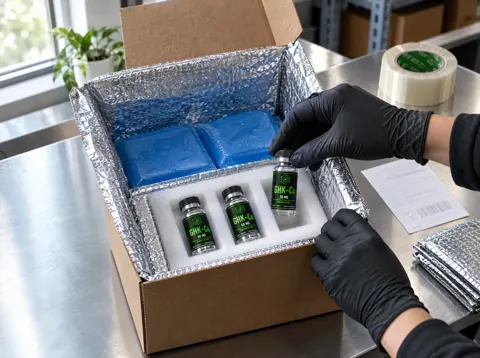 Full walkthrough · JournalResearch peptides in transit: heat, cold and storage
Questions
That a material absorbs water vapor from the surrounding air.
Freeze-dried peptides typically are, because they are very dry, porous and often largely amorphous.
It adds weight that is not peptide and speeds up chemical degradation in the solid state.
Most often by Karl Fischer titration.
Because a cold vial opened in warmer, humid air can collect condensation.
The extreme case, where a material absorbs so much water that it dissolves into a liquid.
A curve showing how much water a material holds at equilibrium across a range of humidities.
Sources and standards
Written and reviewed by the Codex Research quality team · Last reviewed November 8, 2026 · For laboratory research use only.
On real products
Every Codex vial ships freeze-dried, sealed and lot-labelled. See how hygroscopic applies on a real product, then read the full guide.
 Metabolic
Research peptide
Metabolic Research
Cagrilintide is a lipidated amylin analog that acts at the AMY1-3 receptors and the calcitonin receptor, studied in calcitonin-family GPCR pharmacology.
 Dermal
Research peptide
Dermal Research
SNAP-8 is an eight-amino-acid peptide modelled on the SNAP-25 N-terminus, studied in SNARE-complex assembly research.
 Repair
Research peptide
Tissue-Repair Research
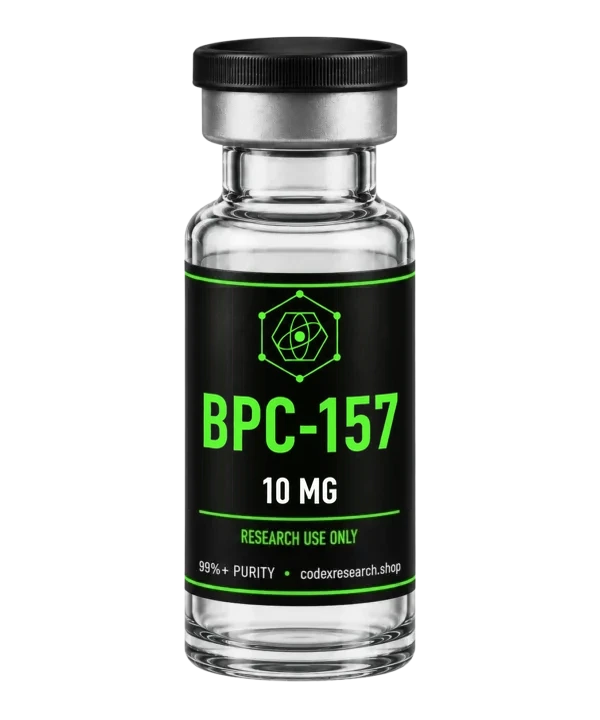
BPC-157 is a 15-amino-acid synthetic peptide taken from a gastric-juice protein, studied in endothelial, fibroblast and growth-factor research. Lot-tested by HPLC and LC-MS.
Journal guideResearch peptides in transit: heat, cold and storageRead the guideKeep going
 From lab to your door
U.S.-made research vials, shipped with lot-matched, lab-tested COAs you can scan straight off the label.

21+ Only
Codex Research provides research-grade compounds for laboratory and research use only. By entering, you confirm you are at least 21 and agree to our Terms & Conditions.
By proceeding you affirm the statements above are true. Products are supplied for laboratory research use only — not for human or veterinary use, not for use in diagnostic procedures, and not evaluated by the U.S. Food and Drug Administration. Full disclaimer.


