
Class 1
Benzene · 2 ppm
Class 1: avoid
Known or strongly suspected carcinogens and environmental hazards. Should not be used unless strongly justified, with very low limits.
(“rih-ZID-yoo-ul SOL-vents”)
What is left behind once the liquids used in making a material are gone.
The short answer
Residual solvents are traces of the organic solvents used during manufacture or purification that remain in the finished material after drying.
Solvents such as acetonitrile, methanol or ethyl acetate are used throughout chemical manufacturing and purification, and drying removes most but never all of them. ICH Q3C sorts common solvents into three classes by risk and sets limits, usually in parts per million. Residual solvents are measured by gas chromatography, most often headspace GC.
Reviewed by the Codex Research quality teamUpdated Nov 8, 2026
Word study
Say it
re·sid·u·al sol·vents
(“rih-ZID-yoo-ul SOL-vents”)
Roots and origin
RootLatin
OriginLatin
A residual solvent is literally the dissolving liquid that stayed behind. Pharmacopeias first called them organic volatile impurities, which says the same thing from the testing side: volatile chemicals that should have left but did not.
Around the world
Tap a language to hear it spokenDefinition
Residual solvents are the traces of organic solvents that remain in a material after it has been made, purified and dried. FDA guidance based on ICH Q3C defines them as organic volatile chemicals used or produced in the manufacture of drug substances or excipients, or in the preparation of drug products, that are not completely removed by practical manufacturing techniques.
ICH Q3C sorts common solvents into three classes by risk. Class 1 solvents, such as benzene and carbon tetrachloride, should be avoided altogether. Class 2 solvents, such as acetonitrile, methanol, dichloromethane and N,N-dimethylformamide, are limited to set concentrations. Class 3 solvents, such as ethanol, acetone and acetic acid, are of lower risk, and amounts up to 5,000 ppm, or 0.5%, are considered acceptable without further justification.
Limits are expressed in parts per million by weight. For Class 2 solvents the guideline gives a permitted daily exposure and a matching concentration limit: 410 ppm for acetonitrile, 3,000 ppm for methanol, 600 ppm for dichloromethane and 880 ppm for N,N-dimethylformamide. The lists are maintained over time, and newer revisions have added solvents as safety data became available.
Because solvents are volatile, they are measured by gas chromatography. In headspace GC, the sample is sealed in a vial and warmed so that solvents move into the gas above it, and that gas is injected into the instrument. Each solvent appears as its own peak and is quantified against a standard, which makes the method both specific and sensitive.
Residual solvents also add weight that is not peptide. Together with water and counter-ions, they are part of the non-peptide fraction of a powder. A certificate that reports residual solvents should name which solvents were tested, the method, and the result or limit for each.
By class
Known or strongly suspected carcinogens and environmental hazards. Should not be used unless strongly justified, with very low limits.
Solvents with a permitted daily exposure. Each has its own concentration limit, from a few ppm to several thousand.
Solvents of low toxic potential. Up to 5,000 ppm (0.5%) is acceptable without justification.
Solvents with insufficient data for a limit. Manufacturers justify any residual levels themselves.
For buyers
Practical drying never removes every trace of solvent. The question is which ones remain, and how much.
A level that is fine for ethanol can be far too high for acetonitrile. The solvent’s name matters as much as the number.
Residual solvent, like water and counter-ions, is weight in the vial that is not peptide.
At Codex Research
Each Codex Research product page carries a lot-matched certificate of analysis reporting HPLC purity and mass spectrometry identity for the lot in stock.
See it live: the net peptide content guide in the glossary
Myth vs fact
Tap a card to flip it.
Watch for
Quick check
Which solvents were tested, by name.
Results and limits in ppm.
Usually headspace gas chromatography.
 Full walkthrough · JournalPeptide purity grades explained
Questions
Traces of organic solvents left in a material after manufacture and drying.
Class 1 solvents should be avoided, Class 2 are limited to set concentrations, and Class 3 are low risk with limits up to 5,000 ppm.
By gas chromatography, usually headspace GC, which samples the vapor above a warmed sample.
ICH Q3C lists 410 ppm for acetonitrile, a Class 2 solvent.
Parts per million by weight: 1,000 ppm equals 0.1%.
Not usually. TFA in a peptide is mostly bound as a counter-ion and is measured by other methods.
No. Research certificates often focus on identity and purity; residual solvents are reported when tested or requested.
Sources and standards
Written and reviewed by the Codex Research quality team · Last reviewed November 8, 2026 · For laboratory research use only.
On real products
The current certificates for these products report a residual solvents result for the lot in stock. See it on each product page, then read the full guide.
 Cellular
Research peptide
Cellular Research
SS-31 (elamipretide) is a synthetic tetrapeptide that binds cardiolipin at the inner mitochondrial membrane, studied in bioenergetics and oxidative-stress research.
 Repair
Research peptide
Immune Research
Thymosin alpha-1 is a 28-residue acetylated peptide isolated from calf thymus in 1977 and generated from prothymosin alpha, studied in T-cell biology.
 Repair
Research peptide
Tissue-Repair Research
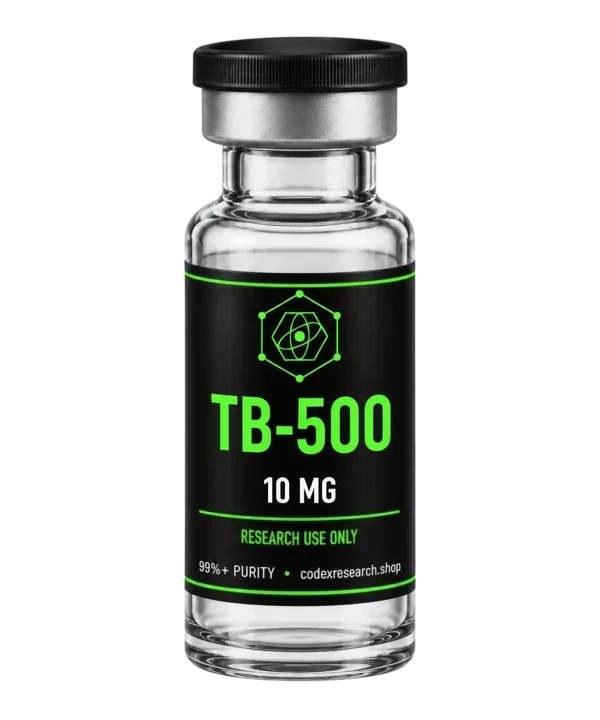
TB-500 is Ac-LKKTETQ, the acetylated actin-binding fragment of Thymosin Beta-4 (residues 17–23), supplied as a lyophilized peptide for actin-regulation and cell-migration research.
Journal guidePeptide purity grades explainedRead the guideKeep going
 From lab to your door
U.S.-made research vials, shipped with lot-matched, lab-tested COAs you can scan straight off the label.

21+ Only
Codex Research provides research-grade compounds for laboratory and research use only. By entering, you confirm you are at least 21 and agree to our Terms & Conditions.
By proceeding you affirm the statements above are true. Products are supplied for laboratory research use only — not for human or veterinary use, not for use in diagnostic procedures, and not evaluated by the U.S. Food and Drug Administration. Full disclaimer.


