

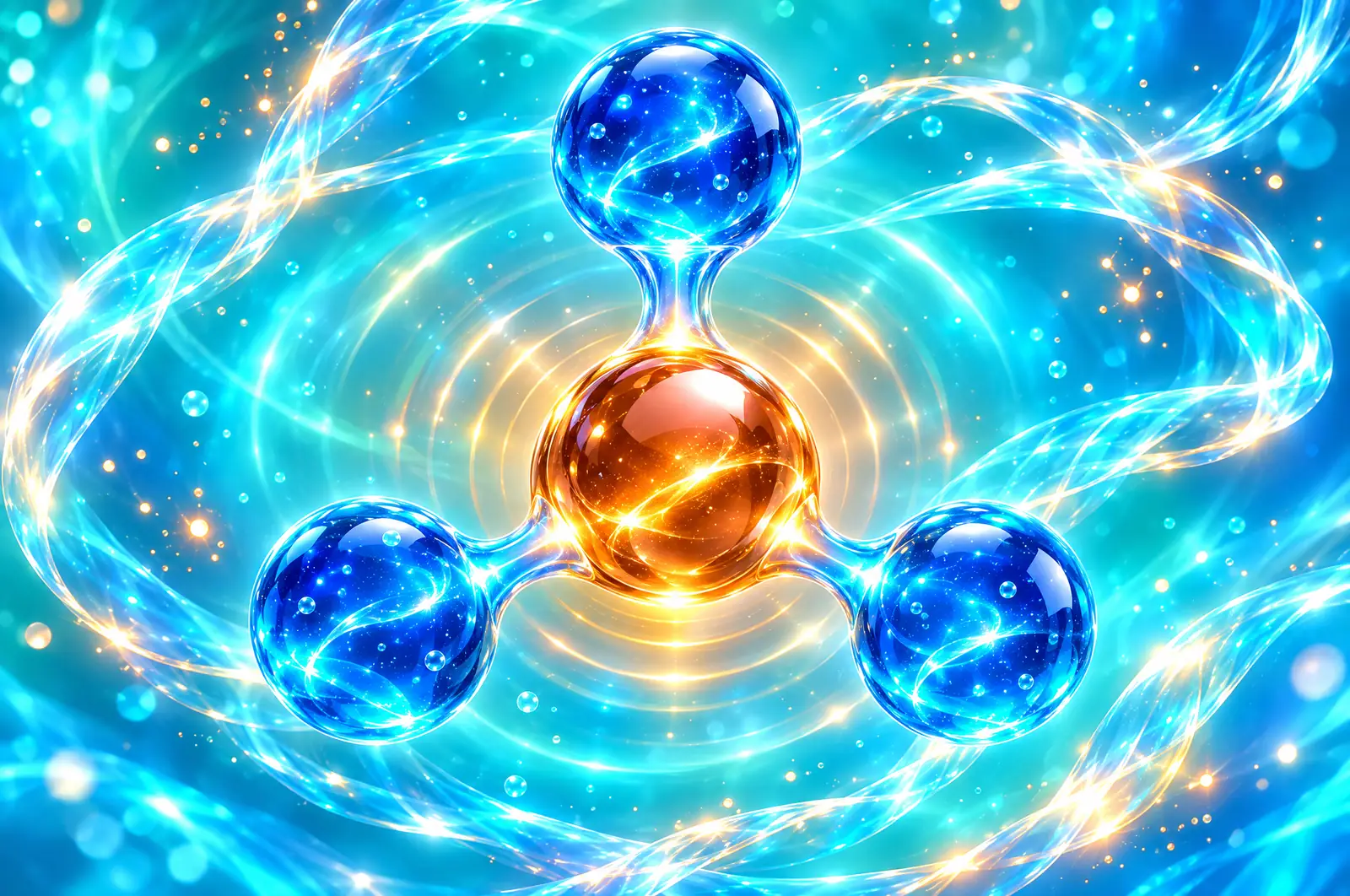
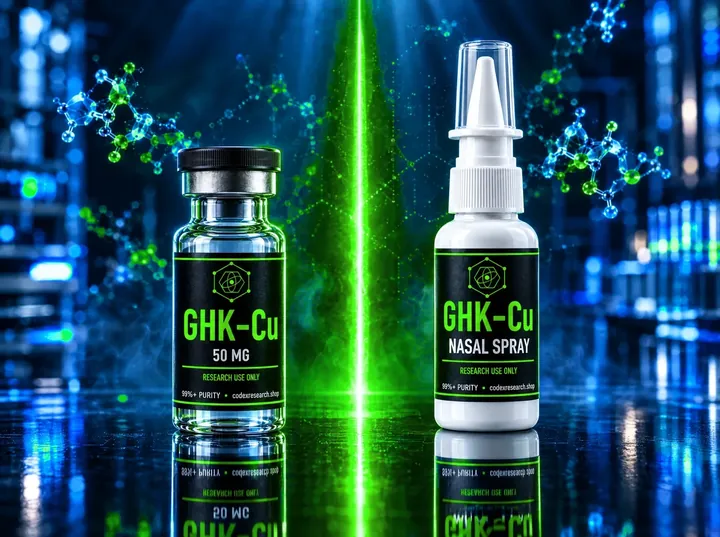
GHK-Cu is three amino acids wrapped around a copper ion, and that copper is the reason the powder is blue. This profile covers what the molecule is, how tightly it holds its metal, what fifty years of cell-culture research report, where the evidence is thin, and what a certificate for a copper peptide should show.
Key takeaways
- GHK is the tripeptide glycyl-L-histidyl-L-lysine, about 340 Da. Bound to one copper(II) ion it becomes GHK-Cu, about 402 Da. It was first isolated from human plasma in 1973.
- GHK holds copper through three nitrogen atoms with a dissociation constant near 7 × 10⁻¹⁴ M, tight enough to compete with albumin for copper in laboratory tests.
- In fibroblast culture, GHK-Cu is reported to raise collagen and glycosaminoglycan synthesis and to change MMP-2 and TIMP levels. Several effects peak near nanomolar concentrations and fade at higher ones.
- The copper matters. In one study copper ions reproduced the MMP-2 effect and the peptide alone did not, so experiments need copper-only and peptide-only controls.
- GHK-Cu is small, polar and metal-bound, which makes it harder to test than most peptides. It is not approved by the FDA as a drug.
ImportantResearch use only. This profile describes the structure of a research peptide and how it is studied in laboratory models. It does not describe human or animal use. Codex Research compounds are not approved by the FDA and are sold for in-vitro laboratory research only.
Quick answer
GHK-Cu is a three-amino-acid peptide holding one copper ion. The peptide is glycyl-L-histidyl-L-lysine, written GHK, and weighs about 340 Da. With a copper(II) ion attached it weighs about 402 Da and turns blue. Loren Pickart isolated the peptide from human plasma in 1973 [1].
Labs study GHK-Cu mainly in collagen and extracellular-matrix models. In cultured fibroblasts it is reported to raise collagen and glycosaminoglycan synthesis and to change the enzymes that remodel the matrix [3, 4, 5]. The evidence comes largely from cell culture and from a small number of research groups. The FDA has not approved GHK-Cu as a drug [14].
GHK-Cu at a glance
| Property | GHK-Cu |
|---|---|
| Peptide sequence | Gly-His-Lys (GHK) |
| Metal | One copper(II) ion per peptide |
| Molecular formula (peptide) | C14H24N6O4 |
| Molecular weight | About 340.4 Da (GHK); about 401.9 Da (copper complex) |
| CAS numbers | 49557-75-7 (GHK); 89030-95-5 (GHK-Cu) |
| Appearance | Blue powder; the free peptide is white |
| Other names | Copper Tripeptide-1 (cosmetic labels), copper-GHK, prezatide copper |
| First described | 1973, isolated from human plasma [1] |
| Main research area | Collagen, glycosaminoglycans and matrix remodelling |
| Current Codex lot | FLL-0629, 99.78% by HPLC |
Where GHK-Cu comes from
Pickart was studying a factor in human serum that prolonged the survival of cultured liver cells. He identified it as the tripeptide glycyl-L-histidyl-L-lysine [1]. Seven years later his group reported that the peptide binds copper readily and increases copper uptake into cultured cells, and proposed that it works as a copper carrier [2]. That proposal still frames most of the research, which looks at the peptide as a way of moving copper to the cells that need it.
A second observation gave the peptide a possible source inside tissue. The same three-residue sequence sits in the alpha 2 chain of type I collagen. A French group suggested that proteases could release it wherever collagen is broken down, which would make GHK a signal generated by the matrix itself [3].
Pickart's later reviews report that plasma GHK is about 200 ng/mL at age 20 and about 80 ng/mL by age 60 [9]. Those figures come from his own measurements and are widely repeated. Read them as one group's data.
How GHK holds copper
The copper is the centre of the molecule's chemistry, and it has been mapped in detail.
- Three nitrogens grip the metal. In solution, copper(II) binds the amino group of glycine, the nitrogen of the first peptide bond and a nitrogen in the histidine ring. A fourth, loosely held position is open to other molecules, and free amino acids such as histidine or glycine can occupy it to form mixed complexes [10, 11].
- The grip is tight. Calorimetry measured a dissociation constant of about 7 × 10⁻¹⁴ M at pH 7.4, with one copper per peptide [12].
- It can compete with albumin. Albumin carries much of the exchangeable copper in plasma. In an equilibrium-dialysis experiment with equal concentrations of the two, about 42% of the copper was found on the peptide [10].
- Copper moves on and off quickly. Unlike some other copper-binding peptides, GHK exchanges its copper fast, which is consistent with the carrier role proposed for it in 1980 [2, 11].
Copper binding depends on pH. The nitrogens that hold the metal pick up protons in acid, so acidic conditions favour release of the copper. That has a practical consequence for testing, covered below.
GHK and GHK-Cu are different reagents
Papers and labels use the two names loosely. They describe different things: the free peptide and the copper complex. One fibroblast study makes the distinction concrete. GHK-Cu raised MMP-2 levels, copper ions alone reproduced the effect, and the peptide without copper did not [5]. An experiment that reports a "GHK" result without saying which form was used leaves out the variable that may explain it.
How GHK-Cu is studied in the lab
Most of the foundational work uses human dermal fibroblasts, the cells that build and maintain connective tissue.
| Research line | Model system | Reported finding | Source |
|---|---|---|---|
| Collagen synthesis | Fibroblast culture | Increase beginning near 10⁻¹² M and peaking at 10⁻⁹ M, with no change in cell number | [3] |
| Glycosaminoglycans | Human fibroblasts | More dermatan sulfate and heparan sulfate; no change in hyaluronic acid | [4] |
| Matrix remodelling | Dermal fibroblasts | Higher MMP-2 protein and mRNA; more TIMP-1 and TIMP-2 secreted | [5] |
| Keratinocytes | Monolayers and skin-equivalent models | More proliferation; higher integrin alpha 6 and beta 1, PCNA and p63 | [6] |
| Growth factors | Normal and irradiated fibroblasts | Faster doubling; early rise in bFGF and VEGF from irradiated cells | [7] |
| Gene expression | Public cell-line dataset | Expression changes across a large share of human genes | [8] |
Collagen and glycosaminoglycans
The 1988 collagen study set the pattern for the field. GHK-Cu increased collagen synthesis in fibroblast cultures at picomolar to nanomolar concentrations, and the increase did not come from having more cells [3]. A follow-up from the same laboratory measured glycosaminoglycans, the sugar chains that fill the space between collagen fibres. GHK-Cu preferentially raised dermatan sulfate outside the cell and heparan sulfate on the cell layer, and left hyaluronic acid unchanged [4].
Building and breaking down the matrix
Cells turn the matrix over as well as build it. The 2000 study showed that GHK-Cu also raises MMP-2, an enzyme that degrades matrix proteins, together with TIMP-1 and TIMP-2, the proteins that restrain it [5]. The authors read this as remodelling: production and turnover moving together. The same group had earlier reported more connective-tissue accumulation in a rat dermal model [13].
Keratinocytes and growth factors
Work outside the fibroblast broadened the picture. In skin-equivalent models, copper-GHK made basal keratinocytes more proliferative and raised integrins and p63, a marker associated with the stem-cell population of the epidermis [6]. In serum-free culture, fibroblasts that had been exposed to radiation doubled faster with GHK-Cu and produced more basic fibroblast growth factor and VEGF early on [7].
The response curve bends
Several of these studies share a feature that is easy to miss. The response rises, peaks and then falls. Glycosaminoglycan synthesis peaked between 10⁻⁹ and 10⁻⁸ M and drifted back toward control at higher concentrations [4]. Collagen synthesis peaked at 10⁻⁹ M [3]. A single high concentration can therefore miss the effect entirely, which is why this compound needs a concentration series.
The gene-expression data
The most quoted modern claim about GHK comes from a computational analysis. Using the Broad Institute's Connectivity Map, a public library of gene-expression responses in cultured cell lines, Pickart and Margolina reported that GHK changed the expression of about 31% of human genes by 50% or more [8].
Read that figure with its limits in view. It describes cell lines exposed to the compound in a screening dataset. One group produced the analysis. A change in a gene's transcript does not show a change in protein or in cell behaviour. The dataset is useful for generating hypotheses and each hypothesis still needs its own experiment.
How strong is the evidence?
GHK-Cu has a longer research record than most peptides sold for laboratory use, and the record has clear limits.
- Two groups produced much of the classic work. Pickart's laboratory and the Reims group led by Maquart account for many of the foundational papers [1, 2, 3, 4, 5, 13]. Independent groups have added the keratinocyte, irradiated-fibroblast and copper-chemistry studies [6, 7, 11, 12].
- Most findings are from cell culture. Animal work exists, mainly in rodent dermal models [13]. Controlled human trials of the kind that support an approved drug do not.
- The chemistry is the strongest part. The structure of the copper complex and its binding strength have been measured by several methods that agree with each other [10, 11, 12].
- The mechanism in cells is unsettled. Copper delivery, matrix signalling and gene-expression effects have all been proposed. They may overlap.
Testing a copper peptide
GHK-Cu is harder to analyse than a typical research peptide, for three reasons.
- It is small and polar. Three residues with several charged groups pass quickly through a standard reversed-phase HPLC column. Labs adjust the method to hold the compound long enough to separate it from impurities.
- It carries a metal. Peptide purity by HPLC does not measure copper. Copper content needs an elemental method such as ICP.
- Acid can strip the copper. HPLC and LC-MS commonly use acidic mobile phases. Under those conditions the complex can release its metal, so a mass spectrometer often detects the free peptide near m/z 341 even when the vial holds the copper complex.
What a full GHK-Cu report can include
| Line | What it answers | Typical method |
|---|---|---|
| Identity | Is the peptide GHK? | LC-MS; the free peptide appears near m/z 341, with a doubly charged ion near m/z 171 |
| Purity | How much of the peptide material is GHK? | HPLC with a method suited to small polar compounds |
| Copper content | Is the metal present in the expected amount? | ICP-OES or ICP-MS |
| Counter-ion and water | How much of the powder is neither peptide nor copper? | Ion chromatography; Karl Fischer titration |
| Endotoxin | Is bacterial contamination below the stated limit? | LAL |
Copper content gives a useful cross-check. One copper atom in a complex of about 401.9 Da is about 15.8% of the mass. A salt form or residual water lowers the measured figure, so a result somewhat under that value is expected, and a result near zero points to the free peptide.
The current Codex lot
The current Codex lot, FLL-0629, was tested by Accurate Test Labs and reported on July 14, 2026:
| Test | Specification | Method | Result |
|---|---|---|---|
| Purity | Report | HPLC (TM-13) | 99.784% |
| Endotoxin | ≤ 7.00 EU/mg | LAL | 0.10 EU/mg |
This report covers purity and endotoxin. It does not carry a separate identity line, so request one from info@codexresearch.shop if your work depends on it. The endotoxin result is given as a number, which is more useful than a bare "pass". What endotoxin testing means explains how to read it, and HPLC vs mass spec covers why purity and identity need different instruments.
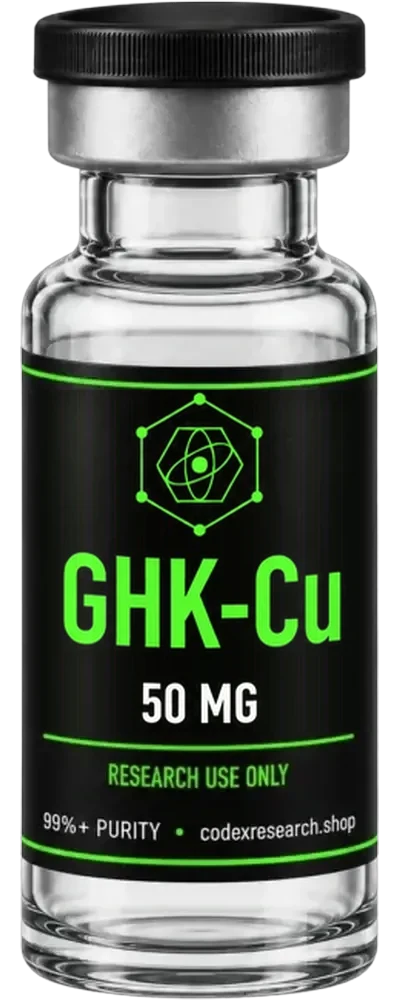
A simple visual check also applies to this compound. GHK-Cu powder is blue. A white powder in a vial labelled GHK-Cu suggests the free peptide. Whatever a certificate lists, the issuing laboratory can confirm whether it is real. Our guide to third-party testing gives the steps.
Stability and storage as a research material
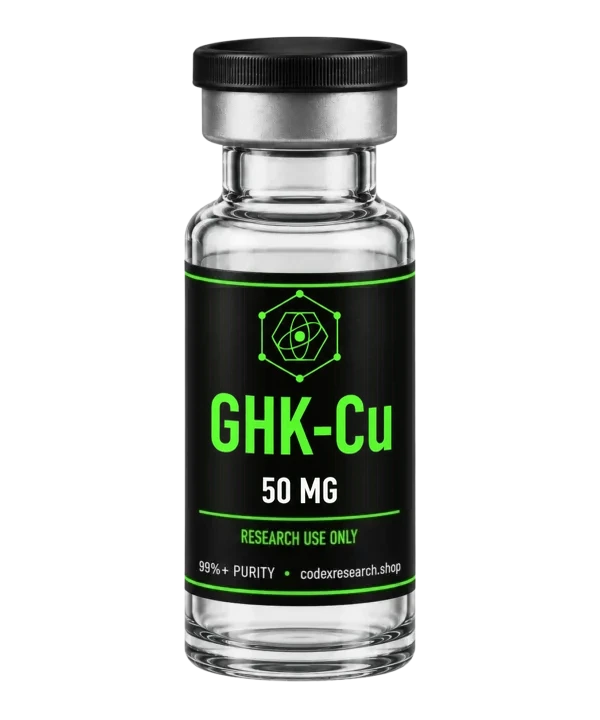
Codex supplies GHK-Cu freeze-dried. The powder is hygroscopic and takes up water from humid air, so a sealed vial belongs somewhere cold, dry and dark, with its lot number recorded beside it.
Two points are specific to a copper complex. Acidic conditions favour release of the metal, as described above. And copper(II) in this complex is stable under moderate conditions but can be reduced to copper(I) at strongly reducing potentials, which releases the ion [11]. Strong reducing agents in an assay buffer are therefore worth noting in the study record.
For the journey from our facility to yours, see research peptides in transit.
Planning in-vitro work with GHK-Cu
Five habits separate a clean GHK-Cu experiment from an ambiguous one.
- Run three arms. GHK-Cu, the peptide without copper, and a copper salt at the matching concentration. Without them an effect cannot be assigned to the complex [5].
- Use a concentration series. The classic effects peak near nanomolar levels and decline above them [3, 4]. Span several orders of magnitude.
- Work in molar units. One milligram of GHK-Cu is about 2.5 micromoles, more than three times the number of molecules in a milligram of BPC-157.
- Mind the serum. Albumin binds copper and competes with GHK for it [10]. Serum-free and serum-containing media can give different results, and one of the growth-factor studies was run serum-free [7].
- Stay on one lot and write it down. The lot number, the purity and the form supplied (complex or free peptide, and which salt) all belong in the methods.
GHK-Cu beside BPC-157 as a research material
The two best-known compounds in this catalogue ask different things of a lab.
| GHK-Cu | BPC-157 | |
|---|---|---|
| Size | 3 amino acids plus copper, about 402 Da | 15 amino acids, about 1,419.5 Da |
| Metal | Copper(II), part of the molecule | None |
| Main research area | Collagen, glycosaminoglycans, matrix remodelling | Endothelial and fibroblast signalling |
| Typical cells | Dermal fibroblasts, keratinocytes | Endothelial cells, tendon fibroblasts |
| Controls that matter most | Peptide without copper; copper salt alone | Positive growth-factor control; lot record |
| Hardest part of testing | Small, polar, and copper is measured separately | No aromatic residues, so detection relies on the peptide bond |
| Shape of the evidence | Fifty years of cell culture, strong chemistry | Wide preclinical base, no confirmed receptor |
Our BPC-157 profile covers the right-hand column in full.
Regulatory status
GHK-Cu has no FDA approval as a drug. Codex Research supplies it for in-vitro laboratory work, on the terms set out in what research use only means.
Two other facts are often confused with approval:
- Cosmetics. The complex appears on cosmetic labels as Copper Tripeptide-1. Cosmetic ingredients are regulated differently from drugs and from research compounds.
- Compounding. In September 2023 the FDA placed an entry for GHK-Cu in Category 2 of its interim compounding list, citing possible immunogenicity from aggregation and peptide-related impurities. In April 2026 it removed that entry after the nominations were withdrawn [14]. Neither step is an approval. This section reflects the position in November 2026.
Common misconceptions
"GHK and GHK-Cu are interchangeable." They are the peptide and its copper complex. In at least one study the copper, not the peptide, carried the effect [5].
"More is better." Several reported effects peak near nanomolar concentrations and fade above them.
"It changes a third of the genome, so it does everything." The figure comes from a screening dataset in cell lines. It lists transcripts that moved and says nothing about what a cell or tissue does as a result.
"A purity result proves the copper is there." HPLC purity describes the peptide. Copper needs its own measurement.
"It is approved because it is in skin-care products." A cosmetic ingredient listing is not a drug approval.
Related compounds and blends
AHK-Cu is a close relative in which alanine replaces glycine. It is a separate compound with a much smaller literature.
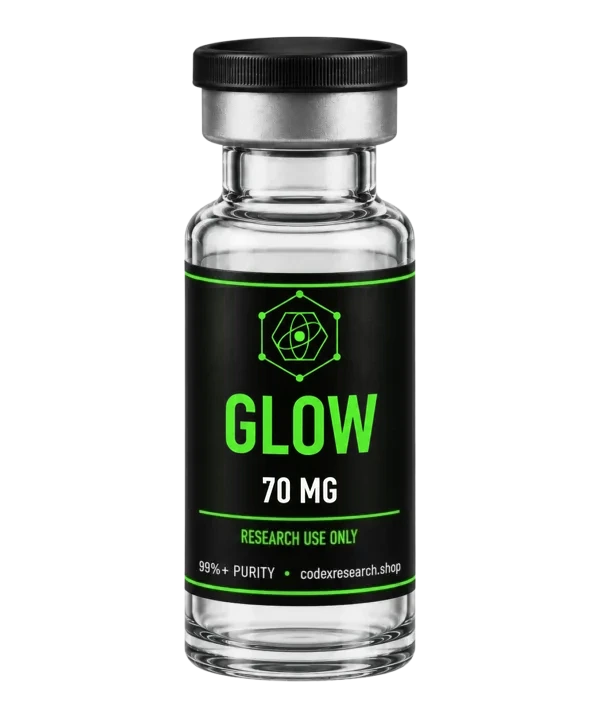
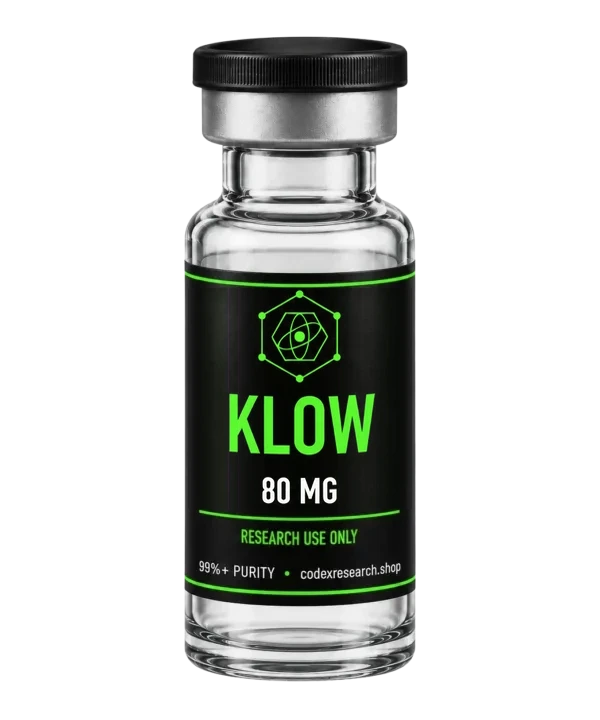
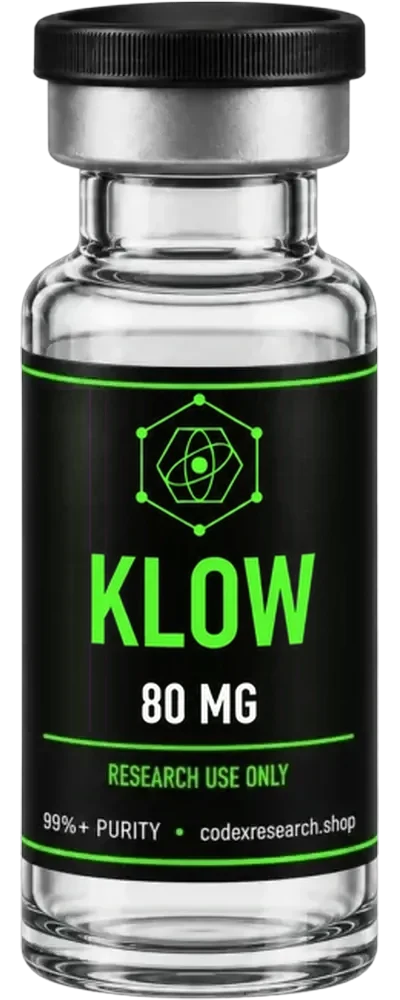
Codex Research supplies GHK-Cu on its own and as the largest component of two research blends. Glow combines it with BPC-157 and TB-500, and Klow adds KPV. Glow vs Klow compares the two blends component by component, and What is BPC-157? profiles the peptide they share with GHK-Cu.
What this profile does not tell you
This profile covers structure, copper chemistry, the research literature, testing and regulation. It does not describe how GHK-Cu behaves in any person or animal, establish safety or effectiveness for any purpose, or replace the certificate for the lot you hold. Research compounds are not approved by the FDA for human or veterinary use.
How Codex Research documents GHK-Cu
Each Codex GHK-Cu lot is tested by an independent laboratory, and the report is published on the product page with the laboratory and report number named. Check that the lot printed on your vial is the lot on that page. To request the complete report, or an identity result for a specific lot, write to info@codexresearch.shop.
Frequently asked questions
What is GHK-Cu?
What does GHK stand for?
What is the difference between GHK and GHK-Cu?
Why is GHK-Cu blue?
What is the molecular weight of GHK-Cu?
How strongly does GHK bind copper?
Where does GHK occur naturally?
What is GHK-Cu studied for in the lab?
Does the copper matter, or is it the peptide?
Is more GHK-Cu always more effective in a cell assay?
Is GHK-Cu FDA approved?
Is GHK-Cu the same as copper tripeptide-1?
How is GHK-Cu tested?
How is GHK-Cu different from AHK-Cu?
How should GHK-Cu be stored as a research material?
References
- Pickart L, Thaler MM. Tripeptide in human serum which prolongs survival of normal liver cells and stimulates growth in neoplastic liver. Nat New Biol. 1973;243(124):85-87.
- Pickart L, Freedman JH, Loker WJ, et al. Growth-modulating plasma tripeptide may function by facilitating copper uptake into cells. Nature. 1980;288(5792):715-717.
- Maquart FX, Pickart L, Laurent M, Gillery P, Monboisse JC, Borel JP. Stimulation of collagen synthesis in fibroblast cultures by the tripeptide-copper complex glycyl-L-histidyl-L-lysine-Cu2+. FEBS Lett. 1988;238(2):343-346.
- Wegrowski Y, Maquart FX, Borel JP. Stimulation of sulfated glycosaminoglycan synthesis by the tripeptide-copper complex glycyl-L-histidyl-L-lysine-Cu2+. Life Sci. 1992;51(13):1049-1056.
- Siméon A, Emonard H, Hornebeck W, Maquart FX. The tripeptide-copper complex glycyl-L-histidyl-L-lysine-Cu2+ stimulates matrix metalloproteinase-2 expression by fibroblast cultures. Life Sci. 2000;67(18):2257-2265.
- Kang YA, Choi HR, Na JI, et al. Copper-GHK increases integrin expression and p63 positivity by keratinocytes. Arch Dermatol Res. 2009;301(4):301-306.
- Pollard JD, Quan S, Kang T, Koch RJ. Effects of copper tripeptide on the growth and expression of growth factors by normal and irradiated fibroblasts. Arch Facial Plast Surg. 2005;7(1):27-31.
- Pickart L, Margolina A. Regenerative and protective actions of the GHK-Cu peptide in the light of the new gene data. Int J Mol Sci. 2018;19(7):1987.
- Pickart L, Vasquez-Soltero JM, Margolina A. GHK peptide as a natural modulator of multiple cellular pathways in skin regeneration. Biomed Res Int. 2015;2015:648108.
- Lau SJ, Sarkar B. The interaction of copper(II) and glycyl-L-histidyl-L-lysine, a growth-modulating tripeptide from plasma. Biochem J. 1981;199(3):649-656.
- Hureau C, Eury H, Guillot R, et al. X-ray and solution structures of Cu(II) GHK and Cu(II) DAHK complexes: influence on their redox properties. Chemistry. 2011;17(36):10151-10160.
- Trapaidze A, Hureau C, Bal W, Winterhalter M, Faller P. Thermodynamic study of Cu2+ binding to the DAHK and GHK peptides by isothermal titration calorimetry (ITC) with the weaker competitor glycine. J Biol Inorg Chem. 2012;17(1):37-47.
- Maquart FX, Bellon G, Chaqour B, et al. In vivo stimulation of connective tissue accumulation by the tripeptide-copper complex glycyl-L-histidyl-L-lysine-Cu2+ in rat experimental wounds. J Clin Invest. 1993;92(5):2368-2376.
- U.S. Food and Drug Administration. Certain bulk drug substances for use in compounding that may present significant safety risks.

 From lab to your door