

"Third-party tested" is one of the most repeated claims in the research peptide market and one of the least checked. This guide explains what independent testing really means, how to verify the lab and the report, and the warning signs that a certificate has been reused, altered or invented.
Key takeaways
- Third-party testing means a laboratory with no stake in the result tested a sample of the lot. It is only as strong as the lab, the method and the link between the report and your vial.
- Accreditation to ISO/IEC 17025 shows a lab is competent for specific tests listed in its scope. Check that the tests on your certificate are within that scope.
- Even regulated drug manufacturers may not rely on a supplier certificate alone: 21 CFR § 211.84 requires their own identity test and periodic validation of the supplier’s results.
- A genuine certificate can usually be verified directly with the issuing lab using its report or sample ID.
- Reused reports, missing lot numbers, round numbers, edited images and labs that cannot be contacted are the most common signs of a weak or fake certificate.
ImportantResearch use only. This guide explains how laboratory test reports for research materials are verified. It does not describe human or animal use. Codex Research compounds are not approved by the FDA and are sold for in-vitro laboratory research only.
Quick answer
Third-party testing means a sample of a lot was tested by a laboratory with no stake in the result. It is the strongest quality claim a research peptide supplier can make, but only when three links hold: the lab is competent for the tests it ran, the report is genuine, and the report describes the lot in your vial.
You can check all three. Confirm the lab is real and, ideally, accredited to ISO/IEC 17025 for those tests. Verify the report directly with the lab using its report or sample ID. And check that the lot printed on your vial is the same lot the report covers. Most weak or fake certificates fail at least one of these checks.
Testing terms you will see
| Term | Meaning |
|---|---|
| Third-party lab | A laboratory independent of the manufacturer and seller. |
| In-house testing | Testing performed by the manufacturer’s or seller’s own lab. |
| ISO/IEC 17025 | The international standard for testing-laboratory competence and impartiality. |
| Scope of accreditation | The specific tests, methods and sample types a lab is accredited for. |
| Report / sample ID | The unique identifier a lab assigns, used to verify a certificate. |
| Proficiency testing | Blind samples analyzed by many labs to compare their results. |
| Data integrity | Results that are complete, original, accurate and traceable to who produced them. |
| Retained sample | Part of a lot kept back so it can be re-tested later. |
Why "tested" is not the same as "independently tested"
A test result is only as trustworthy as the incentives behind it. When a seller tests its own product, it is grading its own work. Independent testing removes that conflict: the lab is paid to report what it measures, not to sell the product.
The gap between claimed and measured quality is well documented. When researchers at Ghent University independently re-tested synthetic peptides that had been ordered for research at 95% purity or higher, they found a large discrepancy with the suppliers’ certificates: only 44% met the required purity, and in one case the main compound had a different structure from the one ordered [1]. In another case, peptides from two commercial suppliers contained about 1% by weight of an unrelated peptide, enough to produce false-positive results in a sensitive cell assay [11].
| Testing model | Who tests | Strength | Limitation |
|---|---|---|---|
| Supplier statement only | Nobody, or not disclosed | None | A claim with no evidence |
| In-house testing | Manufacturer or seller | Can be rigorous and fast | Conflict of interest; harder to verify |
| Third-party testing | Independent lab | Removes the conflict of interest | Only as good as the lab and the lot match |
| In-house plus third-party | Both | Routine control plus independent confirmation | Costs more |
How regulated industry treats supplier certificates
Drug manufacturers face strict rules on exactly this question. Under 21 CFR § 211.84, a manufacturer may accept a supplier’s report of analysis in place of its own full testing only if it runs at least one specific identity test itself and validates the reliability of the supplier’s results at appropriate intervals [5].
In other words, even the most regulated part of the industry does not take a certificate on trust. Research materials are not held to drug rules, but the principle is useful for any buyer: a certificate is a claim that should be verifiable.
What makes a lab credible: ISO/IEC 17025
ISO/IEC 17025 is the international standard for the competence, impartiality and consistent operation of testing and calibration laboratories [2]. Accreditation is granted by an independent accreditation body after it assesses the lab’s:
- methods, and whether they are validated for the samples tested,
- staff training and competence,
- equipment calibration and maintenance,
- quality system, records and handling of complaints and errors,
- impartiality, including how conflicts of interest are managed.
Accreditation bodies that sign the ILAC Mutual Recognition Arrangement recognize each other’s accreditations, so a lab accredited in one signatory country is recognized as competent in others [3].
Check the scope, not just the logo
Accreditation is granted for specific tests, listed in the lab’s scope of accreditation. A lab might be accredited for HPLC purity but not for endotoxin, or for one sample type but not another. When a certificate shows an accreditation logo, the useful question is whether the tests on that certificate fall within the scope.
| Accreditation check | What to look for |
|---|---|
| Accreditation body | A recognized body, ideally an ILAC MRA signatory |
| Certificate number | Listed on the lab’s site or the accreditation body’s directory |
| Scope | Includes the methods on your certificate (HPLC, MS, LAL, USP <71>) |
| Expiry | Accreditation is current |
What a complete certificate of analysis contains
The World Health Organization publishes a model certificate of analysis used in pharmaceutical trade [4]. It is a useful benchmark for any certificate:
| Element | Why it matters |
|---|---|
| Laboratory name and address | Identifies who is responsible for the results |
| Certificate ID and page numbering | Makes the document traceable and complete |
| Product name and batch number | Ties the results to one lot |
| Original manufacturer | Shows where the material came from if it was repacked or traded |
| Dates of manufacture and testing | Shows testing happened in a sensible time frame |
| Each test, with method, specification and result | Makes every number checkable |
| Subcontracted tests identified | Shows which results came from another lab |
| Conclusion | States whether the lot complies |
| Name and signature of responsible person | Shows who released the report |
| Accreditation reference | Shows which tests are accredited |
The WHO model also notes that when material is repacked or traded, the original manufacturer’s certificate should be attached and the original batch number carried through [4]. That is the same traceability principle covered in our guide to US-made vs imported peptides.

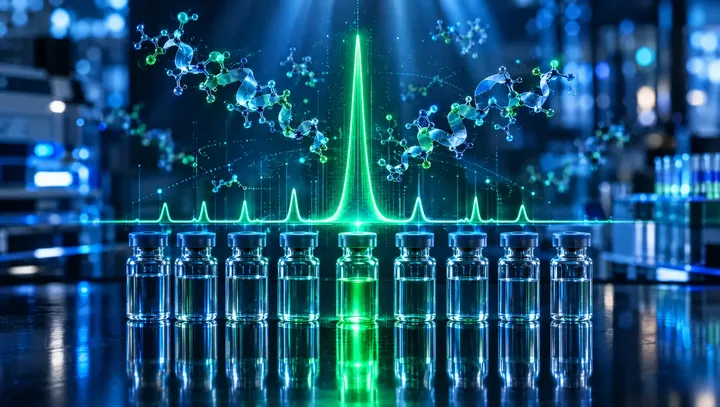
A certificate is only as good as the run behind it. Showing the chromatogram lets the number be checked.
How to verify a certificate, step by step
- Match the lot. The lot number on the certificate must match the lot printed on your vial. If it does not, stop: the report describes something else.
- Find the lab independently. Search for the laboratory yourself. Do not rely on contact details or links supplied by the seller.
- Check accreditation and scope. Look the lab up with its accreditation body and confirm the tests on your certificate are in scope.
- Contact the lab with the report ID. Ask whether the report is genuine, whether it was issued to the seller and whether it matches the lot number shown.
- Compare the details. Product name, fill size, dates and results on the lab’s copy should match yours exactly.
- Look at the data. A chromatogram or peak table for purity, and a measured mass for identity, show the results were measured, not typed.
TipMany labs offer an online report-verification page or will confirm a report by email. A seller that discourages you from contacting the lab is itself a warning sign.
Red flags of a fake or altered COA
Fake certificates tend to fail in predictable ways:
| Red flag | What it suggests |
|---|---|
| No lot number | The report cannot be tied to any vial |
| Same report across orders or products | A template is being reused |
| Lab cannot be found or contacted | The lab may not exist |
| Lab exists but does not recognize the report | The document has been fabricated or altered |
| Results with no methods | No way to tell how numbers were produced |
| Perfectly round numbers (e.g. 100.00%) | Real measurements carry decimals and variation |
| Mismatched fonts, alignment or logos | The document may have been edited |
| Blurry, cropped or low-resolution images | Details may have been hidden or changed |
| Dates that do not fit | Testing after sale, or a report years old |
| Chromatogram that does not match the result | The trace may belong to another sample |
| Accreditation logo with no certificate number | Accreditation cannot be checked |
Checking the chromatogram
When a chromatogram is included, a few quick checks help. The main peak should dominate, the baseline should be steady and the reported purity should be consistent with the visible peak areas. A shoulder on the main peak can hide a co-eluting impurity; analysts use spectral or mass data across the peak to check for this [12]. Identical chromatograms on reports for different products or lots are a strong sign of reuse.
Data integrity: why the record matters as much as the result
Regulators treat the integrity of the data as seriously as the result itself. FDA guidance on data integrity describes records that are attributable, legible, contemporaneous, original and accurate, often summarized as ALCOA, and treats deleted, altered or selectively reported results as serious failures [6].
| ALCOA principle | What it means for a certificate |
|---|---|
| Attributable | You can tell who ran the test and who released the report |
| Legible | The record is clear and readable |
| Contemporaneous | Results were recorded when the work was done |
| Original | The report comes from the lab’s own system, not a copy of a copy |
| Accurate | The numbers reflect what was actually measured |
A genuine third-party certificate is one end of a long record: sample receipt, instrument runs, calculations and review. That is why a real report can be confirmed by the lab that issued it.
How good labs stay honest: validation and proficiency testing
Two practices separate careful laboratories from careless ones:
- Method validation. The ICH Q2(R2) guideline sets out how analytical methods are shown to be specific, accurate, precise and reliable across their working range [7].
- Proficiency testing. Labs analyze the same blind samples sent by an external program and their results are compared. Long-running programs, such as a six-year comparison of endotoxin methods, show how this catches drift between labs and methods [8].
A lab that validates its methods and takes part in proficiency testing produces numbers that agree with other competent labs, which is the whole point of independent testing.
What happens when nobody checks
Where products move through markets with no independent verification, testing has repeatedly found claims and contents far apart:
- A 2024 study that bought semaglutide vials from illegal online pharmacies found purity of only 7.7% to 14.37% against 99% printed on the labels, with endotoxin in every sample [9].
- A study of somatropin bought from websites selling without prescription found every sample contained significantly less active substance than labeled [10].
Neither problem would have been visible from the label or a supplier statement. Both were found by independent analysis.
Questions to ask about a supplier’s testing
A supplier that relies on genuine third-party testing can usually answer these quickly:
- Which laboratory tests your lots? The answer should be a specific, findable lab.
- Is the lab accredited, and for which tests? Ask for the accreditation body and certificate number.
- Is every lot tested, or only some? Lot-specific reports for every batch are the stronger standard.
- Which tests are run? Identity by mass spectrometry, purity by HPLC, and contaminant tests such as endotoxin and sterility.
- Can I verify a report with the lab? The answer should be yes, with a report or sample ID.
- Do you keep retained samples? Retained samples allow a lot to be re-tested if a question arises later.
| Answer | What it suggests |
|---|---|
| Names the lab, lot-specific reports, verification welcome | Testing is real and checkable |
| Names a lab but reports are generic | Testing may not cover your lot |
| "Tested by our partners", no lab named | The claim cannot be verified |
| Reluctant to share report IDs | Treat the certificate as unverified |
Common misconceptions about third-party testing
| Misconception | Reality |
|---|---|
| "Third-party tested means every vial was tested." | A sample of the lot is tested; the result describes that lot. |
| "An accreditation logo covers every test." | Accreditation covers the tests in the lab’s scope only. |
| "A QR code proves testing." | A QR code is a link; the report it leads to still needs checking. |
| "One good report proves a supplier is reliable." | Each lot needs its own report. |
| "If it looks official, it is official." | Templates and logos are easy to copy. Verify with the lab. |
What third-party testing does not tell you
A third-party certificate describes the composition of a research material at the time it was tested. It does not describe how a compound behaves in any organism, establish safety or effectiveness for any use, or account for what happens to a vial after testing. Research compounds are not approved by the FDA for human or veterinary use.
How Codex Research handles independent testing
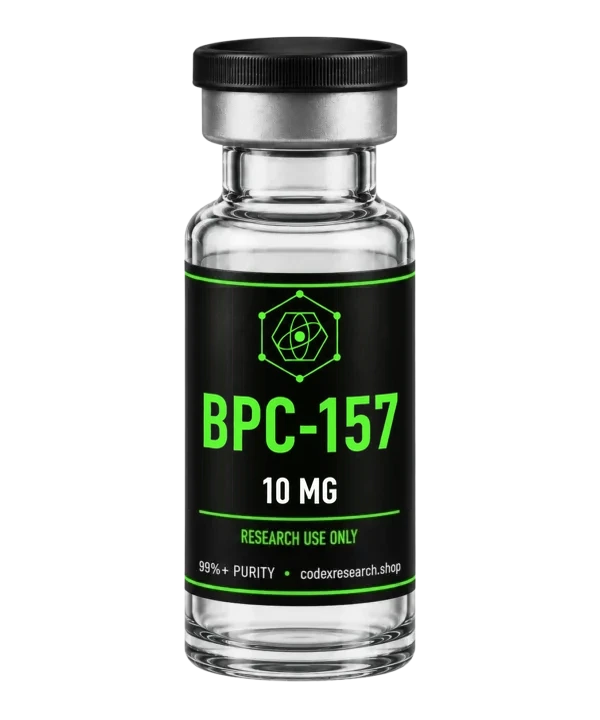
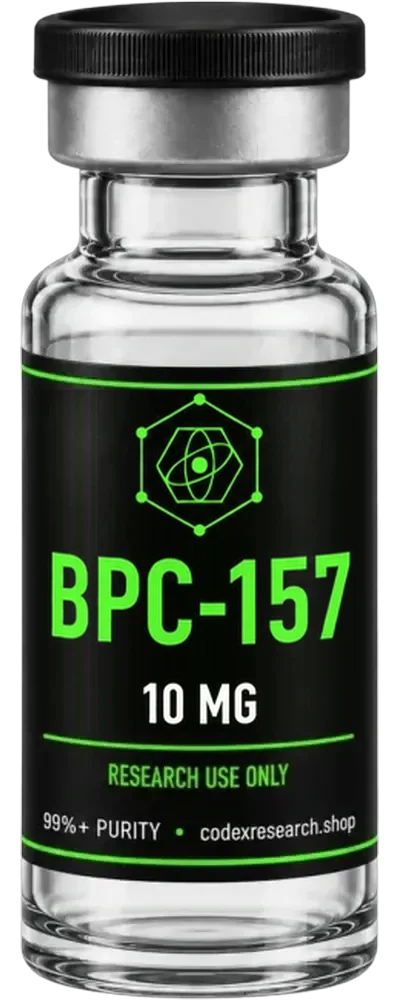
Codex Research publishes lot-specific certificates from a named independent laboratory, showing the lot number, report ID and test date, so each report can be matched to its vial and verified with the lab. Our BPC-157 lot KIZN072426, for example, was tested by Optiq Health Labs under report 0327.OPT.260729-R1. For how the purity and identity lines on that report are measured, read HPLC vs mass spec, or contact info@codexresearch.shop for the certificate for any lot. What is BPC-157? reads that lot’s full report line by line, and Glow vs Klow shows two laboratories testing similar blends with different panels.
Frequently asked questions
What does third-party tested mean for research peptides?
Is third-party testing better than in-house testing?
What is ISO/IEC 17025?
What is an accreditation scope?
How do I verify a certificate with the lab?
What are the signs of a fake COA?
Can a COA be real but still not describe my vial?
Why should a COA show the chromatogram?
Do pharmaceutical companies trust supplier certificates?
What should a complete certificate of analysis include?
What is proficiency testing?
Have independent tests found fake or inaccurate peptide certificates?
What is data integrity in lab testing?
Is a QR code on the label proof of testing?
How does Codex Research handle independent testing?
References
- Verbeke F, Wynendaele E, Braet S, D’Hondt M, De Spiegeleer B. Quality evaluation of synthetic quorum sensing peptides used in R&D. J Pharm Anal. 2015;5(3):169-181.
- ISO/IEC 17025:2017. General requirements for the competence of testing and calibration laboratories.
- International Laboratory Accreditation Cooperation (ILAC). ILAC Mutual Recognition Arrangement and signatories.
- World Health Organization. Model certificate of analysis. WHO Technical Report Series No. 1010, Annex 4, 2018.
- Electronic Code of Federal Regulations. 21 CFR § 211.84, Testing and approval or rejection of components, drug product containers, and closures.
- U.S. FDA. Data Integrity and Compliance With Drug CGMP: Questions and Answers. Guidance for Industry, December 2018.
- U.S. FDA / ICH. Q2(R2) Validation of Analytical Procedures. Guidance for Industry, March 2024.
- Piehler M, Roeder R, Blessing S, Reich J. Comparison of LAL and rFC assays: participation in a proficiency test program between 2014 and 2019. Microorganisms. 2020;8(3):418.
- Ashraf AR, Mackey TK, Vida RG, et al. Multifactor quality and safety analysis of semaglutide products sold by online sellers without a prescription. J Med Internet Res. 2024;26:e65440.
- Vida RG, Fittler A, Mikulka I, et al. Availability and quality of illegitimate somatropin products obtained from the Internet. Int J Clin Pharm. 2017;39(1):78-87.
- Currier JR, Galley LM, Wenschuh H, et al. Peptide impurities in commercial synthetic peptides and their implications for vaccine trial assessment. Clin Vaccine Immunol. 2008;15(2):267-276.
- Lincoln D, Fell AF, Anderson NH, England D. Assessment of chromatographic peak purity of drugs by multivariate analysis of diode-array and mass spectrometric data. J Pharm Biomed Anal. 1992;10(10-12):837-844.






 From lab to your door