


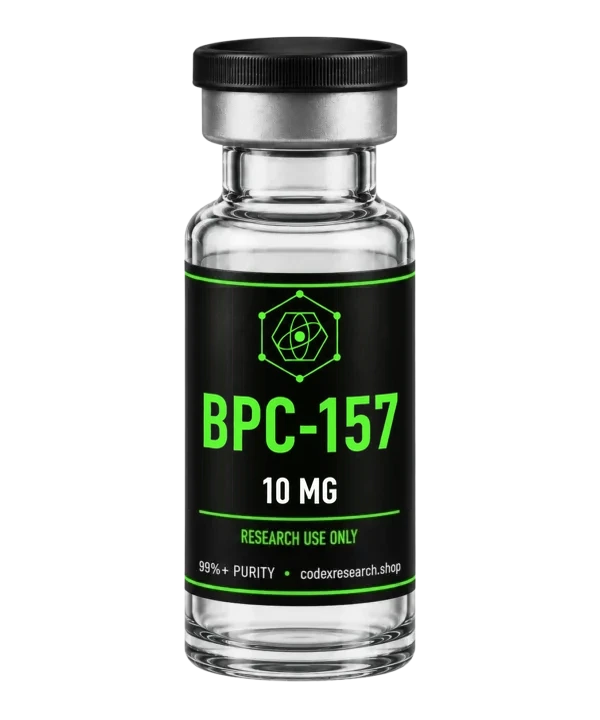
BPC-157 is one of the most searched research peptides in the United States and one of the least understood. This profile covers what the molecule is, where its name comes from, which signalling pathways it is studied in, how much of the evidence holds up, and how to read the certificate for a specific lot.
Key takeaways
- BPC-157 is a synthetic 15-amino-acid peptide, GEPPPGKPADDAGLV, with a molecular weight of about 1,419.5 Da. Its sequence was described in 1993 as a fragment of a larger protein found in gastric juice.
- No single receptor has been confirmed. In cell models BPC-157 is linked to several signalling routes, including VEGFR2-Akt-eNOS, ERK1/2, Src-caveolin-1-eNOS and FAK-paxillin.
- A 2025 systematic review found 36 eligible studies published between 1993 and 2024. Thirty-five were preclinical and one was clinical.
- The FDA has not approved BPC-157. Its compounding status changed twice in 2026, and neither change is an approval. WADA lists it under section S0.
- The chain has no aromatic amino acids, no cysteine and no methionine, which shapes how labs detect it by HPLC and how it degrades. Identity needs mass spectrometry.
ImportantResearch use only. This profile describes the structure of a research peptide and how it is studied in laboratory models. It does not describe human or animal use. Codex Research compounds are not approved by the FDA and are sold for in-vitro laboratory research only.
Quick answer
BPC-157 is a synthetic peptide made of fifteen amino acids, written GEPPPGKPADDAGLV, with a molecular weight of about 1,419.5 Da. Researchers described the sequence in 1993 as a fragment of a larger protein found in human gastric juice and named that protein BPC, for "body protection compound" [1].
In the laboratory, BPC-157 is studied mostly in cell-migration and blood-vessel models. Cell studies link it to several signalling routes, including VEGFR2-Akt-eNOS [3], ERK1/2 [5] and FAK-paxillin [2], and no single receptor has been confirmed. Almost all of the published evidence is preclinical. The FDA has not approved BPC-157 for any use, and WADA prohibits it in sport [15, 17].
BPC-157 at a glance
| Property | BPC-157 |
|---|---|
| Sequence (one-letter) | GEPPPGKPADDAGLV |
| Sequence (three-letter) | Gly-Glu-Pro-Pro-Pro-Gly-Lys-Pro-Ala-Asp-Asp-Ala-Gly-Leu-Val |
| Length | 15 amino acids (a pentadecapeptide) |
| Molecular formula | C62H98N16O22 |
| Molecular weight | About 1,419.5 Da (monoisotopic 1,418.7 Da) |
| Names in the literature | BPC 157, PL 14736, "stable gastric pentadecapeptide" |
| First described | 1993, as a fragment of a gastric-juice protein [1] |
| Confirmed receptor | None |
| Regulatory status | Not FDA approved; WADA section S0 |
| Current Codex lot | KIZN072426, 99.23% by RP-HPLC |
Where BPC-157 comes from
The story starts with a hypothesis about the stomach. In 1993 a group at the University of Zagreb proposed that the stomach responds to stress by releasing protective factors, and reported a protein of about 40,000 Da in human gastric juice that they called BPC [1]. They then characterized a fifteen-residue fragment of it, which they considered essential for its activity, and labelled it BPC 157.
Three points from that origin still matter when you read about the compound:
- The research material is synthetic. Every study uses the fifteen-residue peptide made by chemical synthesis. The parent protein is far less documented than the fragment.
- The name describes a hypothesis. "Body protection compound" is the label its discoverers chose. It says nothing about the molecule's chemistry.
- It has more than one name. Papers from the pharmaceutical company Pliva used the code PL 14736 for the same sequence [6], and many papers write "BPC 157" with a space. A literature search needs all three.
The peptide is also described as "stable" because it is reported to resist breakdown in gastric juice, which is unusual for a peptide [9].
The sequence, residue by residue
A peptide's behaviour in a test follows from its amino acids. BPC-157 has an unusual mix.
| Amino acid | Count | Positions | Why it matters |
|---|---|---|---|
| Proline (P) | 4 | 3, 4, 5, 8 | Rigid residues that kink the chain and limit how it folds |
| Glycine (G) | 3 | 1, 6, 13 | The smallest residue, adds flexibility between rigid stretches |
| Aspartic acid (D) | 2 | 10, 11 | Acidic; a known site for isomerization during storage [18] |
| Alanine (A) | 2 | 9, 12 | Small and non-reactive |
| Glutamic acid (E) | 1 | 2 | Acidic |
| Lysine (K) | 1 | 7 | The only basic side chain |
| Leucine (L), valine (V) | 1 each | 14, 15 | Hydrophobic C-terminal end |
Three absences are as informative as what is present:
- No aromatic residues. There is no tryptophan, tyrosine or phenylalanine, so BPC-157 barely absorbs light at 280 nm. Labs detect it through the peptide bond at about 210 to 220 nm.
- No cysteine or methionine. These are the residues most prone to oxidation. Their absence removes one common degradation route.
- Three acidic side chains against one basic one. At neutral pH the peptide carries a net negative charge, which affects how it separates on a column.
Suppliers provide BPC-157 as the free peptide or as a salt. The FDA's own compounding documents name two forms, BPC-157 free base and BPC-157 acetate [15]. A counter-ion adds mass that is not peptide, which is one reason the weight of powder in a vial and the amount of peptide are different numbers.
How BPC-157 is studied in the lab
Most mechanistic work falls into five lines. Each comes from cell culture or isolated tissue, and each measures a signalling event in a dish or tissue bath.
| Research line | Model system | Reported finding | Source |
|---|---|---|---|
| VEGFR2-Akt-eNOS | Human endothelial cells | More VEGFR2 expression, receptor internalization and pathway activation | [3] |
| ERK1/2 | Human endothelial cells | Changed phosphorylation of ERK1/2 and of c-Fos, c-Jun and Egr-1 | [5] |
| Early-response genes | Caco-2 cells | Faster expression of egr-1 and its repressor nab2 than PDGF-BB | [6] |
| Src-caveolin-1-eNOS | Endothelial cells, isolated rat aorta | Nitric oxide production; concentration-dependent vessel relaxation | [7] |
| FAK-paxillin, GH receptor | Rat tendon fibroblasts | More migration and spreading; higher growth hormone receptor expression | [2, 4] |
Endothelial signalling
The best-characterized work uses endothelial cells, the cells that line blood vessels. One study reported that BPC-157 raised VEGFR2 expression and triggered the VEGFR2-Akt-eNOS cascade, and that blocking receptor internalization suppressed the effect [3]. A second group reported that BPC-157 increased endothelial cell proliferation, migration and tube formation, and changed the phosphorylation of ERK1/2 along with its downstream targets c-Fos, c-Jun and Egr-1 [5].
Nitric oxide and the Src-caveolin-1 route
Nitric oxide appears throughout the BPC-157 literature. Reviews from the Zagreb group describe an interaction with the nitric oxide system across many animal models [8]. A 2020 study gave that idea a mechanism. In isolated rat aorta BPC-157 produced a concentration-dependent relaxation that depended on the endothelium and on nitric oxide. In endothelial cells it increased phosphorylation of Src, caveolin-1 and eNOS, and reduced the binding between caveolin-1 and eNOS that normally holds the enzyme inactive [7].
Early-response genes
Work published under the PL 14736 name looked at egr-1, an immediate-early gene that switches on within minutes of a growth signal. In undifferentiated Caco-2 cells the peptide stimulated expression of egr-1 and its repressor nab2 more quickly than the growth factor PDGF-BB [6]. Egr-1 also appears among the ERK1/2 targets in the endothelial study, so two independent groups reached the same gene from different directions.
Fibroblast migration
In fibroblasts grown from rat Achilles tendon, BPC-157 increased outgrowth, migration and spreading through the FAK-paxillin pathway, and raised expression of the growth hormone receptor [2, 4]. Our BPC-157 vs TB-500 comparison covers these two studies in detail and sets them beside the actin-binding work on TB-500.
What the five lines have in common
All five sit upstream of the same cell behaviours: movement, survival and vessel formation. None identifies the molecule BPC-157 binds first. That gap is the central open question, and it explains why reviews describe the peptide's mechanism as incompletely understood [13, 14].
How BPC-157 breaks down
Two studies describe what happens to the molecule itself.
A 2022 study tracked radiolabelled BPC-157 in rats and dogs. The intact peptide had a plasma half-life of under 30 minutes. It broke down into small peptide fragments and then into single amino acids, which entered normal amino-acid metabolism, and the label left the body mainly through urine and bile [9]. A companion toxicology study in mice, rats, rabbits and dogs reported that the peptide was well tolerated and caused no serious toxicity in those species [10].
The second study came from an anti-doping laboratory that had found BPC-157 in confiscated vials. Its team incubated the peptide in plasma and identified a stable metabolite, then validated a urine method with a detection limit of 0.1 ng/mL. BPC-157 itself stayed stable in urine for at least four days [11].
For a lab, the practical reading is that the intact molecule is short-lived in biological fluids. An experiment that runs for hours in serum-containing medium is measuring the response to a compound that may be partly degraded by the end.
How strong is the evidence?
The honest answer is that the evidence is wide and shallow.
A systematic review published in 2025 searched PubMed, Cochrane and Embase through June 2024. From 544 records it kept 36 studies: 35 preclinical and one clinical. The authors graded the evidence at levels IV and V, the lowest tiers, and found no clinical safety data [12].
Three features of the literature explain that grade:
- Concentrated authorship. A large share of BPC-157 papers comes from one research group and its collaborators. Independent groups in Taiwan and China have added mechanistic studies [2, 3, 5, 7], which is why those papers carry weight.
- Preclinical scope. Cell culture and rodent models dominate. Reviews written by outside authors note the distance between that base and controlled human data [13, 14].
- No confirmed target. A compound with a known receptor can be tested with a blocker or a knockout. BPC-157 research cannot yet do that, so each finding rests on its own experiment.
Read the literature as a set of laboratory hypotheses. Several have been reproduced at the level of cell signalling. None has been established in controlled human trials.
Regulatory status
The FDA has not approved BPC-157 for any human or veterinary use. Codex Research sells it for in-vitro laboratory research only. Our guide to what research use only means explains that designation.
BPC-157's status in pharmacy compounding has moved several times, and the dates matter because older articles describe a position that no longer holds:
| Date | Event |
|---|---|
| September 2023 | The FDA places BPC-157 in Category 2 of its interim compounding list, citing possible immunogenicity and the difficulty of characterizing peptide impurities [15] |
| April 2026 | The FDA removes BPC-157 from Category 2 after the nominations are withdrawn [15] |
| July 2026 | The FDA's Pharmacy Compounding Advisory Committee votes 8 to 6, with one abstention, to recommend adding BPC-157 free base and acetate to the compounding list [16] |
An advisory vote is a recommendation to the agency. It does not amend the list, and nothing in this sequence is an approval of BPC-157 as a drug. This section reflects the position in November 2026.
In sport, the World Anti-Doping Agency names BPC-157 as an example under section S0 of the Prohibited List, which covers substances with no current approval for human therapeutic use [17].
Reading a BPC-157 certificate
A certificate of analysis describes one lot. Here is the report for the current Codex lot, KIZN072426, tested by Optiq Health Labs under report 0327.OPT.260729-R1 and reported on August 3, 2026. The same table appears on the BPC-157 product page.
| Test | Specification | Method | Result |
|---|---|---|---|
| Identity | BPC-157 | LC-MS | BPC-157 |
| Potency (assay) | Report | HPLC | 4.85 mg |
| Purity | ≥ 98.0% | RP-HPLC | 99.23% |
| pH | 5.0 to 8.0 | Probe | 5.90 |
| Water activity | Report | Probe | 0.2457 aw |
| Endotoxin | ≤ 0.05 EU/mg | LAL | Pass |
| Sterility | No growth | USP <71> | No growth |
| Yeast and mold | Within limits | USP <61>/<62> | Pass |
| Residual solvents | 22 analytes | GC-MS | None detected |
| Heavy metals (As, Cd, Pb, Hg) | Within limits | ICP-OES | None detected |
What each group of lines tells you:
- Identity. LC-MS confirms the main component has the mass of BPC-157. For this sequence, expect a singly charged ion near m/z 1,419.7 and a doubly charged ion near m/z 710.4.
- Purity. 99.23% of the detected material is the target peptide, above the 98.0% specification. Our guide to purity grades explains what the remaining fraction can contain.
- Potency. The assay measured 4.85 mg against a 5 mg label, or 97% of label. Residual water and counter-ion account for gaps of this size in a lyophilized powder.
- Water activity. A value of 0.2457 aw indicates a dry cake, which supports stability in storage.
- Contaminants. Endotoxin, sterility, solvents and metals each pass against a stated limit. What endotoxin testing means covers the first of these.
To check that a report is genuine, confirm it with the laboratory that issued it. Our guide to third-party testing gives the steps, and HPLC vs mass spec explains why identity and purity need different instruments.
Stability and storage as a research material
BPC-157 is supplied as a lyophilized powder. Like most freeze-dried peptides it is hygroscopic, so moisture is the first risk to a sealed vial, followed by heat and light.
Its chemistry points to one specific weakness. The two neighbouring aspartic acid residues at positions 10 and 11 are sites where a peptide backbone can isomerize or cleave over time, a route described for peptides and proteins generally [18]. The missing cysteine and methionine work in its favour, because oxidation at those residues is a common problem that this sequence avoids.
Sealed vials are kept cold, dry and away from light, with the lot number kept beside the vial. Research peptides in transit explains what heat and time do to a freeze-dried vial between dispatch and delivery.
Planning in-vitro work with BPC-157
The points below are general research practice applied to this compound.
- Pick readouts that match a pathway. Western blots for phosphorylated Akt, eNOS, ERK1/2, Src or FAK test the reported signalling directly. A migration or tube-formation assay shows an outcome and cannot say which route produced it.
- Work in molar units. One milligram of BPC-157 is about 0.70 micromoles. Comparing it by weight with a smaller peptide such as TB-500 compares different numbers of molecules.
- Account for degradation. Because the intact peptide is short-lived in plasma [9], note the medium, the serum content and the duration of each experiment.
- Include a positive control. VEGF in an endothelial assay, or PDGF-BB in a fibroblast assay, shows that the system can respond.
- Keep one lot per study and record it. Purity, peptide content and counter-ion vary between lots. The lot number, purity and identity result belong in the study record.
Common misconceptions
"BPC-157 has a known receptor." It does not. Several pathways respond to it in cell models, and the first binding partner is unidentified.
"It is a natural gut hormone." The sequence was reported as part of a gastric-juice protein. The research compound is synthetic, and no circulating form of the fragment is well characterized.
"The FDA banned it" or "the FDA approved it." Neither is accurate. BPC-157 has never been approved, and its compounding status has changed more than once.
"A high purity number proves it is BPC-157." HPLC purity measures how much of the sample is the main component. Mass spectrometry confirms what that component is.
"BPC-157 and TB-500 are versions of the same thing." They share no sequence and are studied through different mechanisms.
Related compounds and blends
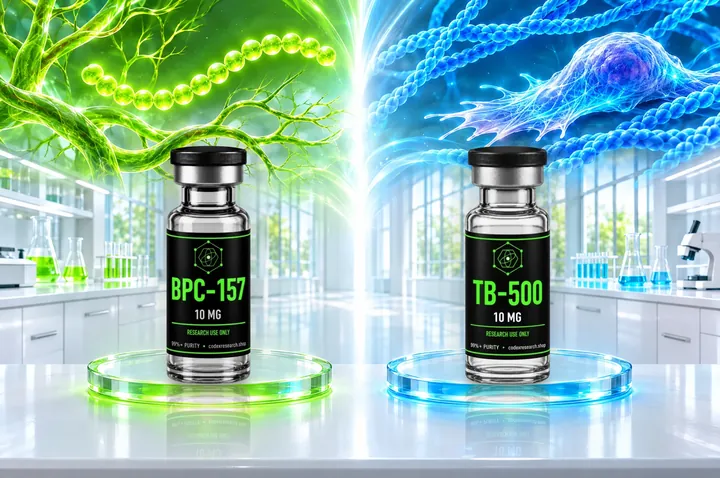
BPC-157 is most often discussed beside TB-500, a seven-residue fragment of thymosin beta-4. The two are unrelated, and our BPC-157 vs TB-500 comparison sets out the differences in structure, mechanism and evidence.
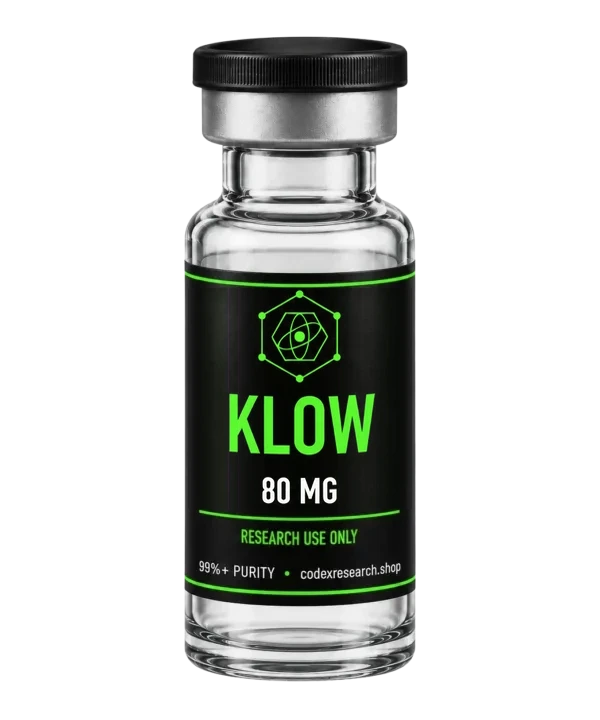
Codex Research supplies BPC-157 on its own and in three research blends: Wolverine pairs it with TB-500, Glow adds GHK-Cu, and Klow adds GHK-Cu and KPV. Glow vs Klow compares the last two, and What is GHK-Cu? profiles the copper peptide they share. For attribution, studies that use a blend usually run the single peptides alongside it.
What this profile does not tell you
This profile covers structure, origin, the research literature, regulation and testing. It does not describe how BPC-157 behaves in any person or animal, establish safety or effectiveness for any purpose, or replace the certificate for the lot you hold. Research compounds are not approved by the FDA for human or veterinary use.
How Codex Research documents BPC-157
Every Codex BPC-157 lot ships with a lot-matched certificate of analysis from an independent laboratory, published on the product page. The current report confirms identity by LC-MS, purity by RP-HPLC and potency by HPLC, and adds endotoxin, sterility, residual-solvent and heavy-metal results. Match the lot number on the page to your vial before use. For the full report on any lot, contact info@codexresearch.shop.
Frequently asked questions
What is BPC-157?
What does BPC stand for?
What is the amino acid sequence of BPC-157?
What is the molecular weight of BPC-157?
Is BPC-157 a natural peptide?
How does BPC-157 work?
What is BPC-157 studied for in the lab?
Is there human research on BPC-157?
Is BPC-157 FDA approved?
What changed with the FDA and BPC-157 in 2026?
Is BPC-157 banned in sport?
How do you confirm that a vial contains BPC-157?
Why is BPC-157 measured at 214 nm and not 280 nm?
How is BPC-157 different from TB-500?
How should BPC-157 be stored as a research material?
References
- Sikirić P, Petek M, Rucman R, et al. A new gastric juice peptide, BPC. An overview of the stomach-stress-organoprotection hypothesis and beneficial effects of BPC. J Physiol Paris. 1993;87(5):313-327.
- Chang CH, Tsai WC, Lin MS, Hsu YH, Pang JH. The promoting effect of pentadecapeptide BPC 157 on tendon healing involves tendon outgrowth, cell survival, and cell migration. J Appl Physiol. 2011;110(3):774-780.
- Hsieh MJ, Liu HT, Wang CN, et al. Therapeutic potential of pro-angiogenic BPC157 is associated with VEGFR2 activation and up-regulation. J Mol Med. 2017;95(3):323-333.
- Chang CH, Tsai WC, Hsu YH, Pang JH. Pentadecapeptide BPC 157 enhances the growth hormone receptor expression in tendon fibroblasts. Molecules. 2014;19(11):19066-19077.
- Huang T, Zhang K, Sun L, et al. Body protective compound-157 enhances alkali-burn wound healing in vivo and promotes proliferation, migration, and angiogenesis in vitro. Drug Des Devel Ther. 2015;9:2485-2499.
- Tkalcević VI, Cuzić S, Brajsa K, et al. Enhancement by PL 14736 of granulation and collagen organization in healing wounds and the potential role of egr-1 expression. Eur J Pharmacol. 2007;570(1-3):212-221.
- Hsieh MJ, Lee CH, Chueh HY, et al. Modulatory effects of BPC 157 on vasomotor tone and the activation of Src-Caveolin-1-endothelial nitric oxide synthase pathway. Sci Rep. 2020;10(1):17078.
- Sikiric P, Seiwerth S, Rucman R, et al. Stable gastric pentadecapeptide BPC 157-NO-system relation. Curr Pharm Des. 2014;20(7):1126-1135.
- He L, Feng D, Guo H, et al. Pharmacokinetics, distribution, metabolism, and excretion of body-protective compound 157, a potential drug for treating various wounds, in rats and dogs. Front Pharmacol. 2022;13:1026182.
- Xu C, Sun L, Ren F, et al. Preclinical safety evaluation of body protective compound-157, a potential drug for treating various wounds. Regul Toxicol Pharmacol. 2020;114:104665.
- Cox HD, Miller GD, Eichner D. Detection and in vitro metabolism of the confiscated peptides BPC 157 and MGF R23H. Drug Test Anal. 2017;9(10):1490-1498.
- Vasireddi N, Hahamyan H, Salata MJ, et al. Emerging use of BPC-157 in orthopaedic sports medicine: a systematic review. HSS J. 2025;21(4):485-495.
- Józwiak M, Bauer M, Kamysz W, Kleczkowska P. Multifunctionality and possible medical application of the BPC 157 peptide: literature and patent review. Pharmaceuticals (Basel). 2025;18(2):185.
- Gwyer D, Wragg NM, Wilson SL. Gastric pentadecapeptide body protection compound BPC 157 and its role in accelerating musculoskeletal soft tissue healing. Cell Tissue Res. 2019;377(2):153-159.
- U.S. Food and Drug Administration. Certain bulk drug substances for use in compounding that may present significant safety risks.
- McDermott. Bulk-list bound? PCAC backs majority of peptides in two-day public meeting. Client alert, July 27, 2026.
- World Anti-Doping Agency. The Prohibited List, section S0: Non-approved substances.
- Manning MC, Chou DK, Murphy BM, Payne RW, Katayama DS. Stability of protein pharmaceuticals: an update. Pharm Res. 2010;27(4):544-575.




 From lab to your door