

Lyophilized is the technical word for freeze-dried: the peptide is frozen and its water is pulled off as vapor under vacuum, leaving a dry cake in the vial. This guide explains the three stages, why peptides are sold this way, what the cake can and cannot tell you, and how lyophilized differs from liquid, dry-fill and raw powder.
Key takeaways
- Lyophilized and freeze-dried mean the same thing: the product is frozen, then its ice is removed as vapor under vacuum without passing through a liquid phase.
- The process has three linked stages: freezing, primary drying (sublimation) and secondary drying (desorption).
- Peptides are lyophilized because many of them are unstable in water. Removing the water slows the reactions that break them down.
- Dry does not mean inert. Deamidation, oxidation and aggregation still occur in the solid state, and temperature and moisture set the pace.
- A cake’s appearance is not a quality test. Identity, purity and content come from the lot’s certificate of analysis, not from how the powder looks.
ImportantResearch use only. This guide explains what lyophilization is and how lyophilized research materials are made and described. It does not cover preparation or use, and it does not describe human or animal use. Codex Research compounds are not approved by the FDA and are sold for in-vitro laboratory research only.
Quick answer
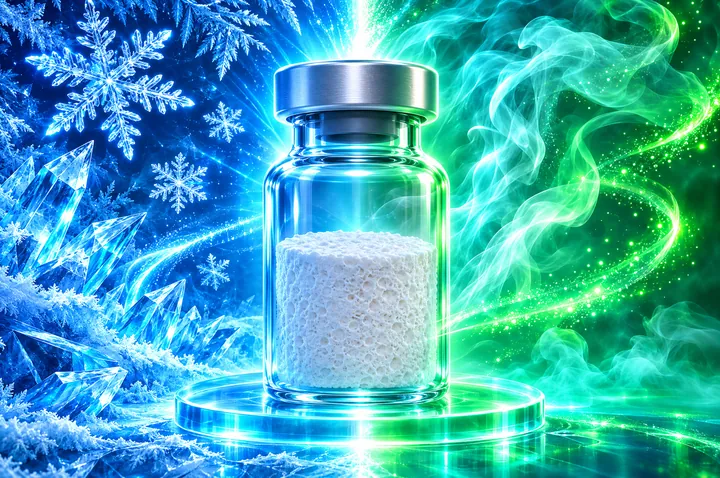
Lyophilized means freeze-dried. A lyophilized peptide was dissolved, filled into its vial as a liquid, frozen, and then dried under vacuum so the ice left as vapor without ever melting [1]. What remains is a dry, porous solid called a cake.
Peptides are sold this way because many of them are unstable in water [6]. Taking the water out slows the reactions that break them down, and freeze-drying does it without excessive heat [1]. The dry form is more stable, but it is not inert: reactions still run in the solid state, at a pace set mainly by temperature and moisture [5].
What does lyophilized mean?
The FDA describes lyophilization, or freeze drying, as a process in which water is removed from a product after it is frozen and placed under vacuum, so that the ice changes directly from solid to vapor without passing through a liquid phase [1].
That last part is the point of the method. Ordinary drying uses heat to evaporate liquid water. Freeze-drying skips the liquid stage, so the product is never warm and wet at the same time, which are the conditions under which fragile molecules degrade fastest.
Is lyophilized the same as freeze-dried?
Yes. Lyophilized and freeze-dried are the same thing, and the FDA guide uses the two terms interchangeably [1]. Laboratory and pharmaceutical documents tend to say lyophilized. Everyday language says freeze-dried. A vial described either way went through the same process.
Terms you will see
| Term | Plain meaning |
|---|---|
| Lyophilization | Freeze-drying: freeze the product, then remove the ice as vapor under vacuum |
| Lyophilizer | The freeze dryer: a chamber with temperature-controlled shelves and a vacuum system |
| Sublimation | Ice turning directly into vapor without melting |
| Primary drying | The stage that removes frozen water by sublimation |
| Secondary drying | The stage that removes water still bound to the solid (desorption) |
| Cake | The dry, porous solid left in the vial |
| Residual moisture | The small amount of water that remains after drying |
| Collapse | Loss of the cake’s structure when the product gets too warm during drying |
| Meltback | A form of collapse caused by incomplete sublimation |
| Reconstitution | Dissolving a dried material back into liquid. Not covered in this guide |
Why are peptides lyophilized?
The short answer is in the FDA guide itself: products are made in lyophilized form because of their instability in solution [1].
Peptides fit that description well. A 2023 review of peptide formulation notes that peptides are often unstable in aqueous solution, and that a stable, dry formulation can be designed instead, even though a liquid is more convenient [6]. A review of solid-state chemistry makes the same point from the other side: peptide and protein drugs are often formulated in the solid state to stabilize them during storage [5].
The FDA lists these advantages of lyophilization [1]:
- Liquid processing. The product is processed and filled as a liquid, which simplifies clean (aseptic) handling.
- Stability. A dry product is more stable than the same product in solution.
- Gentle water removal. Water is removed without excessive heating.
- Fast dissolution. The dried solid dissolves rapidly and easily.
It also lists the costs, among them more handling and processing time and expensive, complex equipment [1]. Lyophilization is described in the literature as a common but cost-intensive way to give a formulation long-term stability [3]. That cost is the reason liquid products exist at all. Where a molecule is stable enough in water, makers avoid the freeze dryer.
How lyophilization works: the three stages
The FDA describes lyophilization as three separate, unique and interdependent processes: freezing, primary drying and secondary drying [1]. In manufacturing, they sit inside a longer sequence [1]:
- The material is dissolved, generally in water.
- The solution is passed through a 0.22 micron filter.
- The filtered liquid is filled into individual vials, and stoppers are set partway into the necks so vapor can escape.
- The vials are loaded onto the shelves of the freeze dryer and frozen.
- A vacuum is applied and the shelves are warmed, so water leaves from the frozen state.
- The stoppers are pressed fully into the vials inside the chamber, and the vials are sealed.
Stage 1: freezing
The shelves cool the vials until the water in the solution has turned to ice. The product is typically frozen well below its eutectic point, the temperature at which the frozen mixture begins to melt [1].
Freezing looks like the simple part, but a review devoted to it calls it presumably the most complex step in lyophilization. How the ice forms affects the structure of the dried solid, its residual moisture, how quickly it dissolves later, and how the two drying stages perform [3].
Stage 2: primary drying (sublimation)
With the product frozen, the chamber is pumped down to a vacuum and the shelves are warmed slightly. The ice sublimes, leaving as vapor [1]. The space each ice crystal occupied becomes a pore, which is why the finished cake is light and sponge-like.
Temperature control decides whether this stage works. The FDA guide advises holding the product at least 4 to 5 degrees below its eutectic point during primary drying [1]. A widely cited design paper frames the same limit as the collapse temperature, the point above which the partly dried solid can no longer hold its shape [2]. The physical event behind collapse is the glass transition of the frozen material [12].
Stage 3: secondary drying (desorption)
When the ice is gone, some water is still bound to the solid. Secondary drying removes it by desorption [1]. This stage sets the residual moisture of the finished product.
Why every product needs its own cycle
A freeze-drying cycle is a recipe of shelf temperatures, chamber pressures and hold times, and it is written for one formulation. The thermal properties of the material being dried are the basis of both the formulation and the process design [9], and those properties shift easily. A standard text on the subject notes that seemingly subtle changes in composition, such as a different pH, buffer salt, concentration or added ingredient, can change how a solution freezes and dries [12].
For years, cycles were often developed by trial and error, or the settings from the first laboratory run were simply kept, which left many commercial processes neither reliable nor efficient [2]. A 2023 update to that advice revisits all three stages and uses heat and mass transfer models to predict the product temperature and the length of each stage before a batch is run [11].
For a buyer, the consequence is simple. "Lyophilized" names a category of process, not a single standard one. Two suppliers can both sell a lyophilized vial of the same compound and have dried it under very different conditions, which is one more reason to judge a lot by its test results.
Why some cakes are large and others barely visible
The size of a cake depends on how much solid was dissolved in the liquid that went into the vial. A few milligrams of peptide on its own is very little material, and it dries to a thin disc or a film.
Manufacturers who want a fuller, sturdier cake add a bulking agent, an inactive ingredient that provides the structure. Mannitol is a popular choice in freeze-dried formulations, although it brings complications of its own, including vial breakage and changes in its crystal form within the finished cake [13].
Neither result is better in itself. A large cake may be mostly bulking agent, and a small one may be peptide with nothing added. What matters is that the supplier states what is in the vial and that the certificate reports the peptide content.
What the cake can and cannot tell you
A lyophilized vial is often judged by how its cake looks. The appearance carries some information, but less than people assume.
What it can show. The FDA guide recommends inspecting every lyophilized vial for correct cake volume and appearance. It singles out meltback, a form of cake collapse caused by incomplete sublimation, because it can change the physical form of the material and lead to instability and degradation [1].
What it cannot show. A commentary written by freeze-drying specialists argues that striving for a uniform, elegant cake is reasonable, but that a non-ideal appearance sometimes has no impact on product quality and is simply an inherent characteristic of the product, its container and its drying process [8]. A cake that has broken into loose powder in transit is the same material it was when it left the freeze dryer.
The practical rule: appearance can raise a question, but it cannot answer one. Whether a vial contains the right molecule, at the stated purity and amount, is established by testing the lot. Our guides to HPLC and mass spectrometry and to peptide purity grades explain those tests.
Dry does not mean inert
Lyophilization slows degradation. It does not stop it. A review of solid-state chemistry lists the reactions known to occur in dry peptides and proteins: deamidation, peptide bond cleavage, oxidation, the Maillard reaction, beta-elimination, and dimerization or aggregation [5]. The same review names the factors that control them: temperature, moisture content, the other ingredients present, and whether the solid is amorphous or crystalline [5].
The process itself is also a stress. A review of protein lyophilization notes that freezing and drying both generate stresses, and that even a successfully lyophilized product may have limited long-term storage stability [4]. A review of peptide aggregation counts lyophilization among the physical factors that influence whether peptides self-associate [7], and a broad review of stability covers the dried state as its own topic alongside aqueous solution [10].
This is why a lyophilized vial still comes with storage conditions. Our guide to research peptides in transit covers what heat, cold and humidity do to a dry vial in the mail.
Residual moisture: why "dry" still has a number
No lyophilized product is completely free of water. The FDA guide handles residual moisture as a property to be specified and tested, with limits that should be justified by stability data, because free water left in the product can drive biological and chemical reactions [1].
Residual moisture also explains a point that confuses many buyers. An HPLC purity figure describes the peptide material only. It does not count water or counter-ions, so the weight of the cake is always somewhat more than the weight of the peptide in it. Our guide to peptide purity grades explains what that figure leaves out.
Lyophilized vs liquid, dry-fill and raw powder
| Form | How it is made | What to know |
|---|---|---|
| Lyophilized in the vial | A measured volume of filtered solution is filled into each vial and freeze-dried there | The amount in each vial is set by a liquid fill. The FDA lists ease of processing a liquid among the advantages [1] |
| Liquid (non-lyophilized) | The peptide is supplied dissolved | Many peptides are unstable in aqueous solution, so shelf stability depends heavily on the formulation [6] |
| Dry fill | Powder dried in bulk is weighed into each vial | A trade term, not a pharmacopoeial one. Ask what process was used and what the certificate reports for content |
| Raw powder | Bulk dried peptide, not divided into vials | Describes packaging, not quality. It may or may not have been freeze-dried |
One detail from the FDA guide is worth knowing when comparing these. A vial that received too little liquid at filling is subpotent, and the guide notes that low fills are hard to detect once the product has been lyophilized [1]. That is one reason a certificate that reports measured content is more useful than a label claim.
How to read "lyophilized" on a label or certificate
- Appearance. Certificates usually describe the material in words, such as a white lyophilized powder. This confirms the form. It is not a purity result.
- Lot number. The lot on the certificate should match the lot on the vial. Lyophilization is done in batches, and results belong to the batch that was tested.
- Purity and identity. Look for a purity result by reversed-phase HPLC and an identity result by mass spectrometry.
- Content. Where the certificate reports a measured amount, compare it with the amount on the label.
- Water content. Some certificates report residual moisture or water content. Where it is given, it tells you how much of the cake’s weight is water.
- Storage conditions. The label or product page should state how the sealed vial is to be kept.
Common misconceptions
- "Lyophilized means sterile." It does not. Lyophilization is a drying process. The FDA guide covers filtration and aseptic filling as separate controls, and stresses that vials remain exposed until they are sealed [1].
- "Lyophilized means pure." Freeze-drying removes water. It does not remove peptide-related impurities.
- "A perfect cake means a good product." Appearance and quality are different questions [8].
- "A lyophilized peptide lasts forever." Solid-state reactions continue, governed by temperature and moisture [5].
- "Freeze-dried is a lower grade than lyophilized." They are the same process under two names [1].
What "lyophilized" does not tell you
The word describes the physical form of a material and the process used to dry it. It says nothing about identity, purity, content, endotoxin level or sterility, each of which is a separate test with its own result. It does not describe how a compound behaves in any organism or establish safety or effectiveness for any use. Research compounds are not approved by the FDA for human or veterinary use.
How Codex Research handles lyophilized vials
Every vial in the Codex Research catalog is supplied as a freeze-dried solid in a sealed glass vial. Our peptides are made in the United States and lab tested by lot, and each product page shows the results for the lot currently shipping. Published Codex Research certificates judge purity against a specification of 98.0% or higher by reversed-phase HPLC, and full reports also confirm identity by LC-MS.
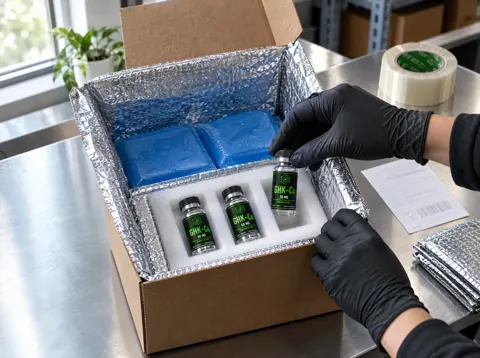
Orders placed before 3 PM ET on a weekday leave the same day in an insulated mailer. Our shipping guide explains what that packaging is for. To see how the molecule gets made before it is dried, read how peptides are made. For the certificate behind any lot, contact info@codexresearch.shop.
Frequently asked questions
What does lyophilized mean?
Is lyophilized the same as freeze-dried?
What is a lyophilized peptide?
Why are peptides lyophilized?
What are lyophilized peptides used for?
What are the three stages of lyophilization?
What is lyophilized powder?
What is a lyophilization cake?
Does a cracked, shrunken or loose cake mean the peptide is bad?
What is the difference between lyophilized and non-lyophilized peptides?
What is the difference between lyophilized and dry-fill peptides?
Is a lyophilized peptide completely dry?
Do lyophilized peptides degrade?
Does lyophilization change a peptide’s purity?
Are Codex Research vials lyophilized?
References
- U.S. FDA. Guide to Inspections of Lyophilization of Parenterals (7/93). Inspection Guides.
- Tang X, Pikal MJ. Design of freeze-drying processes for pharmaceuticals: practical advice. Pharm Res. 2004;21(2):191-200.
- Kasper JC, Friess W. The freezing step in lyophilization: physico-chemical fundamentals, freezing methods and consequences on process performance and quality attributes of biopharmaceuticals. Eur J Pharm Biopharm. 2011;78(2):248-263.
- Wang W. Lyophilization and development of solid protein pharmaceuticals. Int J Pharm. 2000;203(1-2):1-60.
- Lai MC, Topp EM. Solid-state chemical stability of proteins and peptides. J Pharm Sci. 1999;88(5):489-500.
- Nugrahadi PP, Hinrichs WLJ, Frijlink HW, Schöneich C, Avanti C. Designing formulation strategies for enhanced stability of therapeutic peptides in aqueous solutions: a review. Pharmaceutics. 2023;15(3):935.
- Zapadka KL, Becher FJ, Gomes dos Santos AL, Jackson SE. Factors affecting the physical stability (aggregation) of peptide therapeutics. Interface Focus. 2017;7(6):20170030.
- Patel SM, Nail SL, Pikal MJ, et al. Lyophilized drug product cake appearance: what is acceptable? J Pharm Sci. 2017;106(7):1706-1721.
- Franks F. Freeze-drying of bioproducts: putting principles into practice. Eur J Pharm Biopharm. 1998;45(3):221-229.
- Manning MC, Chou DK, Murphy BM, Payne RW, Katayama DS. Stability of protein pharmaceuticals: an update. Pharm Res. 2010;27(4):544-575.
- Tchessalov S, Maglio V, Kazarin P, et al. Practical advice on scientific design of freeze-drying process: 2023 update. Pharm Res. 2023;40(10):2433-2455.
- Nail SL, Jiang S, Chongprasert S, Knopp SA. Fundamentals of freeze-drying. Pharm Biotechnol. 2002;14:281-360.
- Thakral S, Sonje J, Munjal B, Bhatnagar B, Suryanarayanan R. Mannitol as an excipient for lyophilized injectable formulations. J Pharm Sci. 2023;112(1):19-35.


 From lab to your door